Perfectionism – Gift or Curse?
Is pefectionism a gift or a curse? That depends. Our Thunderbird Leadership Consulting co-founder, Amy Steinbinder, reviews the concept.
Did you make any decisions for the new year? In our last blog Rory offered a reflective approach using four questions as a guide to help readers act to create a meaningful 2020. In thinking about decisions to act, I came across an interesting article about good judgment [1] by Sir Andrew Likierman. [2] The author and others contend that even though we may think we have all the information in the world, if we do not have ‘good judgment’, our decisions can be doomed.
Likierman offers this definition of judgment: the ability to combine personal qualities with relevant knowledge and experience to form options and make decisions. Judgment is at the “core of exemplary leadership” according to Noel Tichy and Warren Bennis in their book Judgment: How Winning Leaders Make Great Calls [3]. They believe that judgment calls are the single marker of leadership.
To me, making a judgment as a process is clear, but the qualitative aspect of good judgment seems muddier, especially since the outcome of that judgment can often be seen as good or bad, depending on the viewer. I remember my father telling me that I obviously lacked good judgment when as a teenager I did something he didn’t like. . . I missed my curfew because I had to find someone other than the boy I came with to the party (now inebriated) to drive me home. I thought my judgment was pretty good. He disagreed.
Likierman’s article, based on interviews with CEOs and leaders from a broad range of companies, lays out six fundamental leadership practices that are at the heart of good judgment: learning, trust, experience, detachment, options and delivery. He concludes each practice with suggestions for how to improve it.
As you review these practices and recommendations, I invite you use them as an assessment. How do they apply to you, to your organization or community group, perhaps your colleagues?
If you answered yes to any of these questions, we’d love to hear from you. Contact us at 602-538-2548 or 602-615-1192. We have the skills and experience to assist you on your journey.
Good listening is at the core of every book and article I’ve ever read about leadership. I’m sure you too can state all the reasons why attentive listening is so important. Likierman makes the point that the listener is really mining for information. Smart leaders, he says, demand quality, press for it even, in the information they receive. Volume isn’t important, in fact it’s distracting in our era of information overload. Is it well-reasoned and clearly explained, are conclusions obvious? He also points out our human tendency to take the written word at face value, rather than consider it with a healthy dose of skepticism.
How to improve listening and reading:
Examples abound of executives and leaders who insulate themselves by choosing to be surrounded by like-minded people. It is not uncommon for those companies to experience large scale failures, if they are big enough, and failure to thrive if they are small. Though it is comfortable to be with people who share the same world view, that need for comfort should be saved for after hours. It is only in integrating a variety of perspectives that we will have access to all the information needed for good judgment.
How to enhance a culture for broader points of view:
There is much to be said for hiring someone who has a lot of experience in your industry, but make sure there is breadth to it as well as depth. Someone who has years of experience in a fairly narrow niche, for example, out-patient surgery, may find themselves making “easy” judgments out of habit, or overconfidence or familiarity.
How to improve the experience factor:
The skill of detachment is a difficult one to master because it requires us to set our egos aside and remove any personal connection to a particular outcome. Acting with detachment is easier if we are able to understand and address our own preconceptions.
Some ways to improve detachment:
The author makes the point that even though you might be offered two options to choose from, often as not there are more options that haven’t even been considered. There are always more. Not taking action is an option as well as delaying a decision. It is important to explore as many options as possible and try to surface the unintended consequences of each.
Improve your options:
You can make all the right choices but lose out if you don’t exercise judgment in how and by whom those decisions will be carried out. What are the risks of half-hearted or poorly thought out implementation plans? Likierman points out that people with flair, charisma, creativity and imagination may not be in the best position to deliver the results you seek.
Ways to improve on the good options:
There is a lot to be learned about the science and art of leadership. If, as Tichy and Bennis claim, judgment calls are truly the single mark of a leader, looking for ways to turn our OK judgments into good ones is well worth the effort. If you made some new decisions for 2020, reviewing and following the points above could strengthen your results. . . Good luck! And give us a call if you’d like to discuss your situation and how we can assist.
PLEASE NOTE: We are making some improvements to our website in February. Look for the return of our blog in March.
[1]https://hbr.org/2020/01/the-elements-of-good-judgment (accessed 1/14/20)
[2]Sir Andrew Likierman is a professor at London Business School and a director of Times Newspapers and the Beazley Group, both also in London. He has served as dean at LBS and is a former director of the Bank of England.
[3]Tichy, Noel and Bennis, Warren. 2007. Judgment: How Winning Leaders Make Great Calls. Penguin Group.
The New Year is a wonderful time of reflection, to think about where we’ve been, where we are and where we want to be. Rather than making resolutions that slip away within a month, how can you use this time to create meaningful and intentional strategies for your professional future?
Where am I?
The first step in this reflection is to think about where you are in your career. Are you still on an upward path? Are you looking for new opportunities within your organization or across your profession? Are you in a position that satisfies you? How do you go deeper and continue to grow within the position? Are you winding down in your career? Ready for new but less demanding opportunities? And, do you have a realistic sense of direction – of your potential, of where you are and where you can go?
Who am I?
So step two is self-reflection, how much do we know ourselves. How open are we to possibilities? How much do we acknowledge our own strengths? How confident are we in our skills and capabilities? How comfortable are we in taking risks? How adept are we at looking into the future? How do we see ourselves as leaders?
This aspect of self-reflection can benefit from a variety of tools and assessments. Consider CliftonStrengths[1] (formerly Strengths Finder) that helps us learn which of some 36 strengths help us to best achieve our goals. When I think of my colleagues, I am always amazed by the talents they bring to the table. Dorothy Sisneros, one of Thunderbird’s managing partners, knocks my socks off all the time with two of her top strengths as a futurist and a maximizer. When we work together, I’ll talk about a plan (I’m very present oriented) and Dorothy will ask questions about future impacts and possibilities, things I never even begin to think about. She’ll think about how we can best use our people resources using her maximizer strength. I always learn from her perspective.
I recognize my own ability to synthesize ideas and take big picture concepts down to practical applications and appreciate detail-oriented people who ask questions to get us even further in implementation.
Knowing what we are good at, what we love to do and how to interface those skills with people who have other talents is critical to success. I want to talk more about the people interface in a minute, but first I want us to dig a little deeper into our own styles.
We’ve mentioned DiSC numerous times in our blogs…one of our favorite assessment tools. It helps to understand our way of approaching our work and allows us to consider how our preferred approach can be an asset or a liability.
So, as we consider future career decisions, DiSC can help us recognize where we are on a caution v. risk spectrum. Are you more likely to “ready, fire, aim,” or get paralyzed in analysis? I have a tendency to look at everything as possible and exciting – yes, I/we can do that. I’ve learned that it helps me to find more cautious people who will help me identify the risks, the questions that need to be answered before I jump in. By the same token, I’ve worked with folks who prefer a full year of planning before they implement a project. Together, we’ve found a middle ground to pilot strategies and get the project started sooner rather than later.
Where are you on the risk/caution spectrum? How does this relate to finding opportunities and being prepared to take them? In the McKinsey Quarterly[2], they report that women are more likely to believe they need 100% of requirements before they apply for a position, where men will reach for a new possibility if they have about 60% of requirements. What does this say about confidence (and social conditioning)? DiSC D’s and I’s are also more likely to take a leap where S’s and C’s will hold back, study, analyze and have higher expectations of themselves before they step forward.
How ready do you have to be?
Who Can Help?
And this is where the third step in reflection comes in: using colleagues, mentors and friends to help us expand our perspectives – whether to keep us from jumping without a parachute or moving us forward out of our comfort zone. Who are the people in your life who see you better than you see yourself? Who will challenge you, support you and encourage you?
As you reflect on your next steps, use your people resources to help you refine your focus on your self, your capacity and your potential. Brene Brown recommends identifying trusted friends and allies where you can be fully human and vulnerable. Who are the people in your life who can see you at your worst and be there will you, and still lift you up.
Tom Rath[3] describes 8 necessary roles people need to fill for us to achieve success in the workplace. He describes a “vital connection” as a person who “measurably improves your life or a person you can’t afford to live without.” Think about the important people in your life.
Rath’s eight roles are: navigator, connector, collaborator, builder, companion, champion, mind opener and energizer. No one person can or should fill all of these roles. As you consider your direction in 2020, who do you need right now in order to move to the next step in your career. Is it a mind opener? An energizer? A connector?
I think back to a mind opener in my life from very early in my career. I still remember a conversation I had with a professor when I was in graduate school. He said something to me about taking the lead on a project. I replied that I was not a leader, I was a follower. He looked at me earnestly and said, “that may have been true in the past, but it is not true now. You need to rethink how you define yourself.” That conversation happened some 40 years ago and I’ve never forgotten it. In that moment, I had to rethink who I was, eliminate old messages and baggage, and consider the possibility that I had leadership qualities.
How do you see yourself as a leader? Are you stuck in a singular, old leadership picture? How do you influence others? What skills and capacities do you bring to leadership? We know that the most effective leaders are thoughtful, humble, and good listeners as well as inspiring and visionary. Be careful that you do not recognize your own capacity for leadership and growth.
Who helps you rethink who you are? Who sees things in you that you don’t see in yourself? Jill, my colleague on this blog, is an amazing partner for me. Not only is she a collaborator, but she builds me up and increases my confidence in writing and she energizes me. Talking with her always leaves me more excited about my work.
Who Can I Help?
And that bring me to the fourth step in New Year’s reflections. Who do you support, build up, energize, champion, challenge? Consider that these roles are always a give and take. How are you growing others. Who can you invite into a conversation at the start of this New Year and help them see possibilities and opportunities they might otherwise miss?
References:
[1] https://www.gallup.com/cliftonstrengths/en/252137/home.aspx
[2] Desvaux, G. et. al. (September, 2008) A Business Case for Women, The McKinsey Quarterly.
[3] Rath, T. (2006). Vital Friends. Gallup Press: New York.
Jill began to highlight the events at this year’s Summit in her last post. I thought I’d format the second part of our Summit reflection as TIPS. What did we learn, what can we take away?
I really appreciated the balance of evidence-based information as well as the exploration of personal renewal at this year’s Summit. Here are some highlights.
Dustin Fennell talked about managing multiple generations in the workplace and ultimately concluded that we are not that different after all. He emphasized a wise, long-standing leadership practice: see your employees as individuals, learn about them – what excites them, motivates them and affirms them, and use that information to support and encourage them. His personal strategy is to:
I would also add that learning about general tendencies of different generations may help you understand why people approach things the way they do. When people behave contrary to our personal expectations and norms, it is easy to discount them as rude, uncaring, insensitive, unmotivated, unprofessional, etc. When we understand different cultures, generations, DiSC styles, personality types, etc. we gain insights that can help us override our own personal preferences and assumptions.
So, absolutely yes, to learning about and valuing our employee’s unique needs, drives and perspectives as Dustin recommended…and when you get lost in your own assumptions, you might want to research how someone might see things another way.
Mara Windsor presented on issues of confidence and gender and brought compelling research that suggests that women may not be as confident as men because of differences in genetics. Check out The Confidence Code by Katty Kay and Claire Shipman. Whether confidence is genetically or socially influenced (or both!), there are things we can do to strengthen our sense of confidence. Her suggestions include:
Another theme emerged numerous times during the Summit recognizing that we have the ability to manage our emotions and reactions to things…nothing “makes us” angry. We interpret input and choose how we respond. This message came through in our “café conversations,” (brief small group opportunities exploring different themes about leadership) as well as in Noushin Bayat’s presentation about Leading from Within.
I trained as a therapist in a former career life and relate these concepts to cognitive-behavioral therapy. We receive input, interpret it (in a nanosecond) and then respond with feelings. Several of the groups in our café conversations wandered into that arena. Colleen Hallberg’s topic stands out as it stated it the most clearly, “It is only information.” Wow!
Think about meetings where things feel uncomfortable. Rather than getting lost in the emotion, what can we ask ourselves? What is happening here? What can I learn from this? I can step back and assess the data I am receiving. What is it telling me? When we recognize that we have a choice in our interpretation and response, we are empowered to take control of our role in the situation.
At a previous Summit, Noushin quoted Rumi, “Out beyond ideas of wrongdoing and rightdoing there is a field. I’ll meet you there.” Those words continue to resonate in her presentation – finding space outside of right or wrong, win or lose to breathe, reflect and reconnect with what and who is important. As leaders, finding this space and time is essential to our effectiveness. Noushin’s gentle words belie a powerful way of being.
Kathy Malloch provided a preview to her recent work with partner, Tim Porter-O’Grady, on their new approach to leadership. (We are waiting for the book to come out.) Some key learnings from Kathy’s presentation include five core strategies of Appreciative Leadership. Consider how you could shift your mindset to be a more appreciative leader and how these approaches could change your organizational culture and results.
Kathy asked a series of provocative questions that are beyond what we can list here.
We’ll continue to share what we learned in future posts. There was enough to help us plan our 2020 topics! So, count on us to revisit confidence, generations and appreciative leadership. We really appreciated all the inspiration we received from the day and are already looking forward to next year. Mark your calendars for Friday, November 13, 2020.
We also continue to appreciate the generosity of our participants who contributed over $2,500 in our Silent Auction. Proceeds will be split between the National Alliance to End Homelessness (https://endhomelessness.org) selected by the Summit planning team and the Yarnell Regional Community Center (https://yarnellcommunitycenter.org) selected by a drawing of organizations recommended by our participants.
And finally, I want to recognize the work of Carla Rotering and Kevin Monaco who provided an amazing time of meditation and reflection. Kevin shared his music with us (https://kevinmonacomusic.com), and I want to conclude our reflections and the year with words from a magnificent poem Carla shared with us during the meditation. At this time of year, may we all celebrate, reflect and appreciate our own gifts and the gifts of those around us.
From WINTER TREE
For my mother Rosemary
November 14, 1930 – November 14, 1965
Aruba, August 2002.
Carla J. Rotering, MD ©
Is there any way I’ll have enough time or enough courage or enough whatever I need enough of
To take the grace of the ordinary and recognize holiness?
To just come into agreement….
And allow one breath,
One single diastole
To solemnly be splendid?
To magnify the simplicity of my heart that moves and shifts everything into the world of sanctity?
If there is, I’m ready for it.
I’m ready to bring forth my heart, in its small, red roundness
To be pierced with utmost tenderness
And there stand open and revealed
Without the shield of my terrible fears to frighten away the gods.
To stand in the light of who I am
And to sit in the power of my own Presence
For one single moment
Even if everyone….or no one….ever notices.
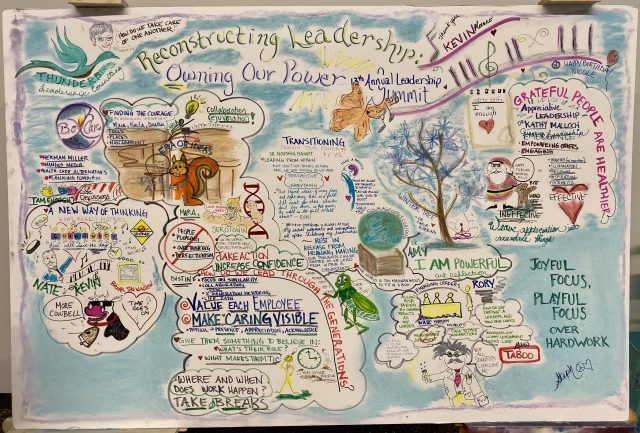
13th Annual Leadership Summit
Reconstructing Leadership: Owning Our Power
One participant described it this way:
“A leadership spa for the soul that provided space for reflection, laughter and tears, commitment to a new way of being, connecting with old and new friends and appreciation for everything that we have.”
Situated at the Phoenix Art Museum on November 15, 2019, the Summit left me with lots of intriguing ideas, making for a rich and meaningful time.
Karla Kaelin, one of the speakers during the Leadership Panel, took us on a journey through three eras of industry, information and ideas, and how management, places of work and tools have changed in each. Old hierarchies are falling in favor of collaborative ‘messes’ which produce innovation much faster in response to the demand for shorter and shorter speed-to-market cycles. Technology is becoming so seamlessly integrated into our lives that we are virtually (ha ha!) unaware of it, like the air we breathe.
One of Karla’s points that excited me was this: What if work became the place you went to rejuvenate? Work can be draining for many people, and when we return home, we are too tired to engage well with the other parts of our lives. How interesting to think of work as a place of rejuvenation, where we receive as much (or more) energy as we give. What would have to happen to make that vision come true? More flexibility, more fun, more control, less nonproductive ‘stuff’? How could your workplace be more rejuvenating so that you wanted to go to work?
Here’s another ‘aha’ moment for me. . . In this era of 24/7 availability for many roles, it has to be OK to work at home, and to rest at work. When work happens is as big an issue as where work happens. Karla shared examples of hospitals with quality staff rest areas immediately across from a nurses station. . . mood lighting, recliners, Skype set ups for contacting family, ping-pong tables.
Who would have guessed that the activity titled Community Building would result in a rousing pick up chorus performance of ‘You Gotta Be’ by Des’ree? But that is exactly what happened, and even the non-singers in the group said they had fun. Musicians Nate Bachofsky and Kevin Monaco led us through group singing, singing in anthem-response style, adding harmonies, varying from whisper to crescendo, and playing with percussion. No doubt, we were energized.
When I think about singing in a chorus, there are lots of similarities to working in collaboration with others. For one, where I place myself when learning a new song is critical. If I’m not familiar with the melody or timing, being near a good singer (mentor?) who projects well is a smart plan. And if I am lucky enough to be in a group with harmonies and tambourines, I can immediately appreciate the richer sound we are trying to create. Adding diversity to our voices is powerful, just like in organizations. The result itself is energizing and spurs us on to better performance. Another similarity is in volume variety. Thinking about softs and louds can apply to leadership. Sometimes the most compelling part of a piece is the absolute quiet of a single, near-whispered note. The sound does not have to be full on William Tell Overture to capture one’s attention or imagination. Sometimes that is too much. Leaders can use many volumes to get their message across.
We had the delightful opportunity to meander through the wonderful Phoenix Art Museum. In the activity titled Transitioning/Owning Our Power guided by Amy Steinbinder, we had time to locate specific works that spoke to us, and answer the question ‘How does this art capture my story of transitioning and owning my own power?’ It was meaningful to share our insights with each other and appreciate the value of art in helping us connect with our deeper selves.
A piece of art that caught my attention was a series of modern paintings, big and subtle squares of color on white backgrounds. They were mostly in hues of orange and yellow. I normally love artwork that features nature, but on Summit day, I was drawn to this one. What pure potential, I thought, anything can appear here even on top of the squares. And that’s how I saw my life unfolding at the moment. A full canvas of opportunity with the time and tools to do and discover something new, which I had long been craving.
I realized too that I was attracted to the simplicity these pieces offered. . . something so basic as a square and color can be a beautiful thing. Just like leadership. One doesn’t need fancy gadgets or complex business models to be an effective leader. Awareness of what inspires your followers and use of your own personal presence are two basic, very simple yet very effective, skills.
The Emerging Leader Panel was facilitated by Rory Gilbert. What a fun discussion and reflection of the day through the eyes of younger leaders Nate Bachovsky, Kathleen Burke and Michelle Dew! Occasional glances around the room showed that seasoned leaders were paying rapt attention to the perspectives of these emerging ones. Here are a few points that inspired me.
Watch summit participants share reflections:
Though I need to stop reflecting here, there is a lot more that can be said about the Summit. Rory Gilbert will continue our next blog posting with Summit Reflections, Part 2.
Jill Bachman’s blog article last month addressed the idea of coasting at work from an employee perspective (click here to read). She described healthy coasting as the need to take a breath as part of a work life cycle and compared it to problematic coasting as an avoidance strategy when the individual is unhappy, burned out, bored or dealing with work/personal issues.
As a manager, your role is to observe behaviors and intervene to attain organizational outcomes. How do you differentiate healthy from problematic coasting and how do you address coasting?
Let’s be clear that coasting is not the same as underperforming. If you have an employee who is not fulfilling their work obligations, not meeting deadlines or completing assignments, or the quality is substandard, these things must be addressed within your company guidelines.
The question is more compelling when you see an employee who appears to be stepping back, not volunteering for new assignments or offering to help, perhaps appearing less engaged, enthusiastic or passionate about the work.
This is a great time to check in.
First of all, assess your own values. What is your belief about “coasting?” Is it ever okay? Does it fit with the company culture? Start-ups rarely have space and time for coasting, but in organization life cycles there are different stages, as with employee life cycles.
One organizational life cycle paradigm describes four stages: start-up, growth, maturity and rebirth or decline. Consider it the same way for employees. Usually there is great enthusiasm from newly hired employees. They remain actively engaged for the first two to three years, learning, volunteering, growing more valuable to the company.
Then, there is the “maturity” phase where they have mastered their position, understand the company, its values and direction and are doing solid to great work. At this point, they have the ability to coast a little. They are comfortable where they are. Employee engagement studies, however, find that this time can be the beginning of an engagement decline. Enthusiasm wanes and commitment lessens.
In an organization, this is the juncture where an organization reinvents itself or begins a decline into irrelevance and/or non-competitiveness. Organizations need to revisit their mission and unique position in the field, analyze external pressures and disruptors, and identify new directions. Where will they be in three to five years?
For employees, it is time to analyze where they are now and where they want to be in three to five years. This is the time, as their manager to have the following conversations.
In all circumstances, it is important to be clear about expectations. Do employees understand what you consider meeting and/or exceeding expectations? Is it acceptable to just meet expectations? Is that coasting? Is there any value to exceeding expectations? This can be monetary (bonuses), advancement or recognition.
I know that I prefer to work in an environment where everyone is excited, committed and passionate about their work, that people support each other and want to go the extra mile. It adds meaning and satisfaction to my work life. I have had the privilege of working with teams that shared that energy. And even then, we knew it was important to find time to take a breath, to step back, appreciate what we accomplished, and celebrate. After that pause we felt ready to tackle the next question, where do we go from here?
To wrap up, remember the comparison to weight training. We need time between sets to recover. When we never let up, we risk injury to our bodies, our minds and our souls. We can do this in short spurts during the workday, through vacations and through occasional lower-demand times in our work lives. We can use these coasting times to rekindle our energy and strengthen our commitment.
Fall has returned. In the breadbasket of the US midwest, it is the time after harvest, time to take a breath and celebrate, reflecting on the productivity of the prior season. . . a time for putting away and “putting up” (canning), an expression of my rural Grandmother’s. There is a similarity between fall and the modern concept of coasting. To me, there is seasonality to a project, a life, a career. Every season has a different focus and the coasting season is a time of slowing down.
A review of internet references highlights an interesting contradiction on coasting in the workplace. There is coasting as seen from the perspective of an individual, contrasted with the advice offered to managers about how to respond to the employee who is coasting. The first offers ways for someone to think about their career, workplace and job performance, even their lives. The other view of coasting is primarily negative, a problem to be addressed. In this blog, our focus will be on the former, and try to answer the question, is it okay to coast?
What does “coast” mean to you? Think about coasting as idling, being in the neutral gear. The engine is ready to take over when called for, and the driver is present. But we’re not really going anywhere. Another example is exercise, where coasting (resting) is a necessary part of strength training. In lifting weights we increasingly stress ourselves with more weight or more reps, then push and push some more until we can’t lift another once. Finally we rest, not just because we must, but because muscles need the time and access to nutrition for recovery.
I like the description by Lydia Smith (1) in her article “Why we should be coasting at work”. She suggests that coasting is “doing just the right amount of work to get by comfortably.” In this context, it is neither shirking one’s responsibilities, nor slacking.
Why should you coast? There is a common view that extremely busy people are very important and highly productive. But is that true? Is the so-called productivity accomplished by constant multitasking? We now have come to appreciate that effective multitasking has limited applications. . . yes when cleaning a counter and listening to an audiobook. No when simultaneously reviewing a board report, drafting an email and talking on the phone with your mother.
Often unseen is the toll of nonstop busyness on our health. We know that a constant flood of stress hormones is bad for us. The super busy person sacrifices relationships and sets a questionable example for the people around them. Nonstop busyness is unsustainable and often leads to burnout. Coasting can help us achieve some balance.
Coasting has two types.
When should we coast? When coasting is part of a conscious decision, not an accident or a habit, it is positive and healthy. Just as in exercise, coasting is necessary, not optional, after a period of hard work. The hard work could be the end of a project that your team has struggled mightily on. Maybe for you, it’s the completion of an educational degree or certificate; or for a nurse, finishing an orientation period and successfully “taking a full load of patients”. Perhaps you recently got married.
Coasting is also necessary at the organizational level. This is harder to implement because there are so many moving pieces. A few important things to consider are the stated and the realized culture, and the consistency of expectations across the company. Is it fine for one department to coast, but not OK for others? Does the leader verbalize an “OK to coast” philosophy in meetings, but demonstrate publicly that he is always available 24/7, miming the expectation that you be available all the time too?
What does “good” coasting look like? That depends on the situation.
For the team who has worked late days and long periods of overtime, coasting could be time off with a moratorium on work email and texts after 5 pm. It might be the agreement that no new projects will be considered for the next quarter, favoring instead an emphasis on troubleshooting and maintenance. For the newlyweds, it’s a honeymoon. For the new nurse, it could be a celebration with a friend and pampering with a pedicure.
When should you worry about coasting?
Is coasting your only gear? In this case, a lack of engagement may be masquerading as coasting. What is driving this coasting. . . a motivational problem, a poor fit with the job or organization, burnout, a lack of stimulation? Whatever the cause, reach out for some assistance. It could be from an employee assistance program, a therapist or coach or mentor, a frank conversation with a manager or a heart-to-heart talk with a trusted friend.
Do you never coast? There is a good likelihood that you will not survive in this mode for long, and your health, relationships and/or job/career will suffer. The suggestions above will be helpful in this case too.
So, is it OK to coast?
The short answer is yes, with a few caveats.
Healthy coasting is a form of self-care, a way to set limits on the pressures and demands that can reduce one’s effectiveness and enjoyment of life. Be aware that not every environment is the right environment for intentional coasting. If you need personal time off after a period of giving it your all, understand how the idea will be received by others around you. If your organization is not particularly supportive, keep your plans to yourself. But in all cases, remember that you are the only one who can take care of yourself. “Put your own mask on first.”
Next Time: In the Tips follow up to this post, we will dig deeper and also discuss the topic of managing employees who coast. Stay tuned.
________________________
References
Last month the Thunderbird blog featured Dr. Carla Rotering’s honor of a Healthcare Heroes Lifetime Achievement Award from the Phoenix Business Journal. The story she tells about living the early years of her life in a boxcar which was repurposed into a cozy home reminded me of the value of repurposing. And it got me to thinking about repurpose in a broader sense than physical recycling.
When I first retired from full time employment I worried about my purpose. Who would I be if I wasn’t a (fill in the blank)? Where would my worth and value come from? I knew those were questions that others anticipating retirement were facing too, so I decided to process the issues and gain perspective by writing a blog called Re:Purpose. Before the blog ended someone suggested that I concern myself less with the actual purpose, and more with repurposing the skills I had gained, applying them to the new areas of my life waiting to be discovered. Repurposing . . . applying or using something in a fresh new context.
Hmmmm. . . How about repurposing leadership? What about the nature of leadership itself. . . freshen and broaden the concept to include everyone in a business or a community or a family as a leader, not just those with the traditional leader title. Do we not all have some voice to offer in the direction of our lives?
And then there is the practice of leadership. We can apply “old” leadership practices in a new setting, in a new way, or with a little makeover. Whether it’s retirement, a new job, a new city, or even just a new office, the “new” about it signals the opportunity to think differently and bring the old, updated maybe, into the new. Recommitment, whether to the fundamentals or to the purpose itself, is another way of refreshing. Perhaps the very process of repurposing can lend a new perspective or help refuel some missing enthusiasm.
Here are some tips to apply the idea of repurposing to leadership.
Self Assessment: What leadership skills do you have that can be carried into a new arena?
How could you make your leadership skills work even better in a new context?
And where might your refreshed leadership skills be put to new use?
In today’s environment we hear so much about recycling, reusing, repurposing, etc., as a way of optimizing what we have and avoiding waste. When I think of repurposing, I also think about it as a recommitment to purpose. It could be that the bigger change is not in what we do but how we think. Remembering the why in what we are doing and why it matters and has meaning can help us approach our lives feeling refreshed, energized and re-purposed.
Thunderbird Leadership Consulting and Boxcar International want to remind you about our 13th Annual Leadership Summit on November 15th, in Phoenix, Reconstructing Leadership: Owning Our Power. Join us for a day where we explore how we deconstruct the messages that limit us and embrace new ways of being and doing, reconstructing leadership.
Leadership is perched at a frontier, with our classical model dissolving as new and bright ideas – our ideas – emerge within us, around us, and right before our eyes. We are caught holding on to an established gold standard while yearning for something different, something innovative – more aligned with the world we inhabit with all of its changes. Now is the time for a new construction for all of us who lead, aspire to lead, and yearn to lead from right where we are.
For more information, and to register, click on the link here.
Please join me in celebrating Dr. Carla Rotering’s Health Care Heroes 2019 Lifetime Achievement Award bestowed by the Phoenix Business Journal. (Watch video here.) Dr. Rotering practices Pulmonary Medicine at Banner Thunderbird Medical Center and White Mountains Regional Medical Center. She has a long history of leadership and education positions including Director of Critical Care, Chair of Medicine and Chief of Staff.
At Thunderbird Leadership, we know Carla as a leader, mentor and coach who is deeply committed to people–to their growth, upliftment, resilience and purpose as they strive toward the best version of themselves in their professional and personal lives.
Her story is compelling and inspirational, but even more so, her way of being is a model of compassion, integrity and genuineness so it is no surprise that she has been recognized for lifetime achievement.
Carla’s story teaches us about opportunity and possibility. Her consulting company is named BoXcar International because she spent her first six years living in a boxcar on the prairie in North Dakota. In her achievement award comments, Carla explained how that experience informed her perspectives. First of all, she explained, she did not see anything unusual about living in a boxcar. It was just the way it was. Secondly, though, on reflection, she viewed the boxcar for a metaphor about repurposing. When the boxcar was no longer needed by the railroad, it served a new purpose for people in need.
That metaphor of repurposing appears to have carried through Carla’s life. She went from clerical roles to medical school in her 30s when she realized this was even a possibility, supporting and nurturing her children at the same time. She engaged full-heartedly in her practice only to discover, after many years of dedicated work, that she was physically and emotionally depleted, a condition experienced by many medical providers.
Carla found another opportunity to repurpose, getting a degree in Spiritual Psychology, training in Crucial Conversations and Emotional Intelligence and two coaching certifications. This study and work helped her regain her inner strength and gave her a new area of focus. While continuing her practice of pulmonary medicine, she founded BoXcar International, providing coaching and facilitation for people in the medical profession to help them take care of themselves so they can continue to care for others.
In the process of her work, she connected with kindred spirits, Amy Steinbinder and Dorothy Sisneros of Thunderbird Leadership. Together, they conceived a Leadership Summit that is unique in design and application, promoting a philosophy of self-care, mindfulness and reflection. Now, in its thirteenth year, the Summit continues to offer participants an opportunity to step back from the never ending demands of doing, to reorient themselves and listen to the deeper meaning of their work and their lives.
Carla’s influence on the Summit is profound. Her poetic language defines the event and her teachings, meditations, poems and presentations create a tone that helps us all hold ourselves and each other more gently, more kindly. Carla’s way of being and seeing emanates from her heart and touches us all.
Lifetime Achievement! Doctor, coach, facilitator, poet, presenter, educator, parent, friend, mentor and guide. All done with humility, compassion, intellect and wisdom.
Congratulations Carla! Once again, join me in celebrating her success and join us all at the thirteenth Leadership Summit on November 15th, 2019 at the Phoenix Art Museum.
Register before October 1 to avoid late registration fees.
For more information click here.
Do you have an emergency communication plan and a “go” bag? These are the things people should think through and pack for any number of situations that could happen in life. I live in wild-land fire country, and I know first hand what it is to need to escape with the most important and irreplaceable things for my life.
In a similar vein, do you have an emergency plan in case you need to leave your work/job in a hurry? Seriously, hopefully no one reading this will be met one day with a security guard, packing boxes and an order to exit your workplace within the hour. But we know these things do happen. Not my company, you think. But maybe, in your company, you are getting the impression that you should leave, for a variety of reasons.
In our latest blog post, Should I Stay or Should I Go?, Thunderbird author Rory Gilbert discussed reasons for staying, and leaving, a job or a workplace. Her focus was the decision-making process and what to consider. In this month’s Tips, we will address some of the practical issues once the staying or leaving has been decided.
Rather than changing your work or job, plan to change your life at work.
No matter if you stay or go, you will find yourself in the process of change, and change is hard, even when we’re in the driver’s seat. Be patient with yourself. You probably have friends, family members and colleagues who have been through a similar situation. They may have great advice for YOU, because they know you. Reach out to them.
If an employee assistance program is available use it for support. An EAP is a confidential resource. Seeking out a mentor or a coach is another useful option during this process. Using all the resources you can and accepting help is not a weakness; it is a sign that you are determined to get through the process in the very best way you can. Isn’t that the advice you would give a friend? Why not be that friend to yourself. Good luck!
References:
https://www.careershifters.org/expert-advice/how-to-survive-a-job-you-hate-but-cant-leave-yet, accessed online 8-23-19.
https://redcaperevolution.com/secrets-to-stay-or-leave-your-job/, accessed online 8-23-19.
https://www.reddit.com/r/personalfinance/comments/6g146m/be_prepared_if_youre_resigning_or_quitting_have/, accessed online 8-23-19.