The Leadership You Lived in 2025

Leadership in 2025 was defined by complexity and constant change, yet leaders everywhere showed remarkable adaptability and resilience.

Growth happened in quiet moments as much as in bold decisions. It happened when you listened more closely, recommitted to firmer boundaries, invited deeper dialogue, or chose patience instead of urgency. It happened when you chose curiosity over certainty. It happened when you aligned your actions with your values and showed your team what consistency looks like in real time.

As you look back over the past year, consider the moments that strengthened your leadership identity.

  • Maybe there was an awareness as a result of a Tbird teaming session you attended.
  • Maybe you built trust in a new way.
  • Maybe you led through conflict with more commitment and composure.
  • Maybe you invested in your team’s development or your own.

Growth rarely arrives in grand gestures. More often, it shows up in small, steady shifts that accumulate over time.Your opportunity for 2026 is to build intentionally on the strengths you discovered this year. Carry forward what made you better and release what no longer serves your leadership.

Call to Action

1. Where did you show the most leadership growth this year? Celebrate and share it with us (reply to this email).
2. How will you build on that momentum?
3. What will you release that is no longer serving you?

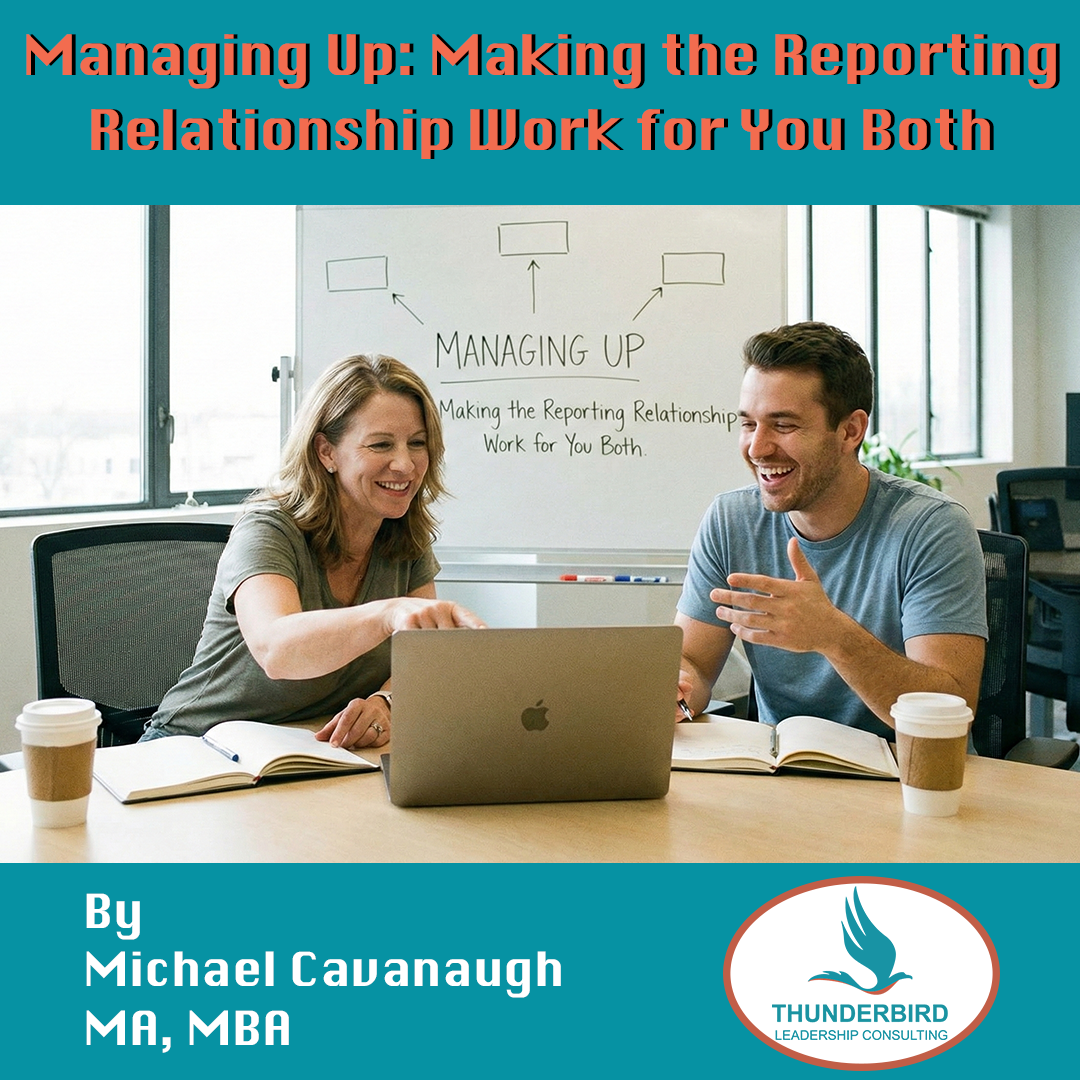
Managing Up: Making the Reporting Relationship Work for You Both

By Michael Cavanaugh, MA, MBA

Most of us spend a lot of time thinking about how to lead and mentor others, or collaborate with peers—but we often overlook one of the most influential relationships in our day-to-day work: the one we have with the person we report to. Some people call that person the boss, others the manager, leader, guide, director, supervisor. In this article I use the term ‘manager’, but insert whatever title that works best for you. 

Managing up isn’t manipulation, flattery, or pretending to be someone you’re not. It’s the proactive work of understanding your manager’s world well enough that the partnership becomes easier, more productive, and mutually beneficial.

Over the years, I’ve found that a few key strategies make all the difference.

1. Understand Their Style and What They Need

Every manager has a style—some lead with data, others with big-picture vision, and some communicate in rapid-fire bullet points while others think out loud. Pay attention.

  • Notice how they prefer to communicate and make decisions. 
  • Clarify their goals and expectations early and often. 
  • Look for how your strengths can support their priorities, and adjust your approach to make collaboration smoother. 

This isn’t about guessing what they want—it’s about understanding how they work so you can work with them instead of around them.

2. Build Trust by Showing Real Value 

Managing up works only when trust is in place. 

That means:

  • Keep your manager in the loop—not with constant reporting, but with thoughtful updates that show you’re on top of your responsibilities. 
  • Solve problems creatively and independently when you can, and ask for guidance when you truly need it. 
  • Lean on them appropriately: good managers want to support your growth, and they appreciate employees who surface issues before they become crises. 

Demonstrating value isn’t bragging; it’s showing reliability, judgment, and initiative. 

3. Handle Hard Moments with Professionalism and Grace 

No workplace is free of tension, misunderstandings, or pressure.

When things get tough:

  • Start with empathy. Your manager has their own stresses and constraints that you may not see. 
  • Offer support when they’re under pressure—small gestures matter. 
  • If you need to address a difficult issue, avoid emotional confrontations. Instead, choose a neutral setting, prepare your thoughts, stick to a single concern, and keep the conversation focused on the work, not the person. 

These are the moments when professionalism pays off the most. 

At its core, managing up is a shared responsibility.
It’s not about surrendering your autonomy; it’s about acknowledging your manager’s authority while working toward a common purpose. When you invest in this relationship with intention, clarity, and respect, work becomes smoother—and your impact grows right along with it. 

At Thunderbird Leadership Consulting, we specialize in supporting your team and strengthening the crucial relationships within it. We understand the dynamics and challenges of working with others and are committed to helping you and your team cultivate healthy, beneficial work styles and relationships. Contact us by call or text with any questions—we’re eager to help.

Good Judgment 2.0…in the Era of Artificial Intelligence

By Jill Bachman, MSN

One of our 2020 blog topics (To Develop Good Judgment) described six critical elements of making decisions, from an article by Sir Andrew Likierman. In his new book, Judgement at Work, Making Better Decisions, his original insights remain solid. 

Today we’re surrounded by data, dashboards, and now— AI. You’d think that with all this information at our fingertips, making great decisions would be easy. Yet as Likierman reminds us, having all the information in the world doesn’t guarantee good judgment.

Likierman defines judgement as “the ability to combine personal qualities with relevant knowledge and experience to form options and make decisions.” It’s the art of knowing what to do when the data alone can’t decide for you. In his research with CEOs, he highlights the six practices at the heart of good judgment: learning, trust, experience, detachment, options, and delivery.  These still apply today—but AI adds a new twist, which can complicate matters as well as help.

Learning: Listen Attentively, Think Critically

Leaders are information miners. The trick is knowing what’s gold and what’s noise. With AI now curating, summarizing, and even writing our information, we need to ask “Where did this come from?” and “What could be missing?”

Quality beats quantity. Read and listen critically—whether it’s a human report or an AI-generated one.

Trust: Seek Diversity, Not Validation

It’s easy to surround ourselves with people—or algorithms—that agree with us. But real judgment comes from welcoming different voices and perspectives.

Don’t just trust data because it’s data. Ask who built the system, what it was trained on, and whose stories are left out. Good leaders build cultures and use tools that challenge assumptions, not just confirm them.

Experience: Make It Broad, Not Just Deep

Experience gives us a strong foundation—but it can also make us overconfident. AI, in its own way, “learns” from experience too—but only from the data it’s fed.

Leaders today need both human experience and digital insight—balanced with curiosity and humility.

Detachment: Check Your Biases—and Your AI’s

We all have blind spots. So do algorithms. The best leaders practice a bit of detachment—pausing to ask, “What’s influencing this decision? Is there something behind this that I don’t understand?” That could refer to ego, habit, or a hidden bias in the data itself.

Detachment helps us see clearly, especially when technology feels persuasive.

Options and Delivery: More Choices, Better Follow-Through

AI can help surface creative solutions we might not have considered—but it can also narrow our thinking if we let it decide for us, or if we decide too quickly. Remember, “recommended” doesn’t always mean “right.”

And once a decision is made, judgment shifts to execution. Even the smartest AI analysis won’t matter if people don’t understand, trust, or believe in the plan. If these are missing, execution can be faulty and miss your target.

The Bottom Line

AI is changing how we make decisions—but not what makes decisions good. Tools can help us analyze, predict, and plan, but only people can apply wisdom, ethics, and empathy.

Good judgment in the time of AI means blending the best of both worlds: human insight guided by machine intelligence, not replaced by it. Because when all is said and done, technology can assist by processing data—but only leaders can make meaning.

How is your organization strengthening judgment in an AI-driven world? Are you finding new ways to balance human insight with digital intelligence? If decisions and complexity are hampering your leadership practices, Thunderbird Leadership Consulting may be able to help shed light on your situation and reveal clarity. Or just reach out—we’d love to hear how you’re leading with judgment in this new era of decision-making.

References: 

https://hbr.org/2020/01/the-elements-of-good-judgment (accessed 11/9/25)

https://www.hbs.edu/bigs/artificial-intelligence-human-jugment-drives-innovation (accessed 11/9/25)

Likierman, Sir Andrew. 2025. Judgement at Work, Making Better Decisions, Profile Books

An Epidemic of Insignificance—and What We Can Do About It

By Rhonda Williams, RN, MSN, MBA

At Thunderbird Leadership, we sit across from leaders every day—twenty, forty, even sixty at a time— bright, motivated professionals who genuinely want to do right by their people. Yet despite good intentions, something heartbreaking continues to show up:

People feel invisible.

According to The Power of Mattering: How Leaders Can Create a Culture of Significance, Dr. Zach Mercurio outlines five sources of insignificance:

  1. Feeling unseen
  2. Feeling unheard
  3. Feeling unvalued
  4. Feeling forgotten
  5. Feeling dispensable

He also points to research showing that nearly half of workers feel undervalued and unappreciated in the workplace—a staggering reality that echoes through every hallway, Zoom room, and leadership session we facilitate.

And here’s the paradox— most leaders dont intend for this to happen. But it does, and not because of grand betrayals or sweeping failures.

It happens in the micro-moments:
– A rushed response instead of real presence
– A performance correction with no curiosity
– Recognition withheld, thinking “they already know they’re doing great”
– A meeting that begins without eye contact or ends without acknowledgment

Insignificance creeps in silently, but its impact is deafening.

This is why I do the work I do. It moves me deeply to know that, through intentional organizational development, we can change a lifereignite a disengaged team, and cultivate a culture where everyone knows they matter.

The work begins with awareness. But it doesn’t end there.

If you’re a leader who wants to stop the spread of insignificance in your workplace, here are three practical ways to start now:

1. See the person, not just the performer.

Ask questions that go beyond the task list. Learn what excites them, what they’re proud of, or how they’re doing as a human. Let your presence say, You matter, even when you’re performing at your best.”

2. Make recognition specific and sincere.

Generic praise feels transactional. Instead, say, “I noticed how calmly you handled that situation with the family this morning. That really made a difference to them.” Specificity reinforces value.

3. Design trust, dont just hope for it.

Trust isn’t built by accident. Involve people in decisions that affect them. Give them room to lead. Trust shows people they are needed, not just tolerated.

The truth is, we all want to feel like we matter.
And the beautiful thing is: we all have the power to make someone feel that way—starting today.

Reference:
Mercurio, Z. (2025). The Power of Mattering: How Leaders Can Create a Culture of Significance. Harvard Business Review Press.

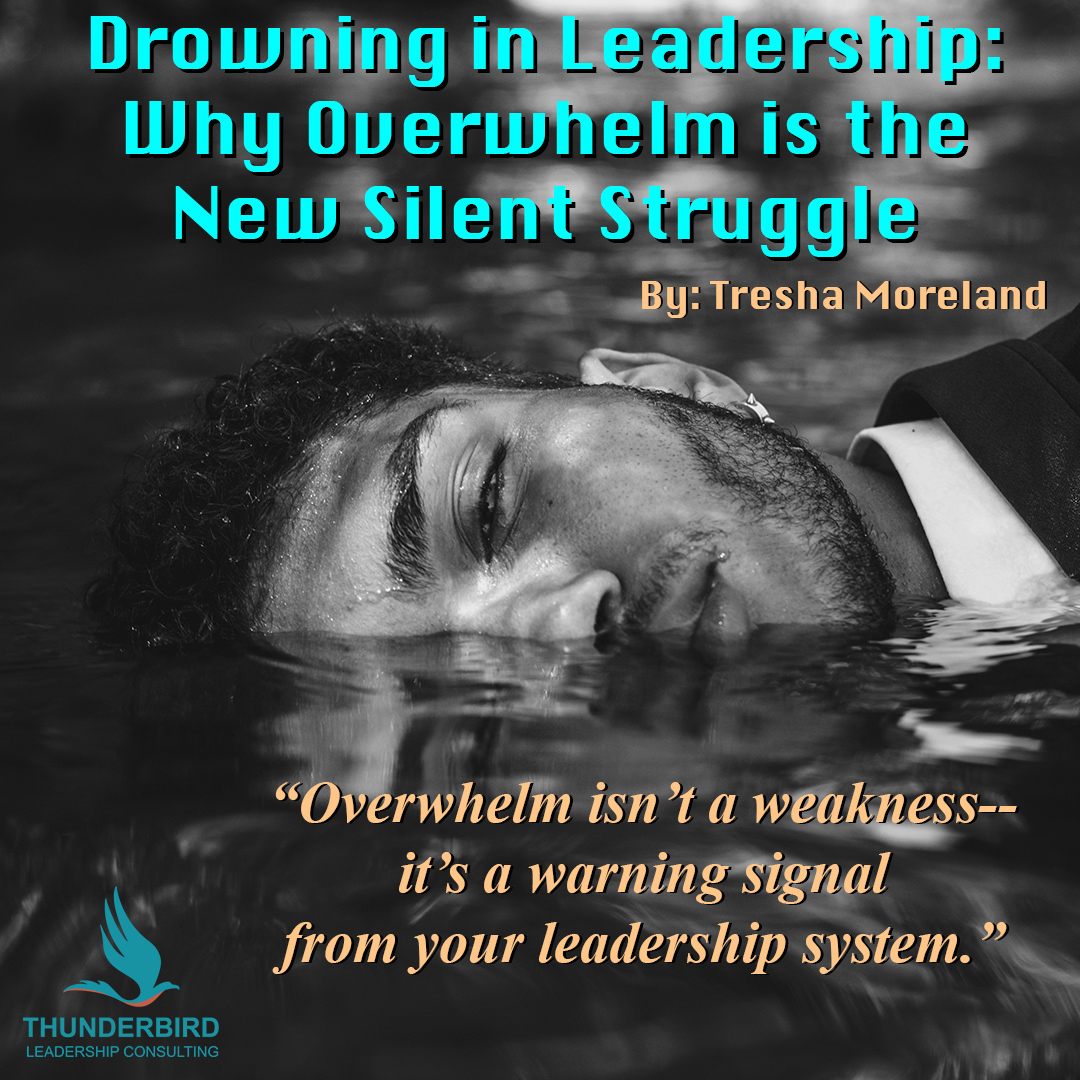
Drowning in Leadership: Why Overwhelm is the New Silent Struggle

By Tresha Moreland, MSHRM/MBA

The Quiet Crisis Few Leaders Talk About

There’s a new crisis creeping through the upper tiers of leadership. It’s not a strategy gap or a skills shortage—it’s overwhelm.

And it’s hitting some of the most high-functioning leaders I coach.

These executives aren’t struggling because they lack capability. They’re struggling because they’ve been expected to operate at high-stakes, crisis-level performance—for far too long, with no pause and no recalibration.

Im Just Overwhelmed”

In most coaching sessions I’ve had, this phrase comes up. It’s whispered with embarrassment or casually tacked onto the end of a sentence—as if being overwhelmed is something to apologize for rather than address.

What I want leaders to know is: overwhelm is not a weakness. Its a warning signal.

Why Overwhelm Hits Executives Hard

Overwhelm at the leadership level isn’t about disorganization or poor time management. It’s the result of complex, unrelenting demands such as:

  • Decision fatigue from nonstop pivots
  • Competing internal and external priorities
  • Responsibility for culture and morale during uncertainty
  • High-stakes visibility without recovery time
  • Leading others through burnout—while experiencing it yourself

Most executives don’t have time to recognize their burnout until it affects outcomes. And by then, it’s often too late for a quick fix.

Signs Youve Hit the Tipping Point

The tipping point doesn’t look like collapse. It looks like:

  • A foggy brain during high-level meetings
  • Avoiding decisions or delaying them indefinitely
  • Checking out emotionally while still “functioning”
  • Low energy that no amount of sleep seems to fix
  • Cynicism or frustration in place of curiosity

This isn’t a leadership flaw. It’s a call for a new model of leadership—one that balances clarity with capacity.

Coaching Through Overwhelm

Here’s what we focus on when coaching leaders through overwhelm—and toward sustainable, high-impact leadership:

1. Apply the 3D Method: Decide, Delegate, Delete

Overwhelmed leaders often try to do it all. Instead, we focus on ruthless prioritization:

  • Decide what only you can do
  • Delegate what others can do at least 80% as well
  • Delete what no longer serves your core goals

This triage tool alone can restore executive clarity.

2. Build Micro-Recovery Into Your Week

Recovery isn’t a two-week vacation. It’s small, intentional moments:

  • 10 minutes of stillness between meetings
  • Walks without devices
  • Creative space with no agenda

These reset your executive brain and reduce reactive decision-making.

3. Lead with Clarity, Not Just Charisma

Clear priorities, stated expectations, and firm boundaries don’t just help your team—they help you. Ambiguity is a mental drain. Replacing it with alignment builds confidence in your decisions and trust in your leadership.

4. Normalize the Conversation

When leaders model vulnerability and clarity, it changes the game. Sharing “I’ve been overwhelmed too” opens the door for more honest discussions across the organization.

Leadership doesn’t need to mean isolation.

5. Shift From Hustle to Wholeness

High-performing leaders often equate success with more. More output, more hours, more meetings. But sustainable success comes from doing less, better.

It means focusing energy on strategic efforts that generate momentum—not just motion.

A New Way Forward

If you’re overwhelmed, you’re not alone—and you’re not broken.

What you’re feeling is a signal that your current leadership model may be outdated for today’s pace. It’s a chance to evolve from reactive to responsive, from exhausted to intentional.

And you dont have to do it alone.

Final Takeaway

As a coach, I’ve seen what’s possible when leaders prioritize clarity over chaos. The results? Renewed focus. Strategic momentum. And leaders who actually enjoy leading again.

Let’s stop glorifying burnout and start designing leadership that lasts.

If this article resonates with what you or your leaders are facing, reach out to us to explore how focused coaching can transform overwhelm into clarity and sustained performance.

Moving Forward: Healing and Innovating Schools

Just the other day, I was sitting in a meeting with a team of teachers and administrators. The theme of our school year has been centered around courage, and we were discussing ways in which we can celebrate this at our end of the year faculty/staff convocation. As we discussed how we wanted to honor the staff after the immense challenge of teaching during this pandemic, it hit me. In all this time since the pandemic started, we had never truly taken the time to reflect on how these past two years affected our faculty and staff. Schools have much to process after dealing with the trauma such as significant disruption to everyday life and work. I have spent the past 8 months speaking with teachers and administrators from around the country from diverse schools and backgrounds to process the effects of the pandemic and political climate on schools. 

As I reflect on my own work as a teacher and leader and from the conversations with other professionals in education, I decided to attempt to answer the questions: How can we begin the process of healing and start the conversations needed to move our schools from a space of disruption to innovation?  Below are some considerations and a call to action for all superintendents, school boards, and those in school leadership positions. 


Pause and Process

Before we can move forward, we have to pause, check-in, and take inventory of our emotions, thoughts and feelings. Teachers, administrators, and staff have been in crisis mode since March 2020, and many haven’t left that space.  We immediately pivoted to teaching online, using new technology, and trying to also meet the social-emotional needs of our students, while taking care of our own families. Before we can move forward at all, I’d charge schools to create space for teachers, administrators, and staff to process everything we’ve been through. Bring in professionals from outside the organization to guide these often difficult conversations. School leaders don’t need to have all the answers, but they can create space in team meetings to demonstrate deep listening and empathy. With the nationwide need for more social-emotional learning in schools for students, how might a social-emotional support program look for the adults in the building? No time is wasted when faculty and staff can pause and reflect on thoughts and feelings. Through the sharing of each others’ stories we can begin to see the commonality in our experiences and begin the process of healing and moving forward. 


Teachers and School Leaders Need Support

If you haven’t been paying attention, I have some troubling news. Teachers and administrators are leaving the profession in droves. Teacher burnout is worse than ever as evidenced by the teacher shortage that has been highlighted in the news. We need brave leaders and policy makers to stand up for our school systems that are quite literally under attack. We have officially come to a crossroads in which the passion for changing lives no longer balances out the poor policies and working conditions that are squeezing the joy and heart from a profession so near and dear to many. Many states and local school districts are still running schools in the same way that they have been for decades. We forge on standing up for fair teacher pay, reduced standardized-testing, fair and equitable access to education, and all other vitally important issues facing our field that deserve the forefront of our attention. While we work to champion for these tough issues, we can still adjust our organizational practices and lead schools into a space of growth and innovation. 


Every Voice Matters

 Once we begin to process our past and current realities, it’s time to collaboratively build the future of our schools and districts and steer toward new possibilities. Take this crucial time to invite all stakeholders to the table to share their vision for the school or district moving forward. Organize your conversations with stakeholders around the following questions: 

  • What issues did the pandemic and our current social-political climate shine a light on in your district/school/organization? 
  • What new practices/lessons from teaching during the pandemic are we holding on to? 
  • What practices & policies are no longer serving us? 

It’s important that everyone has a voice in this process. This conversation can occur with the greater school community as whole, or it may happen at the department/team level. Streamlined communication and transparency in sharing the results of these conversations is a vital step in the process of moving forward towards change.


Real Change Takes Time

Once new opportunities and directions are revealed and identified through these discussions, it’s time to create actionable steps towards change. It’s helpful to bring in an outside organization to help facilitate the discussion and strategic planning so that school leaders can be fully present and part of these important conversations. Having a separate, unbiased set of ears to synthesize the discussions and support the steps forward is vital to the process. 

Change can make us uncomfortable at first. Showing up with honesty, openness, and good intention nurtures growth and makes way for new possibilities. As we learned in preschool from the story of the tortoise and the hare, slow and steady really does win the race. Any changes and decisions that are made must be approached through the lens of “why.” I’m always reminded by a colorful magnet on my classroom white board that, “Great things take time.” It’s so true – real, quality change, when done correctly, is slow, methodical, and purposeful. Be patient in the implementation stage of the process, remain open to feedback, and make adjustments accordingly.


Leadership at All Levels

Everyone has the ability to be a leader no matter what role they possess in the organization. The stakes are too high and the work is too great in education for administrators to call all the shots. To truly change the culture of a school and empower its community, the top down approach must be dismantled and a shared, collaborative approach to leadership must be embraced. Not all teachers and staff have formal leadership training, but by nurturing the skills of self-awareness, deep listening, empathy, curiosity, and decisiveness, a new and positive culture and climate can emerge. When we approach leadership as a shared practice, we can suddenly make time for the tasks, projects, and practices that are more impactful. All of a sudden, principals can be more visible, teachers can have meaningful collaboration, and all stakeholders can feel heard and involved. 


Moving Schools from Disruption to Innovation

After 12 impactful years of service in public and private schools as an educator and leader, I am answering the call to support schools in moving forward and achieving dynamic outcomes. I decided to leave my classroom position and team up with Thunderbird Leadership to support schools on their journey toward healing and innovation. The Disruption to Innovation in Schools program through Thunderbird puts relationships and teaming first. Founded in the principles of Caring Leadership, our programming builds a culture of self-awareness, deep listening skills, empathy, curiosity, and decisiveness in both administrators and staff. This is a time for districts to step back and refocus on the people and relationships that make learning happen. When we do, morale improves, teams are more efficient, and students have a more supportive environment to thrive. Thunderbird truly partners with schools to ignite teams and environments that excel through leadership coaching, teaming, community building, and various professional development topics to promote Caring Leadership in your school. Reach out by email (nbachofsky@thunderbirdleadership.com) to find out how we can help transform your school and join this movement!

The Winding Road

It sounds so simple, but no one had ever told me: The road is winding and wide. I wasn’t aware because most people I knew pursued only one road: The Straight and Narrow. I don’t mean ‘honest’ and ‘moral’ here. I mean ‘straight’ and ‘narrow’– the complete opposite of ‘winding’ and ‘wide’.

Here in Cleveland, we joke that there are only two seasons; winter and construction. You always have to be ready with an alternative route. You can almost never take the most direct path. You must first go south before you can go west, or a little east before you can go north. And don’t forget about rush hour traffic! You’re in it for the long haul. Luckily, there are multiple ways to get to where you’re going.

During a challenging health journey in my late 20s, I began to examine my life more deeply than I ever had up to that point. I felt as though I was headed in the wrong direction, particularly with my career and my life’s dedication. I yearned to be creative again, like I was when I was younger. I wanted to make beautiful creations, important calls-to-action that people admired and felt moved by. I wanted to inspire others with my passion and energy. I felt I knew where I should be, where I always wanted to be, but that place was somewhere on the other side of town. It was a place I was very unfamiliar with, and quite frankly, terrified of.

And so I began to talk with someone about my struggles. The more I spoke about it, the more aware I was of the panic bubbling up inside of me. I was operating on autopilot. I wasn’t engaged or enthusiastic about the work I was doing. I felt undervalued and overworked. I felt disappointed in myself for not having a clearer direction for my life, a more solid plan. I chastised myself because I had allowed this to happen, and now, nearly ten years into my career at that point, I felt trapped and confused. Was this ever really what I wanted to do? What about all the years of education I went through? The degrees I earned? The time I’d already invested at my workplace? It all seemed like a big waste. 

Through my sadness, my therapist offered this simple but impactful perspective: Life is not a straight and narrow path. It is a jagged and twisty, multi-lane roadway, full of construction and bus stops. It is a series of onramps and offramps, and sometimes you have to go far out of your way to get back on track. Sometimes you are driving with poor visibility, and sometimes you’re driving through clear skies with the top down. But you are always moving. Even if you stop momentarily, life beckons you to hit the gas once again. 

I spent a lot of time with this analogy. I thought about what it meant to view my life as a winding road. I thought about all the events of my life that I am grateful for, and I began to notice the twisted roads that led me to them. Of course life is not a straightforward path! There are reasons for this, and here are a few I’ve learned from my experience since then.


1) Life is a series of stops and detours that provides us with feedback on how we are responding and growing as people.

Quite simply put, we do not know what we do not yet know. I like to view my life experiences as a variety of roadside diners. I discover new joints that I love, and others…well, I won’t be coming back for seconds. Use these experiences to fuel change and discover what makes you ‘tick’. By means of detouring and rerouting, I begin to learn my way around town. I discover the bumpy roads, the carefree highways, the heavily patrolled areas, and the places I want to avoid in the future. At 15 years old, I was afraid to drive up that freeway onramp for the first time, but I learned something every time I tried, and it got easier. Learning more about myself and my surroundings has been key to uncovering my personal path and purpose. 


2) We may need to have certain experiences that drive us forward, even if they seem counterproductive.

We may not be ready for a particular ‘point of interest’ yet. That is the bottom line. We may have to acquire some skills, be jolted into some serious reflection, meet some new people, or overcome a challenge before we are prepared to arrive at that destination. Even if you feel restless and anxious, this is a process that asks you to honor your current location. This is where you are today, and there is incredible power in that realization. Each twist and turn is teaching you to become a better driver, and you will be better-equipped to handle future roadblocks. Perhaps a new road will open up now that you’re no longer headed south on the old one. In this way, no experience is a lost cause. No credential, skill, or relationship is a waste of time. No seemingly counterproductive event has forever put you in reverse. You are a master navigator! Even as you are reading and reflecting on this post, you are fine-tuning your route.

I’m reminded of an SNL Weekend Update skit where Leslie Jones talks to Colin Jost about Oprah Winfrey’s experience being fired as a young intern. Jost remarks what a mistake it was for those executives to fire Oprah! “No it wasn’t!” Leslie claps back. “…‘Cause she wasn’t Oprah. She was just some 23-year-old punk, who needed to get fired, so she could become ‘Oprah’!” 


3) Trust that if we set the destination, life will align the right people and situations to get us there.

Life is a complicated web of connections and networks. We’ve all heard of the six degrees of separation concept. Whether there are actually six is not the point. We can be sure that there is at least one path for every destination we plan for. From a vantage point much greater than any mirror or car camera can provide, you have already initiated a chain reaction that is shifting the tides to make things happen.

I have always had many interests. But since I can remember, I always wanted to be a singer and songwriter. There was one problem: I was terrified to put myself out there for people to hear. Over the years, I gradually turned my back on my love of music. Quite some time later, I decided I owed it to myself to forge down that path once again and take a look around! In the last three years, I have now performed many times for an audience, but I had to get through a few hazardous conditions before I could open up. Some were even completely unrelated to music! My original plan had me arriving at my destination really early. Improperly early. It was in my best interest to slow down and take the scenic route. I began to notice the parts of my previous career that had prepared me for an audience. I noticed the new experiences I was having that were encouraging me out of my shell. I noticed the unique and fun moments I was having as a result of this new route–ones I would never have dreamt possible.

I know that it may take you, as it has taken me, some time to get used to this winding road. We are prodded down narrow paths, raised with absolutes, and told it’s ‘my way or the highway!’ We begin to neglect our own navigation system, and we forget who is driving the car.

76-year-old American actor, singer, dancer, and director, André De Shields, offered this piece of advice during his first Tony Award acceptance speech in 2019: “Slowly is the fastest way to get to where you want to be.” So let’s try not to be anxious drivers. The pace and course of your journey has been designed specifically for you. If it feels misguided or too slow, take a deep breath, and stay curious about your surroundings. Ask yourself what you are meant to learn at this time. Find out what is working and what isn’t working for you. Reach out and ask for directions. Discover how you will do things differently next time. If the traffic is too noisy, roll up the windows and put on your favorite playlist! If we settle into the moment, we allow the next turn to reveal itself. 

Above all, remember that life is a process of growth opportunities. There is more to our stories than just the beginnings and ends. We can be motivated by the destination, or we can be excited about the road trip itself. Afterall, the real adventure is in the winding detours.


Curb Your Complaining

by Dr. Carla Rotering


“The only thing complaining does is convince other people that you are not in control.”– Unknown

There’s an old saying that “misery loves company” – and over the last couple of years, things may feel pretty miserable to many if not most of us.  It seems a natural extension to transfer what we experience into the act of complaining.  

Complaining and connecting with those who share our disturbance not only provides some emotional release but it also creates a place of belonging. Who doesn’t want to spend time with people who “get” what we are talking about – who notice the same miserable things we do, push against the same miserable boundaries we do, and complain about the same miserable details that we do?   We become misery buddies, an exclusive club of complainers, operating with the belief that we are bonding and validating one another through our shared complaints.  

We are inherently social beings, and as humans we have the capacity for neuronal mirroring.  Mirroring happens when mirror neurons in the premotor cortex area of your brain respond to an observed behavior or mood of another person as if YOU were actually engaged in that behavior or mood yourself!  So rather than finding comfort and relief, as we unconsciously mimic moods and behaviors, we actually deepen our misery and ultimately habituate the practice of complaining.  That habit of complaining doesn’t make anyone happy.  And you don’t even have to be the complainer!!  Studies show that 30 minutes of LISTENING to someone complain impacts our health and wellbeing just as much as BEING the complainer for that 30 minutes.  The average person complains between 15 – 30 times a day, according to Will Bowen, author of “A Complaint-Free World”.

Have you ever heard the saying “Neurons that fire together wire together”? Neuroscience tells us that repetitive complaining, like any repetitive behavior, re-wires our brains so that the neurons branch out toward each other to create a more permanent bridge, making future complaining more likely.  Over time, it becomes easier to be negative by defaulting to this now-established neural pathway than it is to be positive, which would require the creation of a new pathway – and that holds true even when what is happening around us changes for the better!  

Mission.org explains this phenomenon perfectly:

“The more you complain about things like flakey friends or being asked to push up a project’s 

deadline, the more neurons in your brain stitch themselves together to easily 

facilitate this kind of information. Before you know it, complaining becomes so 

easy for your brain to grasp, you start doing it without even consciously registering

the behavior.”

A Stanford University study using high resolution MRI’s found that complaining or listening to complaining can result in actual damage to our brains by shrinking the hippocampus.  Equally concerning, chronic high cortisol levels, besides triggering our flight-or-fight response, are now thought to damage the hippocampus in the same way.   The hippocampus is an area critical to memory formation, learning, emotional regulation and problem solving.  It is also one of the primary areas of the brain destroyed in Alzheimer’s Disease.

Who wants that???  And what can we do to shift?

Here is a summary of tips offered by the Cleveland Clinic to interrupt the habit of complaint – whether you notice it in yourself or your peers, friends, family:

  •  Look at the big picture – will this really matter in 5 minutes/months/years?  If the answer is “yes” see #5
  • Ask yourself if this IS the issue?  Is “this” (whatever it is) really pushing your buttons or is there something going on that is deeper, harder, more personal.
  • Make it a game!  Wear a bracelet or rubber band around your wrist – and every time you notice yourself complaining (even silently) shift it to the opposite wrist.  The goal is to keep your rubber-band bracelet on the same wrist for longer and longer periods of time.
  • Share legitimate concerns in the right time and place – not on social media, not in a public hallway or shared space.
  • When something really matters, share your concern in a way that is seen as helpful rather than critical. Be a part of the solution!
  • When you offer a valid complaint, start and end with a positive statement. When we start with negative words, no one can hear anything else we say. When we end with negative words, no one can remember what we said before.  This sandwiches your concern between caring statements– and makes all the difference to others and to YOU!!
  • Practice gratitude.  If negativity has become a habit for you or those around you, noticing one small thing daily for which you are thankful can begin to forge a new, positive neural pathway!!

Our invitation to you is to experiment with a “no complaint day” – and see what happens to your energy, your mood, your level of contentment and satisfaction.  

And if you like it, start building new neuronal bridges!!!


https://health.clevelandclinic.org/how-to-stop-complaining-7-secrets-to-being-happier/

https://news.stanford.edu/pr/96/960814shrnkgbrain.html

https://www.ncbi.nlm.nih.gov/pmc/articles/PMC6616250/

https://www.southernliving.com/news/complaining-changes-your-brain

https://m1psychology.com/complaining-is-bad-for-your-brain/

Cultivating a Culture of Courage

As the world returns to in-person work and school, so many conversations are brought into the forefront of public debate. Businesses and organizations have been working to keep up with the recommendations from authorities and professionals. They take into consideration the unique needs, culture, and values of the organization and include dialogue with stakeholders. Over the past few months, I could not help but fall down the rabbit hole of school board meetings that can be found on YouTube. Many of these videos show concerned parents voicing their opinions over hot button topics.

One video stands out to me in particular of a teenager whose grandmother passed away during the global health crisis earlier in the year. At his local school board meeting, the teenager  voiced his support for mandatory masking in front of members of his community. As he spoke, the adults laughed at him and heckled him as he shared the experience of losing his grandmother. In the midst of this shocking behavior, the student continued to share his story, thoughtfully and unwaveringly. Watching this video, I found myself so inspired by this brave act of courage. He demonstrated a level of courage that people twice his age would struggle to show. So how can we be more intentional about cultivating a culture of courage, within ourselves and our communities?

Quote on courage by Brene Brown

The theme of courage has been on my mind so much lately as I have been working with a team of teacher-leaders and administrators to implement a K-12 One District, One Book program. The premise of the program is simple yet incredibly impactful; each student in the district reads the book Courage, by Bernard Waber. The book, insightfully written and beautifully illustrated, highlights a wide spectrum of ways to show courage throughout our lives. The year will be filled with activities that span grade levels, involve the greater community, and invite guest speakers and programming into the schools, all centered around the theme of courage. We can be intentional about our desire to teach and cultivate courage in our organizations and communities. Consider the ideas below and how you as a leader can foster a spirit of courage in your organization. 

Have the courage to be an example

As leaders, if we want to inspire others to be innovative and try new things, we need to be ready to take the vulnerable first step of demonstrating courageous behavior. Embrace this as an opportunity to try something new. Your act of courage should not be a major change that adds more work to your team. Consider demonstrating courage by:

  • Looking for a new way of seeking feedback from your team, staff, or students. 
  • Attempting a new format for running a team meeting
  • Incorporating an energizer at the start of an afternoon staff meeting. 
  • Wrapping-up a lesson by asking students or colleagues to share a 1-word check-in on how they are feeling

Let people know you are trying something new. Displaying your act of courage will inspire and give permission for others to do the same. 

Celebrate wins and failures

Brene Brown reminds us that courage is contagious. Be the example, give others permission to take risks, get out of their way, and be ready to cheer them on. Take time to honor these moments with others. Knowing what your teammates need is important. Some people enjoy a public shout out, while a private, handwritten note goes further for others. Make supporting your team or students a priority. Create opportunities for colleagues to celebrate, appreciate, and collaborate with one another. Never underestimate the power of small acts of appreciation. 

It is easy to celebrate successes, but often we skip the party for our failures. One of my mentors and friends has a sign in her classroom that says, “Mistakes Made Here.” I have always admired it and decided to display the same message in my own classroom. Mistakes make the ground fertile for better ideas and realizations that ultimately optimize an organization’s level of innovation. As leaders, we need to be comfortable supporting others through those failures by helping them debrief, asking how we can be of support, and most importantly, asking the question “What next?” 

Have the courage to be open

As the spirit of courage spreads, be ready for a culture transformation in your organization. Embrace a spirit of collaboration and openness. As people become more courageous, they might feel more comfortable to share constructive feedback. There may be more conversations that feel uncomfortable at times, but this is a sign of healthy, effective teamwork. Giving others voice and choice in the decision-making process, coupled with visibility and approachability, will demonstrate a commitment to a positive culture. Be open to the feedback you are receiving. We have the opportunity now to challenge the old ways and potentially make way for new ways of thinking and Watch the spirit of courage gradually inspire others around you to take risks and try new ways of being and doing. Remember to be there to support and celebrate others. Be patient and watch as your new culture of courage takes root, evolving into a community of innovation and collaboration.


The Imposter Syndrome – How to shift your self-doubting thoughts

Yikes!  Surely, someone is going to recognize I really am not that smart, that I have been lucky – in the right place at the right time. How long will I be able to keep this secret?  Can my family, friends, and colleagues see the real me? Yes, I have accomplished a great deal, but truly, it has all happened by chance.

These types of thoughts are common for professionals who are experiencing Imposter Syndrome, a phenomenon first identified in 1978 by psychologists Pauline Rose Clance and Suzanne Imes.

I recall going through my professional life and believing my opportunities and achievements resulted from what I called the “Mr. Magoo phenomenon”. If you aren’t familiar with this nearsighted cartoon character, let me explain. Mr. Magoo had a TV series in the 1960’s. His extreme nearsightedness led him into harrowing predicaments, yet always, just in the nick of time, Mr. Magoo would take the right action that would lead him to his desired outcome.

Well, I felt my career was a lot like Mr. Magoo. I would find myself not knowing which direction to take in my clinical career, in different leadership positions, and even in academic pursuits. But just as I was feeling most confused, a great option presented itself and the choice was made. As each of these “lucky” occurrences reinforced my belief in mitigating circumstances rather than my own talent, abilities and experiences, the notion of being an imposter was confirmed.

Research is replete with information on the Imposter Syndrome. In fact, did you know more than 70% of us experience feelings of being an imposter at some time or another? There are many highly accomplished people who admit they too have felt like an imposter. Maya Angelou, a three-time Grammy award winner, Tom Hanks who appears in more than 70 films and John Steinbeck a literary giant – all shared something in common at times during their careers –  they described themselves as feeling like frauds. However, they were able to overcome these doubts to have amazing, successful careers.

So, what can the rest of us do to overcome imposter syndrome paralysis when it happens? I asked two of my colleagues at Thunderbird Leadership Consulting to share their wisdom and useful tips to navigate the perils of imposter syndrome.

Carla J. Rotering, a physician, coach and consultant, takes the approach of embracing the self-doubt.

Carla J. Rotering

Carla J. Rotering

“Imposter syndrome is nearly a universal phenomenon regardless of the ‘outer image’ we may see in others. Nearly everyone has almost certainly felt like a fraud at some point. It’s what we do, and it often creates the fear of being ‘found out’ and exposed. There are lots of suggested ways to manage that fear. I personally use a way that at first may feel a little harsh – and yet it is the thought that has proven the most useful for me.

“What if I simply say it is true? I am an imposter. We are all imposters. There is a standard out there somewhere called ‘perfect’ and that is the bar we have set for ourselves. But we are not perfect, any of us. The human condition is simply imperfect by definition. Any claim of perfection is therefore fraudulent.

“When I can recognize that – without judgment, but just with awareness of that FACT – I can tap into a more authentic, humble self. I can use my ‘imposter’ moment as a springboard to growth, learning, and fresh thought. I can let my ego off the hook and alleviate my own suffering and shame. I can lay that useless emotion aside, and then I can acknowledge what I don’t know, ask for assistance when I need it, and lean into the well of information, wisdom, and knowledge that will allow me to grow closer to that bar to which I aspire.

“I can realize I am human – that I am and (hopefully) always will be a work in progress.”

When Nathan Bachofsky experiences Imposter Syndrome, he turns to mentors to seek a reality check.

“I have wrestled with Imposter Syndrome at many points throughout my career and still experience relapses from time to time. A few years ago, I made a transition into a new role that required more of me in terms of leadership and responsibility. There were many challenges that came with this transition that left me feeling like maybe I was not ready or enough.

Imposter Syndrome Quote

I found great comfort in the counsel of my trusted mentors. It helped immensely for me to open up about my challenges to then hear an esteemed mentor in my field say, ‘Oh yes, I felt that way many times,’ or ‘I am still waiting for someone to realize they hired the wrong person’ I thought, ‘Wait, THEY went through this? But they are so confident and successful!’

“We can shine a light on the darkness of Imposter Syndrome through the vulnerable act of sharing our experiences with others and reinforcing the notion that no one is alone in this feeling. I have found my experience with Imposter Syndrome to ebb and flow, but by talking openly about it and maintaining positive affirmations, my relapses can be drastically shortened.”

If you or any of your colleagues are experiencing feelings of being a fake or being lucky in your achievements, know that you are not alone and that you too can shift your thinking. If you’d like to talk to one of our team at Thunderbird Leadership Consulting, please feel free to reach out to us at info@thunderbirdleadership.com