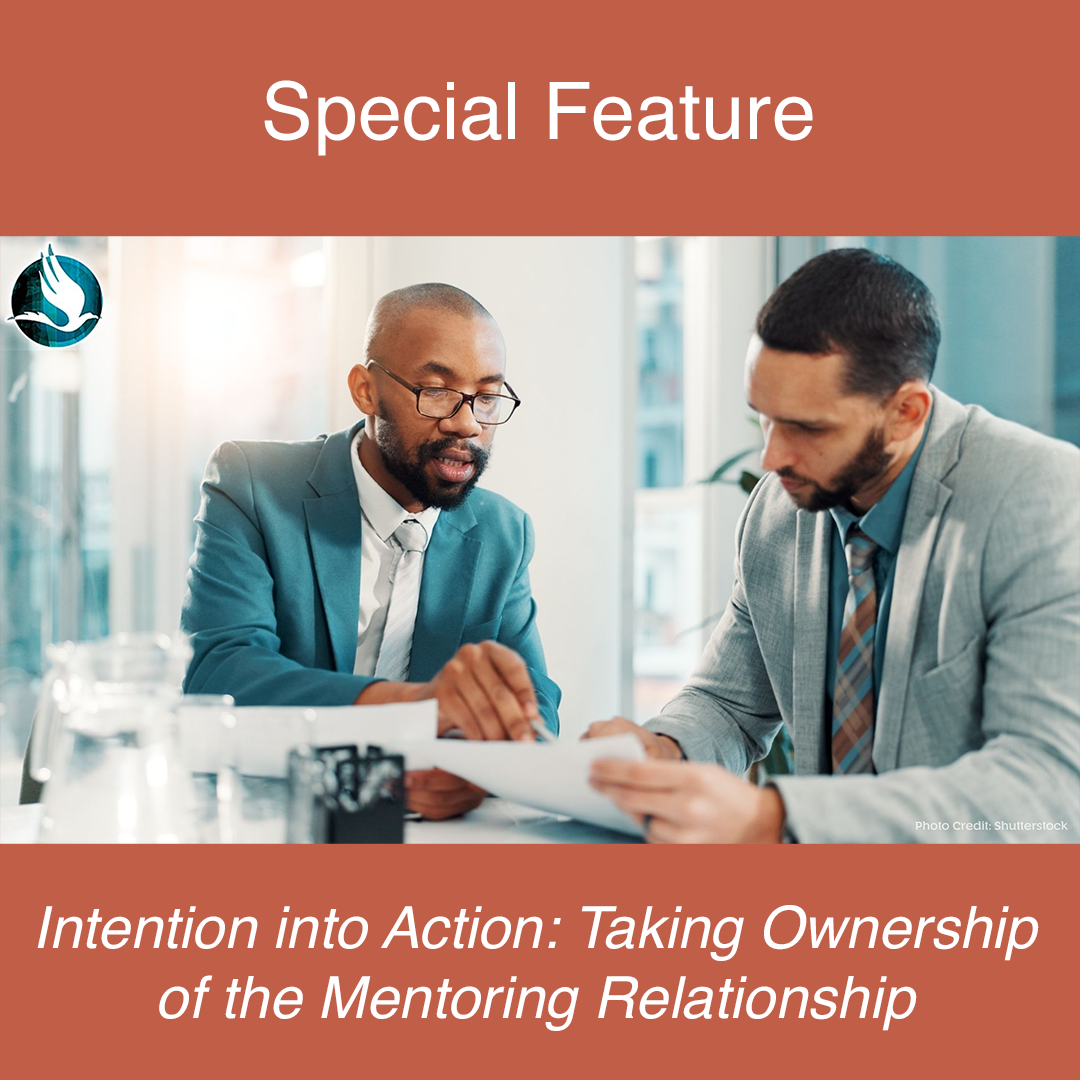
Intention into Action: Taking Ownership of the Mentoring Relationship

Author: Fred Amador, MC, ACC

High-impact mentoring relationships do not happen by accident. They are intentionally designed, actively managed, and grounded in mutual accountability. In organizations focused on building strong leadership pipelines, the effectiveness of mentoring often depends less on the mentor and more on how the mentee engages with the relationship.

High-impact mentees accelerate learning, respect executive time, and translate insight into better leadership decisions. They treat mentoring not as a courtesy meeting, but as a strategic partnership.

A mentor brings pattern recognition, institutional wisdom, and perspective shaped by experience. Unlike a coach—who primarily serves as a thinking partner—a mentor draws from lived experience to help mentees anticipate challenges, avoid common pitfalls, and strengthen judgment.

Because mentors invest their time and experience generously, mentees carry a responsibility to show up prepared, focused, and accountable. Becoming an effective mentee means owning the relationship and maximizing the return on that investment.

When approached intentionally, mentoring accelerates leadership readiness, strengthens judgment, and expands organizational capacity.

The following practices distinguish highly effective mentees.

1. Enter the Relationship with Clarity

Strong mentoring relationships begin with clear expectations and operating norms.

Determine the cadence. Agree on a meeting rhythm—monthly, bi-weekly, or quarterly—that reflects the goals of the relationship and the realities of both schedules.

Select the medium. Decide how you will meet (e.g., Zoom, phone, or in person), recognizing that flexibility and consistency matter more than format.

Take initiative. As the mentee, own the logistics. Schedule meetings, send calendar invitations, and confirm agendas. This signals professionalism and respect for time.

2. Take Ownership of the Learning Agenda

Clarity of purpose enables sharper conversations and better outcomes.

Define your objectives. Be explicit about what you want to work on. Effective goals are specific and decision-oriented—for example, strengthening executive presence, navigating a role transition, or preparing for broader leadership scope.

Establish communication boundaries. Discuss expectations for communication between meetings. Clarify when quick questions are appropriate and when topics should wait for scheduled conversations.

Track progress deliberately. Maintain a simple, shared or personal record of goals, insights, decisions, and action steps. Treat this as a living document that keeps the work focused and accountable.

3. Translate Insight into Action

Mentoring creates value only when insight leads to execution.

Arrive prepared. Send a short agenda or set of questions 24 hours in advance. This allows your mentor to prepare thoughtful, relevant input.

Close the loop. Begin each session by summarizing progress since the last conversation. Share what you did, what worked, and what did not.

Commit to next actions. End every meeting by identifying one or two specific actions. 

Calendar them immediately. Insight is nice, but without action, you lose momentum.

Surface obstacles early. Strong mentees use mentoring conversations to diagnose barriers. 

4. Build a High-Trust, High-Value Relationship

The most productive mentoring relationships are grounded in respect, appreciation, and reciprocity.

Share outcomes and wins. When guidance leads to results such as a successful presentation, a clearer decision, or a new opportunity, remember to close the loop. Mentors value knowing their investment made a difference.

Contribute where appropriate. While mentoring is not transactional, all-star mentees bring value when they can—sharing relevant articles, industry insights, or emerging trends.

Demonstrate respect consistently. Be punctual. Come prepared. Follow through. Express appreciation. These behaviors reinforce trust and credibility over time.


Mentors invest their experience to help others grow into greater leadership responsibility. When mentees approach the relationship with discipline, initiative, and accountability, mentoring becomes a force multiplier for the individual, the mentor, and the organization by accelerating leadership capabilities where they matter most.

For leaders who mentor, the greatest return on your investment comes from mentees who treat mentoring as a strategic partnership rather than a standing meeting.

Reflection

Where might you shift from participating in mentoring to actively owning the value you receive from it?


Shared from APRIL 2026 Issue of Thunderbird Leadership Consulting ELEVATE – Tbird’s Hub for Practical Leadership Insights.


Enjoy our YouTube video below, then visit Thunderbird Leadership’s YouTube channel to watch all of our YouTube videos!

Self-Awareness Is Not a Soft Skill

Across our client engagements, one theme has surfaced consistently. Leaders are not just gaining insight into others. They are gaining clarity about themselves.

This shift is not abstract. It is practical.

This matters more than many leaders realize. Research suggests that while 95% of people believe they are self-aware, only 10 to 15% truly are (Eurich, 2018). This is not a reflection of intent. It reflects how difficult it is to see the full picture when you are in the frame.

Recently, leaders shared how impactful the introduction and integration of DiSC has been across both executive and leadership teams.

Leaders shared:

“I thought I understood my communication style. I did not realize how it was impacting others.”

“Team collaboration and using DiSC to dial into the impact of our styles and how it affects communication and team results. We are using tools to guide differences and team projects.”

“The most significant changes for our teams and executive staff were the development of shared understanding of one another’s communication styles through DiSC and awareness of the consequences of our actions and words.”

Self-awareness is often discussed as a foundational leadership skill. In practice, it is a performance lever.

When leaders understand their natural styles, how they show up under pressure, how they communicate, and how they are experienced by others, several things begin to shift.

Conversations become more intentional.
Reactions become more measured.
Decisions become more thoughtful.

Understanding our natural styles is step one. The real value of a tool like DiSC emerges when it is integrated into day-to-day work, where leaders begin to recognize patterns in themselves and others:

These patterns often become most visible:

  • When urgency increases
  • When navigating tension
  • When decisions are uncertain

This awareness creates choice.

Instead of reacting automatically, leaders can adjust in real time to better align with the needs of the moment and the people around them.

This is where self-awareness moves from insight to impact.

What Leaders Can Do Now

  • Identify one communication pattern that may be helpful in some situations but limiting in others
  • Ask for feedback from a trusted colleague on how your style is experienced
  • Pause in one high-stakes interaction this week and intentionally adjust your approach by dialing up or dialing down your style

Self-awareness is not about changing who you are. It is about expanding how effectively you lead others.

Leaders who understand themselves lead others with greater care and precision.


Reference:

Eurich, T. (2018). What self-awareness really is (and how to cultivate it). Harvard Business Review.


Shared from APRIL 2026 Issue of Thunderbird Leadership Consulting ELEVATE – Tbird’s Hub for Practical Leadership Insights.


Enjoy our YouTube video below, then visit Thunderbird Leadership’s YouTube channel to watch all of our YouTube videos!

Strategically Designed Leadership Capacity in Constrained Environments: Without Burnout

Leadership capacity is often misunderstood as stamina. Work longer. Carry more. Respond faster. Yet the leaders who sustain performance over time are not those who do more, but those who design their work differently.

According to the World Health Organization, burnout is linked to chronic workplace stress that has not been successfully managed, not simply to hard work itself (WHO, 2019). Similarly, Gallup research finds that role clarity and manageable workload are among the strongest predictors of employee engagement and well-being (Gallup, 2023). Capacity, then, is less about volume and more about design.

For many, capacity is often interpreted as a need for additional people. While in some cases that is appropriate, many organizations are operating within financial constraints that limit that option. In those environments, expanding capacity requires a different approach, one grounded in clarity, boundaries, and decision discipline.

The question shifts from “Who else do we need?” to “How can we work differently with the capacity we already have?” 

Consider three disciplines that strengthen leadership capacity.

Clarity

Clear priorities reduce friction. When leaders define what matters most, teams expend less energy guessing and more energy executing. Research from McKinsey shows that organizations with aligned priorities are significantly more likely to outperform peers in long-term results (McKinsey & Company, 2021). Essential to effective clarity is addition by subtraction. In fast-paced environments, resetting existing priorities when adding new ones signals that leaders understand the realities their teams are navigating.

Many leaders do not have a capacity problem. They have a prioritization problem that shows up as one.

Author Antoine de Saint-Exupery wrote, “Perfection is achieved, not when there is nothing more to add, but when there is nothing left to take away.”

Boundaries

Sustainable performance requires visible limits. Harvard Business Review research on energy management suggests that leaders who model recovery and boundary-setting create healthier, more productive teams over time (Schwartz & McCarthy, 2007). This is often where leadership intent and behavior diverge. Without visible boundaries, teams learn that everything is urgent and nothing can wait.

Most leaders are committed to doing whatever it takes to get the job done, even at the expense of their own well-being. In a future article, we will explore five types of boundaries every leader should consider. In the meantime, executive teams can normalize reasonable boundary discussions, providing space to discover hidden barriers.

Decision Discipline

Not every issue requires escalation. Leaders who establish decision rights and empower others prevent bottlenecks and preserve cognitive bandwidth. Clear decision frameworks increase speed where it matters and prevent unnecessary rework (Bain & Company, 2019). When systems embrace the imperfections of nuance, leaders can lean in and balance ownership with growth.

Strong decision discipline requires leaders to consistently ask a different set of questions:

  • What truly requires my involvement?
  • Where is “good enough” sufficient to move forward?
  • What would happen if I removed myself from this decision entirely?

In many organizations, leadership capacity is constrained not by the volume of decisions but by the number of decisions that flow upward unnecessarily. When leaders remain involved in decisions others are ready to own, they unintentionally create dependency, slow execution, and increase their own cognitive load.

Reducing over-involvement expands capacity, strengthens ownership, and builds trust.

Strategically designed leadership capacity identifies and removes what no longer serves. When unnecessary friction is reduced, energy, judgment, and focus are applied where they matter most. The result is greater effectiveness and more sustainable leadership over time.


Executive Team Reflection

Clarity: Where might competing priorities be diluting focus, and what could be removed or reset to create sharper alignment?

Boundaries: What visible boundary could you model this month that would protect sustainability without compromising performance?

Decision Discipline: Where are decisions escalating unnecessarily, and how might clearer decision rights expand ownership and preserve leadership capacity? Where are you staying involved out of habit or protection rather than necessity, and what would change if you stepped back?


Capacity is rarely expanded by adding more. It is expanded by removing friction, redistributing ownership, and making fewer but better decisions.


References (APA)

Bain & Company. (2019). How clear decision roles enhance organizational performance.
Gallup. (2023). State of the global workplace report.
McKinsey & Company. (2021). The organization blog: Aligning priorities for performance.
Schwartz, T., & McCarthy, C. (2007). Manage your energy, not your time. Harvard Business Review.
World Health Organization. (2019). Burn-out an occupational phenomenon: International classification of diseases.


Shared from APRIL 2026 Issue of Thunderbird Leadership Consulting ELEVATE – Tbird’s Hub for Practical Leadership Insights.


Enjoy our YouTube video below, then visit Thunderbird Leadership’s YouTube channel to watch all of our YouTube videos!

Trust Grows When Leaders Stay in the Conversation

Author:  Amy Milliron, M. Ed.

During a leadership session with a rural hospital executive team, the CEO made a comment that stayed with me. She said that their leadership meetings were respectful and efficient, yet she had the sense that some of the most important thinking in the room was not always making its way into the discussion.

As we explored what she meant, she described a pattern she had started to notice. A decision would be discussed in the meeting, and everyone would appear aligned. Later in the week, a director might stop by her office and raise a concern. Another leader might mention a potential issue in a hallway conversation. None of these comments was intended to undermine the decision. They simply reflected perspectives that had not surfaced when the team was together.

What the CEO was observing was not a lack of professionalism or commitment. Her team cared deeply about the organization and about one another. In many cases, people were trying to be thoughtful about timing, respectful of colleagues, and mindful of the pace of the meeting. Their intention was to protect the working relationship and keep the team moving forward.

At the same time, those good intentions meant that valuable information sometimes arrived after the moment when it could most easily shape the decision.

Staying Present Through Tension
We began experimenting with a simple change. As the conversations approached a conclusion, the CEO asked one additional question. She would pause and ask whether anyone saw a risk, trade-off, or perspective that the group had not yet explored. During the first few meetings, the room remained quiet, which is a normal response when a team is adjusting to a different expectation for dialogue. Eventually, one director spoke up about a staffing change discussed earlier in the meeting. The question led to a deeper conversation about scheduling, workload, and patient flow that had not yet been considered fully.

The quality of the discussion improved because the CEO responded with curiosity rather than defensiveness. She asked questions and invited others to build on the point. That response demonstrated that thoughtful disagreement was part of responsible leadership.

Understanding Conflict Styles
A similar dynamic appeared in another organization I recently worked with. A regional operations team had been struggling with decisions that seemed to stall after meetings. When we looked more closely, the team realized that many members relied heavily on a single conflict style. Several leaders preferred to avoid tension when discussions became uncomfortable, while others tended to accommodate the direction that appeared to have the most support in the room.

We used the Thomas-Kilmann Conflict Mode Instrument to help the team explore their patterns. The TKI framework identifies five approaches people often use when navigating conflict: competing, collaborating, compromising, avoiding, and accommodating. None of these modes is inherently right or wrong. Each one can be effective depending on the situation. (Thomas & Kilman, 1974.)

What the team discovered was that they were using only a narrow portion of that range. Avoiding and accommodating helped them maintain positive relationships, but it also limited the depth of their conversations. As leaders became more aware of the different modes, they began experimenting with collaboration and constructive competition when a decision required deeper examination.

Over time, the meetings changed. Discussions sometimes took longer because leaders were willing to ask harder questions and test assumptions together. At the same time, decisions became clearer, and follow-through improved because the thinking behind them had been examined more thoroughly.

Brené Brown describes this kind of engagement as a “rumble.” She defines a rumble as a conversation in which people remain curious, assume positive intent, and work through challenges together rather than avoid them. The purpose of the conversation is not to win an argument. The purpose is to understand the issue well enough to move forward with clarity. (Brown, 2018.)

When leaders demonstrate that difference can be explored with respect and steadiness, several positive shifts occur. Teams begin to bring forward perspectives earlier. Decisions benefit from broader insight. Engagement increases because people see that their thinking influences outcomes. Trust strengthens because conversations happen in the open rather than in private follow-ups.

Leaders sometimes ask how to build stronger trust across their teams. One practical step is to make room for the full range of perspectives that already exists in the organization. When leaders remain present in moments of tension and respond with curiosity, they send a clear signal that differing viewpoints are a valuable part of strong leadership dialogue.

That experience builds confidence. Over time, people learn that raising a question or offering a different interpretation is not a disruption to the work. It is part of the leadership responsibility they share.


Reflection
Before your next leadership conversation, consider where a broader range of perspectives might strengthen the discussion. Notice which conflict styles appear most often in your team and whether expanding that range might help the group examine important issues more fully. 

Leaders who remain steady and curious during disagreement help their teams develop the confidence to stay in the conversation together.

References
Brown, B. (2018). Dare to Lead: Brave Work. Tough Conversations. Whole Hearts. Random House.
Thomas, K. W., & Kilmann, R. H. (1974). Thomas-Kilmann Conflict Mode Instrument.

Citations

  1. Brown, B. (2018). Dare to Lead: Brave Work. Tough Conversations. Whole Hearts. Random House.
  2. Thomas, K. W., & Kilmann, R. H. (1974). Thomas-Kilmann Conflict Mode Instrument.

Shared from March 2026 Issue of Thunderbird Leadership Consulting ELEVATE – Tbird’s Hub for Practical Leadership Insights.


Enjoy our YouTube video below, then visit Thunderbird Leadership’s YouTube channel to watch all of our YouTube videos!

Empathy is a Skill—Not a Mood

Author:  Jill Bachman, MSN, BSN

Empathy has received well-deserved attention as a cornerstone of emotional intelligence, especially in leadership and workplace dynamics. It is very important to recognize the emotions of others and understand what they might be feeling. Yet empathy is often misunderstood as purely emotional: a shared feeling of sadness, joy, or frustration.

In professional settings, however, “feeling what others feel” is not always helpful and can even be counterproductive. Emotional contagion, or absorbing another person’s distress, may lead to burnout, impaired judgment, or inaction.

For workplace effectiveness, it is essential to understand this: Empathy is not primarily an emotion. It is a cognitive and behavioral skill.

What is Empathy?
A practical, actionable definition of empathy includes three distinct components:

  1. Cognitive Empathy

The ability to understand what another person is feeling and why.
This is perspective-taking, a mental exercise, not an emotional one.

Example:
“I understand that missing a deadline would increase her stress because leadership is closely monitoring this project.”

Cognitive empathy requires curiosity and analysis, not emotional absorption.

  1. Emotional (Affective) Empathy

The experience of feeling what another person feels.

While natural and sometimes valuable, this form of empathy can be draining. In professional environments, it is not always necessary, and in excess, it may cloud clear thinking.

  1. Compassionate Empathy (Empathic Concern)

The motivation to respond constructively once you understand the person’s experience.

This is the goal of workplace empathy:
Understanding → Thoughtful Action

In this sense, empathy can be defined as the ability to accurately perceive and understand another person’s emotional and mental state, and to use that understanding to guide an effective, supportive response.

Because it is skill-based, empathy can be developed.

How to Develop Empathy
Strengthening empathy means refining observation and analytical skills.

  • Practice Active Listening
    • Move beyond hearing words. Notice tone, pacing, hesitations, and body language.
    • Reflect back what you hear: “It sounds like you’re feeling overwhelmed by this timeline.”
    • This confirms understanding and builds trust.
  • Engage in Perspective-Taking
    • Intentionally step into the other person’s context. Ask yourself:
      • What pressures are they under?
      • What matters most to them right now?
      • What constraints might I not see?
    • This is cognitive work, not emotional immersion.
  • Seek Clarifying Information
    • Avoid assumptions. Ask open-ended questions:
      • “How is this affecting you?”
      • “What concerns you most about this situation?”
    • Curiosity strengthens accuracy.

How to Deploy Empathy
Empathy is most powerful when it translates into action.

  • Validate Before You Fix
    • People want to feel understood before they want solutions:
      • “That sounds incredibly frustrating.”
      • “I can see why that would feel discouraging.”
    • Validation does not mean agreement, it signals respect.
  • Make Your Communication Helpful
    • If someone is anxious, respond with calm clarity:
      • If someone is discouraged, offer structure and direction.
      • Empathy adapts your delivery, not your standards.
  • Collaborate on Solutions
    • Rather than prescribing a fix, invite partnership:
      • “What support would be most helpful right now?”
      • “What’s one step we can take together?”
    • This reinforces agency and shared ownership.

When You’re Not “Feeling It”
This is where professional empathy matters most.

You may not relate to the emotion. You may not agree with the reaction. You may be tired yourself.

And still—you can be empathetic.

  • Acknowledge the Gap
    • Privately recognize:
      • “I don’t personally feel this, but I accept that it is real for them.”
    • Your role is not to mirror emotion. It is to respond constructively.
  • Focus on the Underlying Issue
    • When emotions run high, look beneath the reaction. Is there a missed deadline? Conflicting instructions? Resource strain? Unclear expectations?
    • Addressing root causes is more productive than reacting to visible emotion.
  • Apply the Process
    • Use cognitive empathy deliberately:
      • Step 1: Listen.
      • Step 2: Take perspective.
      • Step 3: Validate.
      • Step 4: Collaborate on next steps.

When empathy becomes procedural rather than emotional, it becomes sustainable.

The Bottom Line
Empathy does not require you to absorb another person’s distress.
It does not require emotional agreement.
It does not require you to be in the same mood.

It requires attention, understanding, and intentional response.

When practiced as a skill, rather than as a feeling, empathy becomes both powerful and sustainable.

And yes, you can absolutely practice it, even when you’re not “feeling it.”

Reference
Goleman, D. (2012). Emotional Intelligence: Why It Can Matter More Than IQ. Bantam.


Shared from March 2026 Issue of Thunderbird Leadership Consulting ELEVATE – Tbird’s Hub for Practical Leadership Insights.


Enjoy our YouTube video below, then visit Thunderbird Leadership’s YouTube channel to watch all of our YouTube videos!

Expanding Leadership ROI: The Returns That Truly Sustain Performance

Leadership return on investment is gaining long-overdue clarity. While traditional measures often focus on speed, output, and visible progress, organizations are beginning to recognize a broader and more powerful truth: the greatest leadership returns are reflected in how sustainably and effectively work gets done over time.

Short-term indicators like rapid decisions and quick initiative launches can be useful, yet they tell only part of the story. Strong leadership creates something deeper; environments where teams move forward with shared clarity, fewer restarts, and greater confidence. Instead of constant firefighting, leaders and teams experience steadier momentum, healthier energy, and more consistent follow-through.

Research continues to reinforce this shift in perspective. Insights from Gallup show that high-trust, engaged teams significantly outperform others in productivity and retention. These outcomes are not just cultural wins; they translate into real operational strength, continuity, and financial stability. When leadership fosters trust and engagement, organizations spend less time replacing talent and more time advancing their mission.

True leadership ROI shows up in the conditions that make success repeatable:

  • Alignment around a clear and compelling direction
  • Trust that allows teams to collaborate openly and solve problems early
  • Decision-making clarity, especially under pressure
  • The ability to sustain change without burning people out

When leadership investments are effective, friction decreases. Follow-through improves. Teams feel steadier and more capable of navigating complexity. Leaders can operate with both focus and resilience, sustaining performance without sacrificing well-being.

This expanded view of return is gaining traction across sectors. Instead of asking only, “Did we move fast?” organizations are asking, “Did we build clarity, reduce rework, and strengthen commitment?” Research from McKinsey & Company indicates that organizations with strong leadership alignment are far more likely to outperform peers during periods of uncertainty. Leadership steadiness is proving to be a strategic advantage.

At the heart of this evolution is an encouraging realization: leadership effectiveness and human sustainability are not trade-offs. They reinforce one another. Leaders grounded in values, emotional awareness, and disciplined decision-making tend to make clearer, more durable choices; choices that support both performance and people.

For those who want to explore this connection more deeply, this month’s ELEVATE Essentials features a recommended resource on how grounded leadership strengthens impact over time.


Executive Reflection:

Where might your organization be valuing leadership effort and output over leadership impact and human sustainability? What would change if those measures were more intentionally balanced?

References:

Gallup. (2024). State of the global workplace 2024 report. Gallup Press.

McKinsey & Company. (2023). Organizational health and performance during disruption. McKinsey Insights.

Goleman, D., Boyatzis, R., & McKee, A. (2013). Primal leadership: Unleashing the power of emotional intelligence. Harvard Business Review Press.

Shared from February 2026 Issue of Thunderbird Leadership Consulting ELEVATE – Tbird’s Hub for Practical Leadership Insights.


Enjoy our YouTube video below, then visit Thunderbird Leadership’s YouTube channel to watch all of our YouTube videos!

Reading Pick: Strong Ground by Brené Brown

In times of uncertainty, leaders need more than answers. They need steadiness. Strong Ground invites leaders to reflect on how they stay anchored in their values, emotions, and decision-making when pressure is high and clarity feels elusive. Rather than offering quick fixes, Brené Brown encourages leaders to strengthen the internal stability that supports courageous, consistent leadership.

Consider these leadership reflections:

  • Strong ground begins with self-awareness. Leaders benefit from understanding what steadies them so they can support others with greater presence and clarity.
  • Values are not aspirational statements. They are daily behavioral commitments, especially visible when leaders are under pressure.
  • Leadership clarity is strengthened through emotional literacy. Accurately naming what is happening internally often improves judgment, communication, and trust externally.

Actions to Consider

  • Create a shared leadership reading journey using Strong Ground to build common language around values, emotional awareness, and courageous leadership. This can be inclusive, engaging, and energizing.
  • Integrate brief reflection moments into leadership meetings to connect decisions back to stated values. Awareness develops over time through intentional practice.
  • Encourage leaders to pause and name emotional signals during challenging conversations to improve clarity and trust. Going beyond surface-level emotions can be especially helpful. For example, frustration may also reflect:
    • Powerlessness
    • Disappointment
    • Overwhelm

While leaders never assign or judge others’ emotions, increasing the precision with which emotions are named can be a powerful step toward restoring balance and effectiveness.


Shared from February 2026 Issue of Thunderbird Leadership Consulting ELEVATE – Tbird’s Hub for Practical Leadership Insights.


Enjoy our YouTube video below, then visit Thunderbird Leadership’s YouTube channel to watch all of our YouTube videos!

Not Everyone is Ready for a Mentor. Are you?

Author:  Fred Amador, MC, ACC, BAP


What is a Mentor?

Think of a mentor as a “guide on the side.” They are experienced individuals who provide wisdom to help you navigate your career and personal development. While we often imagine a mentor as a senior figure, they can be older or younger than you—experience isn’t always tied to age. A recent Forbes article indicated that 76% of professionals think mentoring is important, while only 37% of people have one. 

This article focuses on formal mentoring relationships: structured connections, whether online or in person, that begin with a clear definition of goals and expectations.

Key Questions for Self-Reflection

Before you reach out to a potential mentor, take a moment to interview yourself. Clarity is the foundation of a successful partnership.

  • What are my specific goals? Identify what you need right now. Are you looking to master a new skill, navigate a promotion, or improve your work-life balance?
  • Is a mentor what I actually need? Consider the level of support required. Do you need a mentor, a coach, a thought partner and committed listener, a sponsor: someone who can advocate and open doors for you, or a therapist: who provides mental health support for past and ongoing challenges. 
  • Am I ready to be mentored? Mentorship requires action. Are you prepared to follow through on suggestions and be held accountable?
  • What defines “trust” for me? How will you determine if this person is a safe and reliable mentor?
  • Can I advocate for myself? How comfortable are you asking for what you want? A mentor can guide you, but you must be willing to take the first step. 
  • What traits do I value? Beyond professional expertise, what personal characteristics (e.g., communication style, values, temperament) are essential in a partner?

Take your time. Seek feedback as needed. Determine which of these questions, if any, would benefit from a deeper probe. 

Finding the Right Fit

Success in mentorship depends on clarity. Once you know what you want, you can begin identifying candidates within your workplace, professional associations, or local community.

Don’t be discouraged if the first person you approach isn’t the right match. It often takes several conversations to find the right mentor.” Above all, ensure your prospective mentor has both the time to invest in you and the genuine willingness to share their journey.

Drop us a line and let us know what additional suggestions you have.

Shared from February 2026 Issue of Thunderbird Leadership Consulting ELEVATE – Tbird’s Hub for Practical Leadership Insights.

Click on ‘Subscribe Today’ below so you can be a part of Thunderbird’s email community and never miss our monthly ELEVATE edition!

Voices of Leadership – Client Spotlight: Circle the City

Circle the City (CTC) continues to model what mission-driven leadership looks like in practice. Across the Greater Phoenix area, their leaders and teams show up with presence, compassion, and clarity, caring deeply for people experiencing homelessness. It demonstrates a relentless commitment to their prosocial purpose and to meeting people where they are.

Circle the City was founded by Sister Adele O’Sullivan in 2010. As a family physician, she began caring for people who were unhoused and living on the streets.  Supporters offered donations to cover the costs that would help unhoused individuals.  For example, the donations would cover medications, eyeglasses, and X-rays.  Sister Adele stored the cash in a shoebox. The shoebox grew into what we know now as Circle the City. Today, they see almost 9000 patients annually!

What stands out about CTC is how intentionally they spotlight both mission and people. Through public storytelling, interviews, and everyday visibility, they elevate the dignity of those they serve while also celebrating the teams doing the work. Their leadership reflects a belief that caring for community and caring for staff are deeply connected, not competing priorities.

A special shoutout to CEO Kim Després, the executive leadership team, and the entire CTC team for their humble, steady, and relentless care for those facing homelessness in their community. Their leadership reminds us that impact is built through consistency, visibility, and values lived out every day.

If their mission resonates with you, consider supporting their work.

Donations help Circle the City continue providing compassionate, life-saving care to some of the most vulnerable members of our community.


👉 Learn more or donate to support their mission.

 
Shared from February 2026 Issue of Thunderbird Leadership Consulting ELEVATE – Tbird’s Hub for Practical Leadership Insights.


Enjoy our YouTube video below, then visit Thunderbird Leadership’s YouTube channel to watch all of our YouTube videos!

Choosing Pace With Intention

Leadership is often measured by how quickly we respond. We celebrate leaders based on our perception of productivity measures. How we decide and how fast. How much we can carry. Yet some of the most meaningful leadership moments happen away from urgency, in the quiet choices about how we show up for others and for ourselves. 

When speed becomes the norm everywhere, leaders desperately try to keep pace. Relationships thin, and listening turns into tolerance. Decisions happen faster, but not always better. Over time, this pace follows leaders home, shaping how present they are with family, friends, and even themselves. Guilt creeps in alongside the thought, “You should be working. You have so much to do.”

Leadership beyond the boardroom asks a different question. Not how fast can I move, but what pace allows me to lead well and live well.

Learning into Action:
Where might slowing down, even briefly, strengthen your leadership, your relationships, and your ability to lead with purpose in the year ahead? When might you pause rather than give an immediate response?


Click on ‘Subscribe Today’ below so you can be a part of Thunderbird’s email community and never miss our monthly ELEVATE edition!