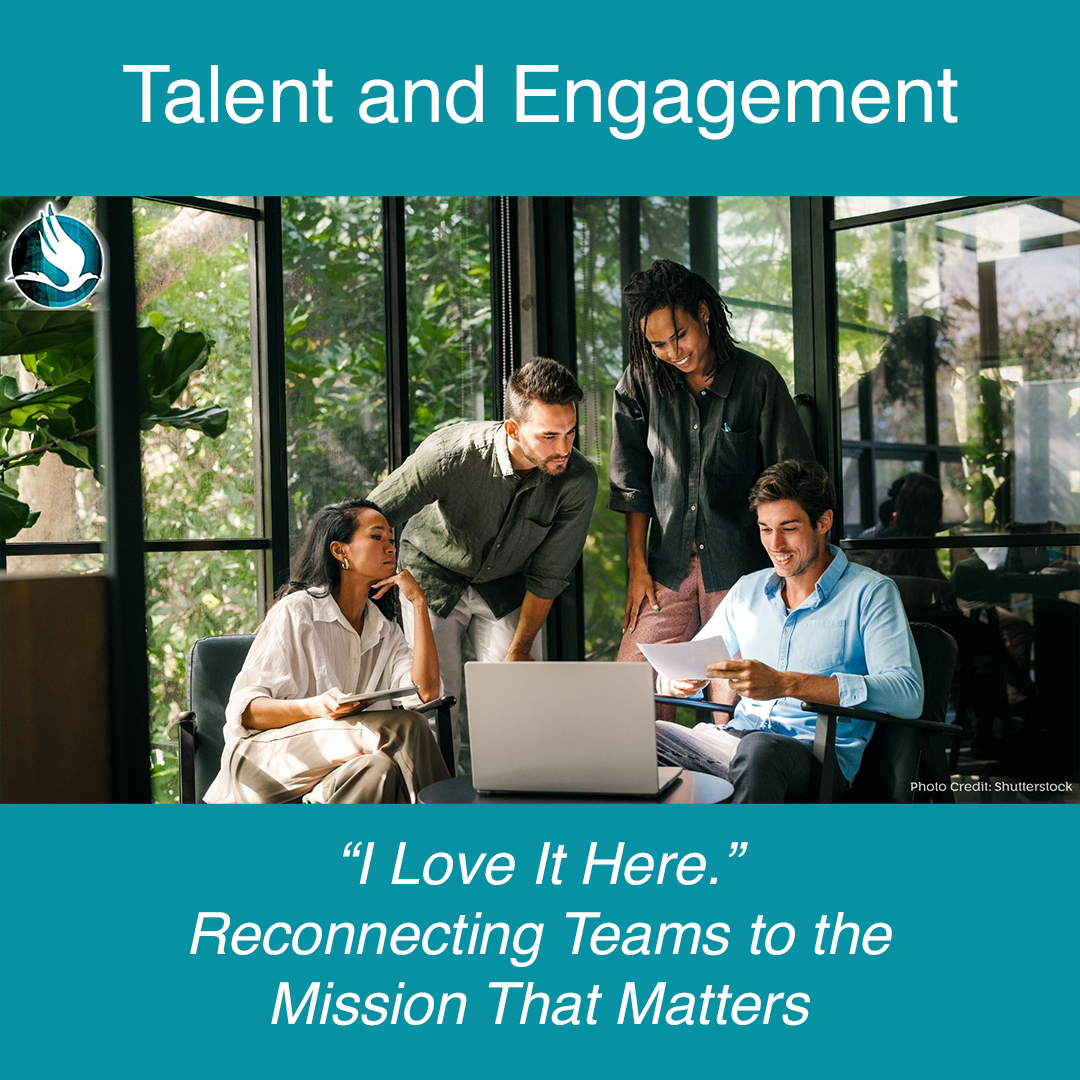
In most organizations, people care deeply about the work. They believe in the mission and want to contribute in meaningful ways. And yet, over time, connection begins to change. The work becomes heavier, the pace increases, and there is less room to influence how the work gets done. Gradually, people begin to feel further from the mission that once energized them.
When connection to purpose weakens, engagement does not disappear. People still show up, do the work, and meet expectations. But it changes form, and something important is missing.
You can feel it.
Discretionary effort declines, perspective narrows, and energy becomes more transactional than intentional. At this point, many organizations focus on motivation. But often, motivation is not the primary issue. Connection is.
People reconnect to purpose when they can see themselves in the work. That happens when their perspective is invited, their input is considered, and their voice has influence. Research from Gallup shows that employees who feel their opinions count at work are significantly more engaged and more likely to contribute at a higher level. This is not about recognition alone. It is about participation in shaping outcomes.
Organizations that sustain strong engagement take a different approach. They create conditions where people can actively contribute to the mission. This goes far beyond words. It shows up in simple, intentional ways such as inviting input before direction is finalized, creating space for respectful challenge, making it visible when contributions shape direction, and reinforcing that diverse perspectives strengthen outcomes. They rebuild the connection that stimulates inspired engagement.
And over time, a different sentiment begins to emerge.
“I love it here.”
Executive Reflection
Where might your team feel disconnected from the mission, even if performance remains strong? How consistently do you invite and incorporate diverse perspectives? What signals are leaders sending about whether it is safe and valuable to speak up?
Shared from MAY 2026 Issue of Thunderbird Leadership Consulting ELEVATE – Tbird’s Hub for Practical Leadership Insights.
Click on ‘Subscribe Today’ below so you can be a part of Thunderbird’s email community and never miss our monthly ELEVATE edition!
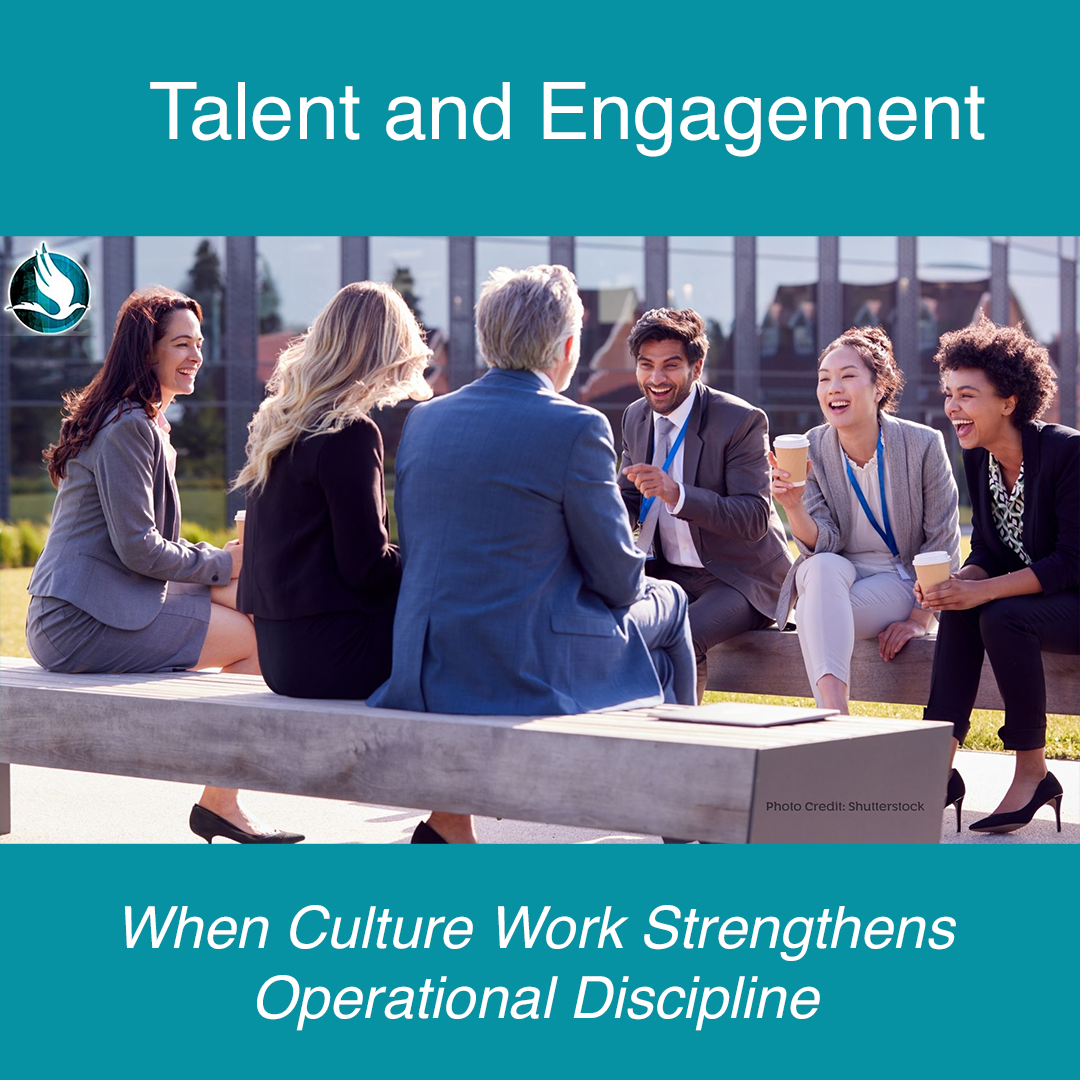
In reviewing recent client feedback, one theme surfaced consistently: our impact extends beyond shaping culture. It strengthens operational discipline.
That insight emerged alongside this reflection from a client: “Our engagement led to measurable improvements in team performance, communication, collaboration, and workflow.”
At first glance, culture and operations can feel like separate conversations. Culture is often associated with trust, values, and behavior. Operations are associated with structure, execution, and workflow. In practice, they are inseparable.
Culture work is operational work.
When leaders clarify expectations, define decision rights, strengthen accountability, and establish consistent communication rhythms, they are not only reinforcing culture. They are improving how work moves. Teams experience less friction. Priorities become clearer. Collaboration becomes more coordinated. Performance becomes more consistent.
This is where the familiar question emerges: does culture drive operational discipline, or does operational discipline reinforce culture?
The answer is both. The sequence matters less than the alignment.
Values without structure create inconsistency. Structure without shared values creates rigidity. When leadership methodology aligns expectations, behaviors, and systems, operational discipline becomes a natural byproduct of cultural clarity. It reduces the friction that slows execution and limits innovation.
What often appears as a culture issue is frequently a signal of operational misalignment.
What It Looks Like in Practice
Leaders often label challenges as cultural issues when the root cause is operational. Consider the shift:
Is it a lack of focus or unclear priorities?
Is it delayed execution, or unclear ownership?
Is it poor communication, or inconsistent communication rhythms?
Is it low accountability, or undefined expectations?
Is it resistance to change, or lack of clarity on what success looks like?
When these underlying elements are clarified, behaviors often shift quickly. What once felt like a cultural challenge is beginning to resolve through operational alignment.
The question shifts from “What is wrong with our culture?” to “Where is our system creating confusion?”
What Leaders Can Do Now
Identify one recurring workflow that feels inefficient and clarify ownership, expectations, and decision rights.
Examine whether current meeting rhythms reinforce clarity or introduce unnecessary noise.
Select one operational process and intentionally align it with a stated cultural value. Observe what changes.
The true measure of culture is how consistently systems reflect stated values. When alignment is present, trust strengthens, execution improves, and teams experience greater clarity in how work gets done.
Shared from APRIL 2026 Issue of Thunderbird Leadership Consulting ELEVATE – Tbird’s Hub for Practical Leadership Insights.
Click on ‘Subscribe Today’ below so you can be a part of Thunderbird’s email community and never miss our monthly ELEVATE edition!
During a leadership session with a rural hospital executive team, the CEO made a comment that stayed with me. She said that their leadership meetings were respectful and efficient, yet she had the sense that some of the most important thinking in the room was not always making its way into the discussion.
As we explored what she meant, she described a pattern she had started to notice. A decision would be discussed in the meeting, and everyone would appear aligned. Later in the week, a director might stop by her office and raise a concern. Another leader might mention a potential issue in a hallway conversation. None of these comments was intended to undermine the decision. They simply reflected perspectives that had not surfaced when the team was together.
What the CEO was observing was not a lack of professionalism or commitment. Her team cared deeply about the organization and about one another. In many cases, people were trying to be thoughtful about timing, respectful of colleagues, and mindful of the pace of the meeting. Their intention was to protect the working relationship and keep the team moving forward.
At the same time, those good intentions meant that valuable information sometimes arrived after the moment when it could most easily shape the decision.
Staying Present Through Tension We began experimenting with a simple change. As the conversations approached a conclusion, the CEO asked one additional question. She would pause and ask whether anyone saw a risk, trade-off, or perspective that the group had not yet explored. During the first few meetings, the room remained quiet, which is a normal response when a team is adjusting to a different expectation for dialogue. Eventually, one director spoke up about a staffing change discussed earlier in the meeting. The question led to a deeper conversation about scheduling, workload, and patient flow that had not yet been considered fully.
The quality of the discussion improved because the CEO responded with curiosity rather than defensiveness. She asked questions and invited others to build on the point. That response demonstrated that thoughtful disagreement was part of responsible leadership.
Understanding Conflict Styles A similar dynamic appeared in another organization I recently worked with. A regional operations team had been struggling with decisions that seemed to stall after meetings. When we looked more closely, the team realized that many members relied heavily on a single conflict style. Several leaders preferred to avoid tension when discussions became uncomfortable, while others tended to accommodate the direction that appeared to have the most support in the room.
We used the Thomas-Kilmann Conflict Mode Instrument to help the team explore their patterns. The TKI framework identifies five approaches people often use when navigating conflict: competing, collaborating, compromising, avoiding, and accommodating. None of these modes is inherently right or wrong. Each one can be effective depending on the situation. (Thomas & Kilman, 1974.)
What the team discovered was that they were using only a narrow portion of that range. Avoiding and accommodating helped them maintain positive relationships, but it also limited the depth of their conversations. As leaders became more aware of the different modes, they began experimenting with collaboration and constructive competition when a decision required deeper examination.
Over time, the meetings changed. Discussions sometimes took longer because leaders were willing to ask harder questions and test assumptions together. At the same time, decisions became clearer, and follow-through improved because the thinking behind them had been examined more thoroughly.
Brené Brown describes this kind of engagement as a “rumble.” She defines a rumble as a conversation in which people remain curious, assume positive intent, and work through challenges together rather than avoid them. The purpose of the conversation is not to win an argument. The purpose is to understand the issue well enough to move forward with clarity. (Brown, 2018.)
When leaders demonstrate that difference can be explored with respect and steadiness, several positive shifts occur. Teams begin to bring forward perspectives earlier. Decisions benefit from broader insight. Engagement increases because people see that their thinking influences outcomes. Trust strengthens because conversations happen in the open rather than in private follow-ups.
Leaders sometimes ask how to build stronger trust across their teams. One practical step is to make room for the full range of perspectives that already exists in the organization. When leaders remain present in moments of tension and respond with curiosity, they send a clear signal that differing viewpoints are a valuable part of strong leadership dialogue.
That experience builds confidence. Over time, people learn that raising a question or offering a different interpretation is not a disruption to the work. It is part of the leadership responsibility they share.
Reflection Before your next leadership conversation, consider where a broader range of perspectives might strengthen the discussion. Notice which conflict styles appear most often in your team and whether expanding that range might help the group examine important issues more fully.
Leaders who remain steady and curious during disagreement help their teams develop the confidence to stay in the conversation together.
References Brown, B. (2018). Dare to Lead: Brave Work. Tough Conversations. Whole Hearts. Random House. Thomas, K. W., & Kilmann, R. H. (1974). Thomas-Kilmann Conflict Mode Instrument.
Citations
Brown, B. (2018). Dare to Lead: Brave Work. Tough Conversations. Whole Hearts. Random House.
Thomas, K. W., & Kilmann, R. H. (1974). Thomas-Kilmann Conflict Mode Instrument.
Shared from March 2026 Issue of Thunderbird Leadership Consulting ELEVATE – Tbird’s Hub for Practical Leadership Insights.