Giving Feedback That Can Be Used
Early in my education, I came across a poster that made a lasting impression on me. Although the image has faded from memory, the words remain vivid: “Feedback is the breakfast of champions.” Like breakfast, however, feedback varies considerably in quality. Some is nourishing and energizing; some is barely adequate; and some leaves us wishing…

Early in my education, I came across a poster that made a lasting impression on me. Although the image has faded from memory, the words remain vivid: “Feedback is the breakfast of champions.”
Like breakfast, however, feedback varies considerably in quality. Some is nourishing and energizing; some is barely adequate; and some leaves us wishing we had skipped it altogether.
Haven’t we all experienced feedback that encouraged us, clarified our thinking, or helped us improve? We have probably also received comments that left us confused, discouraged, or unsure what to do differently.
The value of feedback lies not simply in what is said, but in whether the recipient can understand it, accept it, and use it.
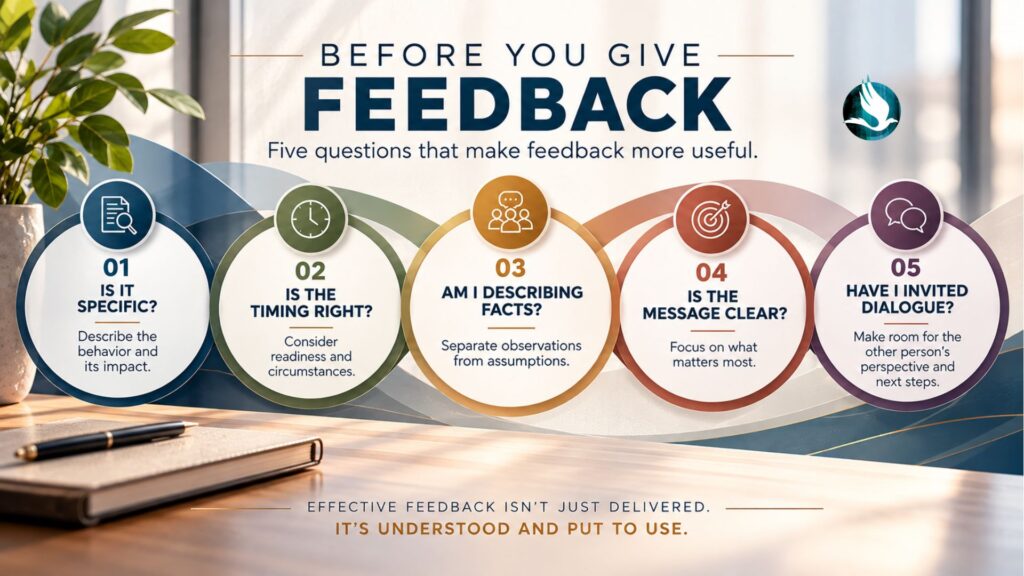
Whether offering recognition for work well done or addressing behavior that needs to change, the following principles can help make feedback more useful.
1. Offer Feedback in Context
Effective feedback begins with a clear description of the situation. Identify when and where something occurred, what the person did, and why it mattered.
Vague comments such as “Great job!” or “You need to communicate better” offer little guidance. Specific feedback helps individuals recognize behaviors worth repeating or changing.
Instead of: “You did a wonderful job leading that meeting.”
Try: “During yesterday’s meeting, you invited comments from people who hadn’t spoken and summarized the different viewpoints before the group made its decision. That helped everyone feel included and moved us toward agreement.”
The second statement identifies the behavior and explains its positive impact.
2. Make Sure It Is Timely
Feedback is generally most useful when delivered reasonably close to the event, while details are fresh and opportunities for improvement remain. However, timely does not always mean immediate. When emotions are elevated, allowing time for reflection may lead to a more productive conversation.
Consider the urgency, emotional climate, and recipient’s readiness. A brief acknowledgment in the moment may be appropriate, followed by a more thoughtful discussion later.
The goal is not simply to deliver feedback quickly, but to deliver it when it is most likely to be heard and used.
3. Be Clear and Check for Understanding
What we intend to communicate is not always what another person hears.
Avoid lengthy explanations, mixed messages, and vague suggestions. State the central point clearly, then invite the recipient’s perspective.
Rather than routinely asking someone to repeat your message, which can feel like a test, consider asking:
- “How does that fit with your understanding of what happened?”
- “What stands out to you from our conversation?”
- “What would be helpful as you think about next steps?”
These questions encourage dialogue and help identify misunderstandings.
This principle applies to positive feedback as well. People benefit from knowing exactly which behaviors contributed to success so they can repeat them.
4. Describe Observations Rather Than Judgments
One of the most important distinctions in effective feedback is the difference between describing what happened and interpreting what it means about a person. Observations are generally easier to discuss than judgments about personality, character, or attitude.
Instead of: “You were unprepared and disorganized.”
Try: “During the presentation, several figures were missing from the slides, and you needed additional time to locate the supporting information. Let’s talk about how to prepare those materials before the next meeting.”
Instead of: “You are always so negative about new ideas.”
Try: “During our last two planning meetings, you raised concerns about each proposed change before we had explored possible benefits. Your concerns may be important, but I’d like us to consider both opportunities and risks.”
Objective language does not require avoiding difficult truths. It means grounding those truths in observable evidence rather than personal labels.
5. Avoid Assuming Intentions
We can observe behavior, but we cannot automatically know the motives behind it.
A missed deadline might reflect competing priorities, unclear expectations, inadequate resources, or poor time management. Assuming that the person simply doesn’t care may lead to an inaccurate and unnecessarily confrontational discussion.
Instead of: “You obviously weren’t interested in completing this assignment.”
Try: “The report was submitted three days after the agreed deadline. I’d like to know more about what happened.”
The explanation may not excuse the outcome, but it can help identify the most appropriate response. Curiosity is not the same as avoiding accountability. We can seek to understand circumstances while maintaining clear expectations.
6. Be Intentional with Your Phrasing
When feedback involves a difficult message, preparation matters.
Before the conversation, identify the two or three points that are most important. Practice saying them aloud in language that is direct, respectful, and free of unnecessary qualifiers.
Avoid beginning with excessive praise simply to soften a criticism. The familiar “feedback sandwich”—praise, criticism, praise—can sometimes obscure the main message and make future compliments seem less sincere.
Instead, communicate your purpose openly:
“I’d like to discuss something that will help strengthen your next presentation.”
Or:
“I have a concern about how yesterday’s situation was handled, and I’d like us to work through it.”
The objective is to be candid without being harsh and supportive without being vague.
7. Appreciate Processing Limits
Feedback requires mental and emotional energy, especially when it challenges how someone sees their own performance. Too much information at once can overwhelm the recipient. A long list of shortcomings may produce discouragement rather than improvement.
Focus on the one or two changes most likely to make the greatest difference.
Pause periodically, invite questions, and allow time for reflection. For complex issues, consider separating the initial conversation from the planning discussion. Written follow-up can also help the recipient remember the key points.
Feedback is more useful when it can be processed, not merely delivered.
8. Choose a Favorable Setting
The setting can significantly influence how feedback is received. When possible, choose a setting that communicates respect and psychological safety.
Constructive feedback about sensitive matters should generally be offered privately, without interruptions or an audience.
Positive feedback may be appropriate publicly or privately, depending on the individual’s preferences and the circumstances. Some people enjoy public recognition; others find it uncomfortable.
Consider beginning with:
“Would now be a good time to talk about how the project went?”
An invitation to engage can make the recipient more receptive, provided the timing and urgency allow flexibility.
9. Be Direct About Severity
Not all feedback carries the same weight. Some conversations concern small adjustments. Others involve serious performance deficiencies, ethical concerns, or safety risks.
When the stakes are high, clarity is essential. Do not soften the message so much that the recipient fails to recognize its importance.
Instead of: “We might want to be a little more careful about following the procedures.”
Try: “The required safety check was not completed. This creates a significant risk and needs to be corrected immediately. Let’s review what happened and the steps necessary to prevent a recurrence.”
Being respectful does not mean minimizing consequences. At the same time, communicate the seriousness of the issue without attacking the person’s character or dignity.
10. Make Feedback a Two-Way Conversation
One of the most valuable improvements we can make is to stop thinking of feedback as something one person gives and another simply receives. Effective feedback invites participation.
After describing your observations, ask:
- “How do you see the situation?”
- “What challenges were you facing?”
- “What alternatives might work better next time?”
- “What support would help you succeed?”
Listening may reveal information that changes your interpretation or suggests a more effective solution.
A genuine exchange promotes ownership. Rather than feeling that a solution has been imposed, the recipient participates in identifying what to do next.
When feedback is offered with clarity, curiosity, and respect—and followed by opportunities to apply what has been learned—it becomes more than a conversation about performance. It becomes a practical investment in growth.
Conclusion
Feedback is only nourishing when it provides something the recipient can use. The true measure of effective feedback is not how skillfully it was delivered, but whether it helped someone learn, grow, or perform more effectively.
REAL CLIENTS. REAL RESULTS.
Effective feedback is elevated through deeper awareness of self and others. That's where Thunderbird's work with DiSC shines.
“I just went through the completion of a number of evaluations for my direct reports. Having their profiles DiSC) on hand allowed me to give more appropriate feedback but it also guided the way I gave the feedback. I had to have a tough conversation with a direct report. It went better than expected. I credit the knowledge I have on hand about the way they function in the team and the use of that to tailor feedback as the reason it went so well.”
Higher Education Leader
CONTINUE EXPLORING
Explore related topics.
BROWSE TOPICS
NEXT STEP
Sometimes the next useful step is a conversation.
Begin with what you are seeing. Together, we can clarify what deserves attention next.
Organizational capability is how sustainable performance is built.
Thunderbird perspectives help leaders look beyond the immediate issue to the organizational conditions shaping what happens next.
Thunderbird perspectives help leaders look beyond the immediate issue to the organizational conditions shaping what happens next.