What Strong Executive Teams Make Possible for the Organization
Executive team effectiveness is about more than how well senior leaders work together. Its greatest value may be found in what becomes possible throughout the organization because of how they lead together. Imagine an organization where leaders understand what matters most, decisions are made at appropriate levels, and departments coordinate their work without constant executive…

Executive team effectiveness is about more than how well senior leaders work together. Its greatest value may be found in what becomes possible throughout the organization because of how they lead together.
Imagine an organization where leaders understand what matters most, decisions are made at appropriate levels, and departments coordinate their work without constant executive intervention.
When new priorities emerge, leaders know how to examine competing demands and make thoughtful adjustments. Managers have the authority and support to exercise judgment. People understand how their responsibilities contribute to shared organizational outcomes.
And when circumstances change, the organization can respond without relying on a few individuals to personally resolve every challenge.
These are some of the possibilities created by effective executive leadership.
Organizations invest considerable time and resources in developing their executive teams. They work to strengthen relationships, improve communication, establish strategic direction, and develop the leadership capabilities of individual executives. These investments matter. Yet the greatest value of a strong executive team may not be found in how well its members function together.
It may be found in how much more effectively the organization functions because of them.
It’s a key point that deserves greater attention.
Executive team effectiveness extends beyond the executive suite
Every executive brings specialized expertise, experience, and responsibility to the leadership table. A chief financial officer contributes financial perspective, an operations executive brings knowledge of operational performance, and human resources leadership contributes expertise in workforce and organizational needs.
Each perspective is essential. But an organization does not become more effective simply because it employs highly capable executives. Collective effectiveness emerges through how leaders use their expertise together.
They understand their shared responsibility for organizational performance, consider decisions beyond their individual functions, address competing priorities, and coordinate the work necessary to achieve organizational goals. Research supports the importance of these collective practices.
In its October 2025 article, Demystifying Top-Team Performance: What Every CEO Needs to Know, McKinsey reported that companies with aligned, effective executive teams were almost twice as likely to achieve above-median financial performance, drawing on earlier research.
The article also presented an analysis of 354 executive-team members across 28 companies. Role clarity, shared purpose, innovative thinking, effective communication, recognition, and psychological safety showed some of the strongest associations with the team’s reported performance.
These findings are correlational, and the smaller study’s performance measures were based on executive-team assessments rather than independently verified organizational financial results. They nonetheless reinforce the importance of how executive teams work together.
There is also a broader consideration.
An executive team’s collective practices shape the conditions in which everyone else works.
How executives make decisions affects the authority others experience. How they establish priorities influences how departments coordinate their work. How they handle disagreements can shape the willingness of others to raise concerns. And how they develop leaders influences the organization’s capacity to function without depending on a small number of individuals.
The effectiveness of an executive team therefore deserves to be evaluated at two levels: how effectively the team works together and what its collective leadership enables throughout the organization.
Four outcomes help illustrate that distinction.
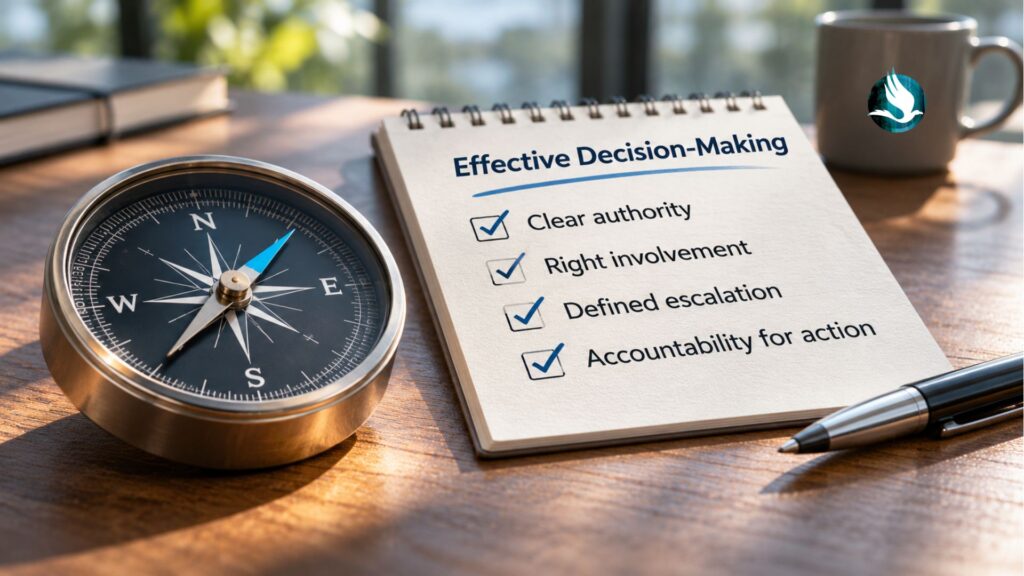
1. Decisions become clearer and more reliable throughout the organization
One of the most valuable things an executive team can establish is an environment where decisions are made with clarity, appropriate authority, and sound judgment.
Consider a department manager who needs to adjust an operational process involving another department.
In an organization with effective decision-making practices, the manager understands the authority associated with the role, whose expertise should be considered, and when additional approval or escalation is warranted. There are established ways to resolve questions that cross departmental boundaries.
The manager can act with confidence while remaining accountable for the decision.
This outcome begins with how the executive team approaches decision-making itself.
Executive leaders establish expectations around authority, participation, accountability, and escalation. They distinguish decisions that require collective deliberation from those that belong with individual leaders. They also recognize when governance, regulatory requirements, or risk considerations warrant additional review. The objective is not to eliminate oversight or make every decision faster. Some decisions require careful deliberation, and appropriate checks are essential.
The opportunity is to create decision-making practices that are proportionate to the importance, complexity, and consequences of the decision.
When those practices become established throughout the organization, leaders spend less time seeking unnecessary confirmation. Responsibilities become clearer, coordination becomes more predictable, and the executive team can devote greater attention to matters that genuinely require its involvement.
An important measure of executive-team effectiveness is not simply how well executives make decisions, but how effectively they enable appropriate decisions to be made throughout the organization.
2. Strategic priorities become coordinated organizational action
Most executive teams can identify their organization’s strategic priorities. The more consequential question is whether those priorities are consistently reflected in how work is organized and carried out.
Consider a healthcare organization seeking to improve patient access. Achieving that outcome may require coordinated contributions from clinical leadership, operations, finance, human resources, technology, and other functions. Each executive can understand and support the goal, yet effective implementation requires something more.
The team must establish how the different functions will contribute, where responsibilities intersect, what resources are required, and which competing commitments may need adjustment. When an unexpected staffing concern, financial constraint, or regulatory requirement emerges, executives need to examine the implications together rather than allowing each department to make disconnected adjustments. This is where effective executive teams create organizational value.
They establish shared priorities, clarify tradeoffs, and support consistent communication beyond the executive meeting. They ensure that organizational commitments translate into departmental expectations, coordinated decisions, and practical implementation.
That does not mean everyone must agree on every issue. Constructive disagreement can improve the quality of decisions when different perspectives are considered before commitments are established.
Alignment becomes meaningful when the organization can act on those commitments.
Research on team effectiveness reinforces the importance of these working conditions. In its article Go, Teams: When Teams Get Healthier, the Whole Organization Benefits, McKinsey examined 110 teams across multiple organizational levels. Its analysis highlighted trust, communication, innovative thinking, and decision-making as important factors associated with team performance, while also emphasizing the influence of team structure and context.
For executive leaders, the implications extend beyond encouraging collaboration. Organizations need practices that make coordination possible.
This may include clear cross-functional responsibilities, agreed decision pathways, reliable information sharing, and established ways to resolve competing demands.
The result is an organization better equipped to move from strategic intention to coordinated execution.
3. Leadership capacity grows beyond individual executives
An effective executive team also strengthens the organization’s ability to lead at multiple levels.
This is particularly important because organizations can become highly dependent on experienced executives without fully recognizing that dependence.
An executive may be exceptionally capable, deeply committed, and highly respected. That person may know the organization’s history, maintain important relationships, and routinely resolve challenges that others find difficult. These contributions are valuable.
But the organization also benefits when that executive’s knowledge, judgment, and effective practices are increasingly shared and supported throughout the leadership structure.
Executive teams help establish these conditions through their approach to leadership development, delegation, coaching, and accountability. Managers need more than assigned responsibilities. They need clarity about expectations, appropriate decision authority, access to relevant information, opportunities to exercise judgment, and feedback that helps them improve.
When executives consistently create these conditions, leadership development becomes more than an individual learning activity. It begins to influence how the organization functions.
Managers become better equipped to address challenges within their responsibilities. Department leaders develop stronger cross-functional relationships. More people gain the experience and confidence needed to contribute to complex decisions.
This does not eliminate the need for executive guidance. Rather, it allows that guidance to be directed where it adds the greatest value.
The benefits become particularly visible during transitions.
When a highly experienced executive retires or moves to another role, does important knowledge leave with that person? Do established relationships and decision processes keep functioning? Are other leaders prepared to carry forward critical responsibilities? An organization with greater leadership depth is better positioned to sustain effective practices through those changes.
The strength of an executive team can be reflected in the leadership capability it develops beyond itself.
4. Organizational performance becomes less dependent on extraordinary individual effort
Many organizations achieve impressive results because dedicated people work exceptionally hard.
Leaders intervene to prevent delays. Experienced employees find workarounds when processes do not function as intended. Teams make extraordinary efforts to meet commitments despite competing demands.
While these contributions deserve recognition, they can also reveal opportunities to strengthen how work gets done.
For example, a major initiative may be completed successfully because a senior executive personally coordinated multiple departments, resolved repeated questions, and monitored every critical step. The result is positive. But an effective executive team can also ask what the experience revealed about the organization’s existing practices.
Were responsibilities sufficiently clear? Did people have the information and authority they needed? Were cross-functional coordination mechanisms effective? Could some of the recurring interventions have been prevented through stronger processes?
These questions are not intended to diminish individual contributions. They help determine what the organization can learn from them. This is especially important when an executive team has experienced sustained success.
In October 2026, the Center for Creative Leadership published Moving Beyond the Plateau to Strengthen Senior Leadership Team Performance. Drawing on longitudinal team research and senior-team experience, the report examined how established working patterns can persist even when teams achieve positive results.
Its central insights emphasize sustained behavioral change, the importance of addressing conflict, and the opportunity to use outcomes as information for improving how teams work.
For executive leaders, the implication is significant. Strong results should not end the conversation about effectiveness. They can also provide evidence about what is working well, what deserves reinforcement, and where organizational practices could become more reliable. This requires environments where leaders can examine setbacks, question assumptions, and raise concerns constructively.
Amy Edmondson’s foundational 1999 research on psychological safety and learning behavior in work teams provides important support for this principle. Her study found that psychological safety was associated with learning behavior, reinforcing the importance of conditions that allow people to speak candidly and learn from experience.
When executive teams consistently model these practices, they create opportunities for similar behaviors to develop elsewhere in the organization. The long-term benefit is not an organization that no longer encounters challenges. It is an organization with stronger practices for recognizing, responding to, and learning from them.
What turns executive-team effectiveness into organizational capability?
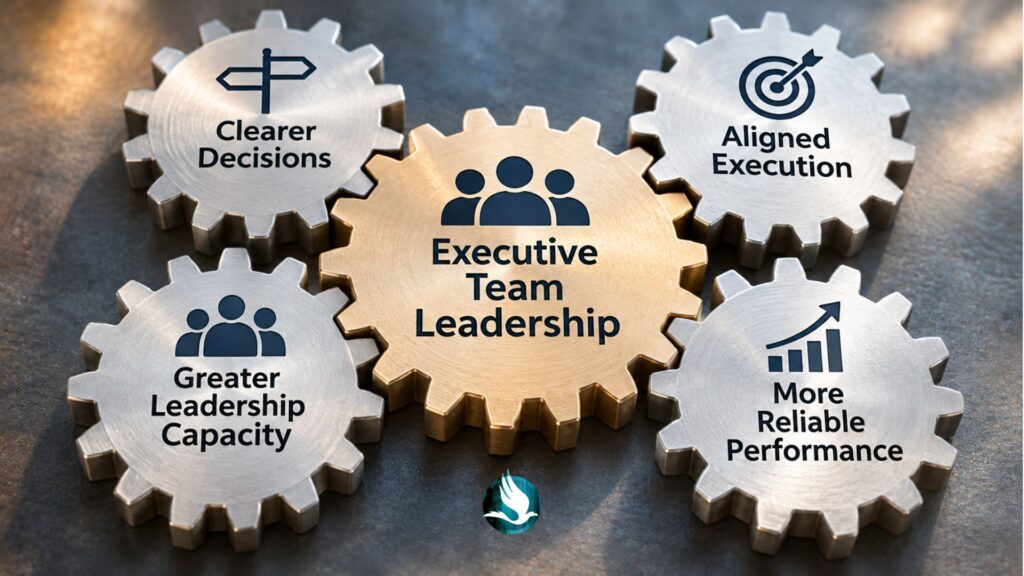
The four outcomes have something in common.
They depend on more than individual executives’ knowledge, relationships, or intentions. They require effective practices to extend beyond the executive team and become part of how work is accomplished throughout the organization.
That progression is important.
An executive team might establish a clear approach to decision-making. But unless managers understand the approach, exercise the intended authority, and receive consistent support, the practice may remain confined to the executive level. Likewise, executives might agree on organizational priorities without establishing how departments will coordinate responsibilities, adjust competing demands, or communicate changes.
Agreement within the executive team is only the beginning. Organizational capability develops when effective practices become established, reinforced, and increasingly reliable beyond the executive team.
This distinction is supported by foundational team research. Wageman, Hackman, and Lehman’s 2005 Team Diagnostic Survey: Development of an Instrument examined the conditions supporting team effectiveness, including how teams are structured, supported, and led.
The broader implication for organizational leaders is that effectiveness cannot be understood solely through individual behaviors or interpersonal relationships. The working conditions that support those behaviors matter as well.
For executive teams, this means paying attention to how collective leadership influences the organizational environment.
Are expectations clear? Does decision authority match responsibility? Are cross-functional relationships and processes supporting the work? Do leaders have opportunities to build judgment and capability? Are established practices sustained when circumstances change?
These questions connect executive-team development to organizational performance.
A more meaningful way to evaluate executive-team effectiveness
Executive teams often evaluate their effectiveness by considering communication, trust, relationships, meeting productivity, and the quality of collective decisions.
These are valuable indicators. But they provide only part of the picture. A more complete evaluation also examines what is happening in the organization because of the team’s leadership.
For example, consider four questions:
1. What decisions are others better equipped to make?
Look for evidence that managers understand their authority, exercise sound judgment, and know when collaboration or escalation is appropriate.
2. What organizational work is becoming more coordinated?
Examine whether shared priorities are translating into clearer responsibilities, more effective cross-functional relationships, and reliable implementation.
3. Where is leadership capacity becoming stronger?
Consider whether leadership development is translating into greater judgment, responsibility, continuity, and effectiveness throughout the organization.
4. What effective practices are becoming more reliable?
Identify processes and ways of working that are increasingly sustained without depending on extraordinary individual intervention.
The strongest answers are not necessarily found in executive-team self-assessments alone. They may also be found in organizational evidence, including leadership feedback, decision patterns, implementation results, cross-functional experiences, and the consistency of practices over time. The purpose is not to create an unnecessarily complicated measurement system. It is to understand whether executive-team effectiveness is producing meaningful benefits beyond the people sitting at the leadership table.
The greatest value of a strong executive team is what it makes possible
Executive teams have substantial influence over how their organizations operate. Their collective decisions, expectations, relationships, and leadership practices help shape the conditions experienced by managers, employees, and the people their organizations serve.
That influence creates an important opportunity.
Executive-team development can strengthen more than relationships and individual leadership behaviors. When effectively translated into organizational practices, it can contribute to clearer decisions, stronger alignment, greater leadership capacity, more reliable execution, and improved adaptability.
These outcomes do not happen automatically. They require intentional leadership, appropriate organizational conditions, and continued attention to how the work is actually accomplished.
But they represent a more consequential ambition for executive teams than simply functioning well together. A strong executive team should leave the organization increasingly capable of accomplishing what matters, even when individual leaders change, demands evolve, or unexpected challenges arise.
Perhaps the most important measure of executive-team effectiveness is not how well the team performs together, but what the rest of the organization becomes capable of doing because of it.
That is a conversation worth having in every executive suite.
References and further reading
- McKinsey & Company. (2025). Demystifying Top-Team Performance: What Every CEO Needs to Know.
- McKinsey & Company. (2024; updated 2026). Go, Teams: When Teams Get Healthier, the Whole Organization Benefits.
- Center for Creative Leadership. (2026). Moving Beyond the Plateau to Strengthen Senior Leadership Team Performance.
- Edmondson, A. (1999). Psychological Safety and Learning Behavior in Work Teams. Administrative Science Quarterly, 44(2), 350–383.
- Wageman, R., Hackman, J. R., & Lehman, E. (2005). Team Diagnostic Survey: Development of an Instrument. The Journal of Applied Behavioral Science, 41(4), 373–398.
REAL CLIENTS. REAL RESULTS.
One CEO said...
“Partnering with Thunderbird helped strengthen our leadership capacity and how we show up as a team. Our leaders have more confidence, clarity, and accountability, and we’re seeing the ripple effect across the organization.”
Kim Després Chief Executive Officer, Circle the City
CLIENT PERSPECTIVE
Hear from the leaders we support.
See how Thunderbird’s work translates into the experiences of leaders and organizations we serve.
CONTINUE EXPLORING
Explore related topics.
BROWSE TOPICS
NEXT STEP
Sometimes the next useful step is a conversation.
Begin with what you are seeing. Together, we can clarify what deserves attention next.
Organizational capability is how sustainable performance is built.
Thunderbird perspectives help leaders look beyond the immediate issue to the organizational conditions shaping what happens next.
Thunderbird perspectives help leaders look beyond the immediate issue to the organizational conditions shaping what happens next.