Future-Proofing Your Organization Starts With Capability
The future will ask different things of your organization. Are you building the capacity to respond? Organizations spend considerable time preparing for the future. Executive teams develop strategic plans, establish priorities, evaluate emerging technologies, examine workforce needs, and consider how changing economic and industry conditions may affect their organizations. These are necessary responsibilities and yet…

The future will ask different things of your organization. Are you building the capacity to respond?
Organizations spend considerable time preparing for the future.
Executive teams develop strategic plans, establish priorities, evaluate emerging technologies, examine workforce needs, and consider how changing economic and industry conditions may affect their organizations.
These are necessary responsibilities and yet there is another question that deserves just as much executive attention.
Is the organization itself becoming more capable of responding to what comes next?
Not simply whether its executives are experienced, its leaders are well trained, or its employees possess the right skills.
But whether the organization has developed the collective capacity to make decisions, coordinate work, adapt its practices, and maintain effective performance when circumstances change.
That distinction may be one of the most important considerations in future-ready leadership.
When Today’s Success Depends on Yesterday’s Conditions
Consider an organization that has performed reasonably well for years.
Its executives understand the business. Its managers know their responsibilities. Its employees are committed to the mission. The organization has developed familiar ways of getting things done, and many of those practices have served it well.
Then conditions begin to change.
Workforce demands become more complex. Technology introduces new possibilities and expectations. Resources become tighter. Customers, patients, students, or communities have evolving expectations. Decisions that once seemed straightforward now affect more people, processes, and priorities and carry more weight.
The organization responds by asking its leaders to work harder, communicate more, make decisions faster, and manage increasing complexity. For a while, that approach may work.
But eventually, familiar challenges begin to surface.
More decisions require executive attention. Departments interpret priorities differently. Leaders struggle to balance immediate demands with longer-term development. Improvements happen, but maintaining them requires considerable individual effort.
The organization still talented people and day to day work feels harder than it should.
What may not have evolved sufficiently is the organizational capability needed to support them.
The Difference Between Having Capable Leaders and Building a Capable Organization
For years, organizations have relied on leadership competencies to create shared understanding of leadership requirements. Leadership competency still matters.
More than ever, these same organizations need leaders with strong judgment, effective communication skills, strategic awareness, and the ability to guide others through uncertainty.
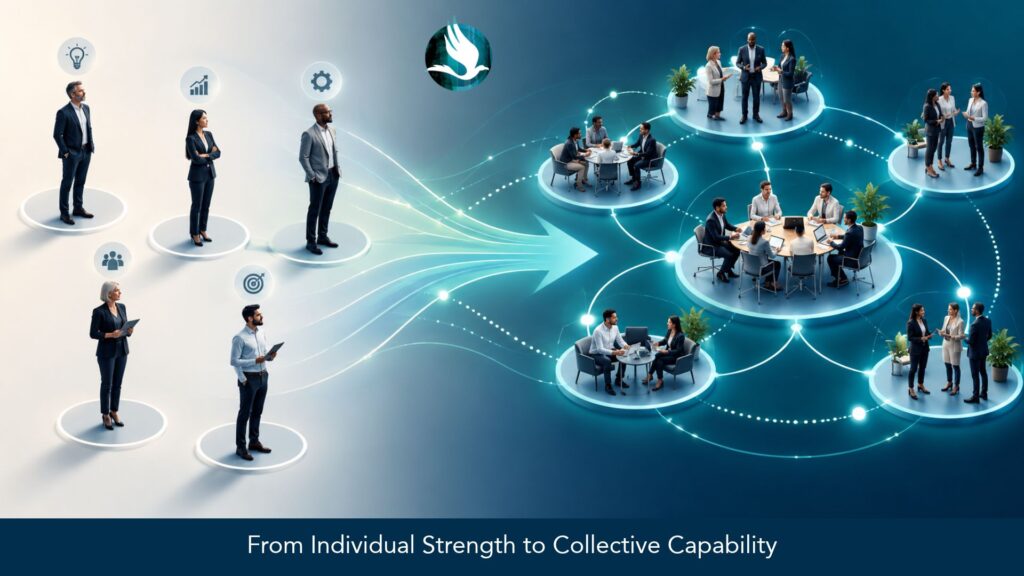
But organizational capability involves something broader. It speaks to the collective capacity of an organization to accomplish work through coordinated people, practices, processes, and resources.
Consider decision-making.
An organization may have executives who make sound decisions individually. Yet if authority is unclear, information moves inconsistently, or implementation responsibilities are poorly coordinated, the organization may still struggle to act effectively.
Or take accountability for example.
A leadership team may understand the importance of clear expectations and follow-through. But when organizational processes do not consistently reinforce ownership, monitor commitments, or address competing priorities, accountability becomes dependent on individual leaders rather than an established organizational practice.
The issue is not necessarily a lack of leadership competency. At times, the missing piece is the organization has not developed the collective systems and practices that allow those competencies to contribute consistently to organizational performance.
A capable organization creates the conditions through which effective leadership can have a broader and more lasting impact.
Future Readiness Goes Beyond Predicting What Comes Next
Executive teams cannot anticipate every change their organizations will encounter. They can, however, influence how prepared their organizations are to recognize and respond to changing conditions.
This is an important principle in
Strategic management scholar David Teece and colleagues established research on dynamic capabilities. They examined how organizations recognize emerging opportunities and threats, mobilize resources, and reconfigure practices to respond to changing environments.
The implication for executives is significant.
Future readiness involves developing the organizational capacity to reconsider and adjust strategy as circumstances evolve.
An organization that gathers useful information but struggles to translate it into decisions may recognize change without responding effectively. An organization that makes timely decisions but cannot coordinate implementation may establish direction without achieving the intended results. An organization that adapts through repeated extraordinary effort may accomplish immediate goals while placing increasing pressure on its people.
These examples reveal why organizational capability is a strategic concern evaluating whether the practices that support effective response are becoming part of how the organization works.
What Executive Teams Can Look For
When considering organizational readiness, I would encourage executives to look beyond strategic plans and leadership competency inventories.
Three questions are particularly useful.
Q1 – What works well because of our systems, and what works because certain people make it happen?
Every organization relies on committed and capable individuals. Yet, there is a meaningful difference between an executive who regularly intervenes to resolve cross-functional problems and an organization with established practices for resolving those problems effectively.
The first may produce results. The second develops a more reliable organizational capacity.
Executive involvement is sometimes essential. The concern arises when routine organizational functioning consistently requires extraordinary individual intervention.
Where does work move smoothly because responsibilities, relationships, and practices are well established? Where does progress depend on a particular person stepping in?
Those answers can reveal opportunities to strengthen organizational capability.
Q2 – Are our collective practices keeping pace with changing demands?
Organizations often add responsibilities, technologies, initiatives, and expectations without reconsidering the practices through which work gets done. The result can be increasing complexity layered onto operating systems that were designed for a different environment.
Decision processes that once worked well may now create delays. Communication practices may no longer reach the right people at the right time. Accountability processes may reinforce priorities that have already changed.
These challenges are not necessarily signs of ineffective leadership. They may indicate that organizational practices need to evolve.
Executive teams should periodically examine whether their decision-making, coordination, learning, and accountability practices remain appropriate and effective for the work the organization must accomplish today.
Q3 – Are we developing the capacity to adapt, or becoming better at reacting?
There will always be unexpected demands. The distinction is how an organization learns from its responses.
For example, when priorities shift, do leaders communicate what has changed and why? When an initiative encounters difficulty, does the organization examine the underlying conditions or ask people to try harder? When teams discover a more effective approach, does that learning remain local, or does it influence broader organizational practice?
Organizations strengthen their adaptive capacity when learning becomes connected to decisions, processes, and future action. Otherwise, the risk of solving similar problems repeatedly without changing the conditions that allow those problems to recur becomes real.
Building Capability Is a Strategic Executive Responsibility
Organizational capability is not something executives can fully delegate to human resources, organizational development, or individual department leaders. Those functions can play essential roles in assessment, development, and implementation. But many of the conditions that shape organizational capability require executive attention.
Decision authority, strategic priorities, resource allocation, leadership expectations, cross-functional relationships, and organizational governance are influenced by the choices executive teams make.
As a result, developing organizational capability requires executives to examine how the organization actually functions. That examination may reveal areas where individual development is needed. It may also reveal opportunities to improve operating practices, clarify responsibilities, strengthen coordination, or establish more effective systems for learning and accountability.
Often, meaningful improvement requires both.
What’s the objective? It is to establish the appropriate collective practices and conditions for effective performance while retaining the flexibility to adapt when necessary.
The Future-Ready Organization Is Being Built Today
Future-proofing does not mean becoming immune to disruption. No organization can guarantee that its people, resources, systems, and strategies will remain sufficient for every future challenge.
But executives can make deliberate choices about the organizational capabilities they strengthen today.
They can reduce unnecessary dependence on individual intervention. They can establish clearer decision rights and more consistent accountability practices. They can strengthen how information is shared, how departments coordinate, how leaders develop others, and how organizational learning influences action. And they can examine whether the organization’s existing ways of working remain suitable for the demands ahead.
These choices matter because organizational capability develops through practice.
It is strengthened not only through what leaders intend, but through what the organization repeatedly does.
The future-ready organization is not simply the one with the most capable people. It is the one intentionally developing the collective capacity to respond, perform, and adapt as conditions change.
An Executive Reflection
At your next executive leadership meeting, consider three questions:
- Where is our current performance too dependent on particular people rather than established organizational practices?
- Which organizational processes or practices have not kept pace with the demands we now face?
- What one collective capability, if strengthened over the next six months, would improve our ability to respond to future challenges?
The answers may reveal an opportunity that is more consequential than another initiative.
They may reveal where the organization itself needs to become more capable.
Explore the research:
For a deeper examination of competency, individual capability, and organizational capability, read Thunderbird’s companion article, Competency vs. Capability: Understanding the Difference and Why It Matters for Organizational Performance.
Selected Research
Teece, D. J., Pisano, G., & Shuen, A. (1997). Dynamic capabilities and strategic management. Strategic Management Journal, 18(7), 509–533. Read the research.
Teece, D. J. (2007). Explicating dynamic capabilities: The nature and microfoundations of (sustainable) enterprise performance. Strategic Management Journal, 28(13), 1319–1350. Read the research.
REAL CLIENTS. REAL RESULTS.

From Thunderbird's Executive Teaming to Department-Level Collaboration
In a healthcare organization, an executive leader adapted practices developed through executive teaming to bring together two interdependent departments experiencing communication challenges. The approach helped strengthen relationships and collaboration across the departments.
Healthcare | De-identified Client Story
CONTINUE EXPLORING
Explore related topics.
BROWSE TOPICS
NEXT STEP
Sometimes the next useful step is a conversation.
Begin with what you are seeing. Together, we can clarify what deserves attention next.
Organizational capability is how sustainable performance is built.
Thunderbird perspectives help leaders look beyond the immediate issue to the organizational conditions shaping what happens next.
Thunderbird perspectives help leaders look beyond the immediate issue to the organizational conditions shaping what happens next.