Competency vs. Capability: Understanding the Difference and Why It Matters for Organizational Performance
Why developing capable people is essential, and why sustainable organizational performance requires something more. Organizations invest considerable resources in developing their people. Leaders participate in development programs, pursue certifications, strengthen technical expertise, and build the competencies associated with effective performance. These investments matter. Organizations need knowledgeable, skilled, and effective leaders. Yet an important question often…
Why developing capable people is essential, and why sustainable organizational performance requires something more.
Organizations invest considerable resources in developing their people. Leaders participate in development programs, pursue certifications, strengthen technical expertise, and build the competencies associated with effective performance.
These investments matter. Organizations need knowledgeable, skilled, and effective leaders.
Yet an important question often receives less attention:
How does the organization become more capable as its people become more competent?
Consider an organization with experienced executives, well-trained managers, and highly skilled employees. Despite those strengths, decisions repeatedly escalate, departments struggle to coordinate priorities, accountability varies across teams, and important improvements depend on a few individuals making extraordinary efforts.
The organization may have considerable individual talent and still experience limitations in how effectively it operates.
Understanding why requires looking beyond individual proficiency to the collective practices, relationships, structures, and systems through which organizations accomplish their work.
This is where the distinction between competency and organizational capability becomes especially important.
What Is Competency?
Competency is generally understood as an integrated combination of knowledge, skills, abilities, and behaviors that supports effective performance in a particular role or area of practice.
The precise definition varies across professional disciplines, but contemporary competency frameworks consistently extend beyond knowledge alone.
For example, the Society for Human Resource Management’s Body of Applied Skills and Knowledge (SHRM BASK) identifies behavioral and technical competencies associated with effective professional practice. The framework includes observable proficiency and applied performance.
Leadership competencies commonly include:
- Communication and interpersonal effectiveness
- Decision-making and judgment
- Strategic thinking
- Conflict management
- Coaching and developing others
- Ethical leadership
- Change leadership
- Collaboration and relationship management
These competencies describe important dimensions of effective individual performance.
A leader who can facilitate a difficult conversation, navigate competing priorities, and provide meaningful developmental feedback demonstrates competencies through behavior, not simply through an understanding of leadership principles. This distinction matters because competency should not be reduced to what someone knows.
Competency includes the ability to demonstrate effective practice.
Organizations have good reason to invest in competency development. Individual proficiency is essential to organizational functioning. However, competency frameworks primarily help establish what effective performance requires of people in defined roles. They do not necessarily tell us whether the organization has established the collective conditions and practices needed to perform consistently.
That brings us to capability.
What Is Capability?
Capability is a broader term used across several disciplines, including organizational development, management, education, strategic management, and human resources.
Its meaning depends partly on the context and the level being examined.
At the individual level, capability generally concerns a person’s capacity to act effectively within relevant circumstances, drawing upon competencies, judgment, experience, and available resources.
Some research perspectives also emphasize potential, recognizing that what someone is capable of accomplishing may extend beyond what they have already demonstrated. This distinction is particularly relevant to leadership development. A leader may possess the foundational competencies, judgment, and learning capacity to assume greater responsibility but have limited opportunities to demonstrate those abilities in their current role.
The absence of demonstrated performance in a particular situation does not necessarily indicate the absence of capability. Similarly, an individual may demonstrate strong proficiency in familiar circumstances while having additional capacity that has not yet been developed or fully expressed.
One influential perspective comes from economist and philosopher Amartya Sen’s capability approach, which distinguishes between the genuine opportunities available to individuals and the outcomes they actually achieve. Although developed primarily within human development and well-being research, this perspective reinforces an important conceptual point: capability need not be limited to already demonstrated performance.
Within leadership and talent development, this invites consideration of both current effectiveness and the capacity for future growth.
Individual leadership capability, therefore, can be understood as a leader’s capacity to exercise effective leadership within the demands and conditions of their role, including abilities that may be further developed or expressed as opportunities and responsibilities change.
A capable leader may draw upon communication, decision-making, emotional intelligence, and strategic thinking competencies to navigate complex organizational responsibilities. That same leader may also possess potential that extends beyond the requirements of their current position.
There is substantial conceptual overlap between individual competency and individual capability. Different frameworks sometimes use the terms interchangeably, while others emphasize demonstrated proficiency, capacity, or future potential differently. For this reason, describing capability as a universally higher stage of competency development is not particularly useful.
Competency helps us understand the proficiency people bring to their work. Individual capability invites consideration of what they have the capacity to accomplish, including potential that may not yet be fully realized.
Both are important to developing effective leaders.
A more meaningful distinction emerges when we shift from the individual to the collective organization.
What Is Organizational Capability?
Organizational capability is the collective capacity of an organization to perform specific activities reliably through coordinated people, practices, processes, and resources.
This definition emphasizes an important reality: organizations accomplish work through systems of interdependent activity.
Individual competencies contribute to those activities, but organizational functioning also depends on how people coordinate, how responsibilities are distributed, how information moves, how decisions are made, and how practices are reinforced.
Organizational capability is therefore more than the sum of individual talent.
Consider decision-making. An organization may employ leaders with strong analytical skills, sound judgment, and considerable experience. Yet effective organizational decision-making also requires:
- Clarity about who has authority to make which decisions
- Access to relevant information and perspectives
- Appropriate decision timeframes
- Coordination when decisions affect multiple teams
- Clear translation of decisions into implementation responsibilities
- Processes for evaluating outcomes and applying lessons learned
A weakness in any of these areas can affect how decisions move through the organization, even when individual leaders are highly competent.
The organizational question extends beyond whether leaders can make good decisions. It asks whether the organization has established the collective capacity to make, communicate, implement, and learn from decisions effectively.
This same distinction applies to communication, accountability, strategic alignment, learning, and leadership development. These are not simply individual activities. They are organizational practices that depend upon multiple people and systems working together.
Why Competency and Organizational Capability Are Not the Same
Competency and organizational capability are closely related, but they answer different questions.
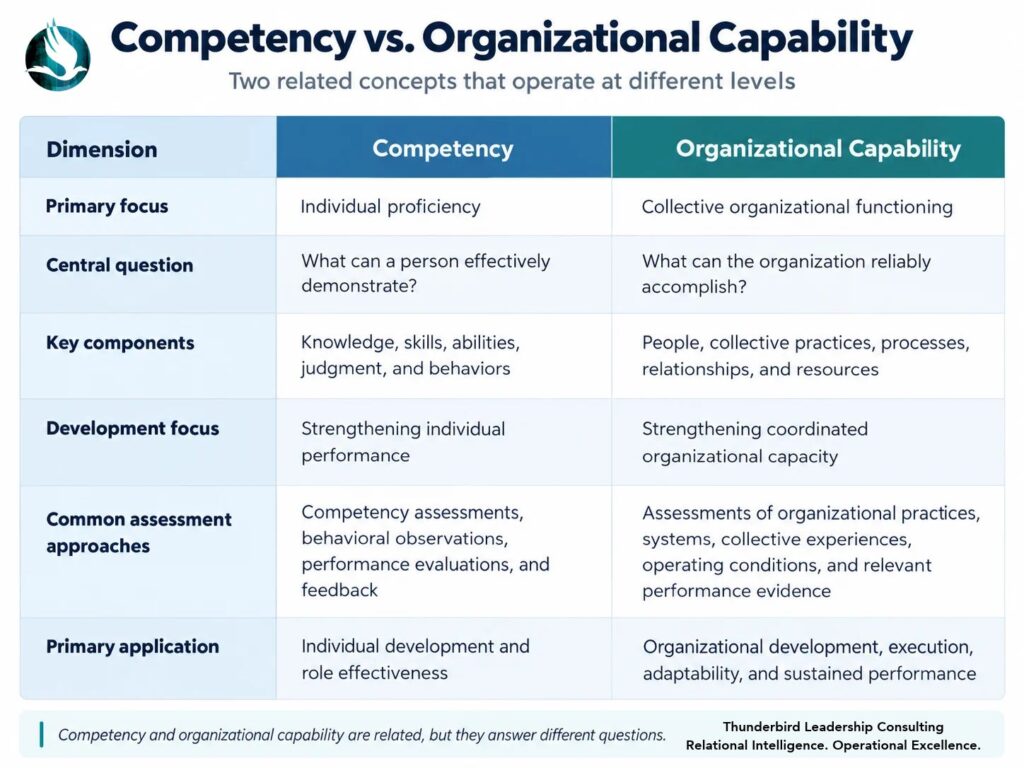
Neither construct replaces the other.
Organizational capability depends in part on what people know and can do. Individual competencies become organizational assets when they are supported, coordinated, and incorporated into organizational systems.
Conversely, even highly competent employees can struggle to achieve collective results when organizational practices or systems make coordinated execution difficult.
The distinction is especially relevant when organizations attempt to address recurring performance challenges through individual development alone.
Why Leadership Development Does Not Automatically Produce Organizational Capability
Leadership development is an important investment in organizational performance.
However, an effective learning experience does not automatically produce sustained changes in the organizational environment.
This is not a new concern.
In their foundational 1988 review of training transfer, Timothy Baldwin and J. Kevin Ford examined the conditions influencing whether learning is generalized to the workplace and maintained over time.
Their work emphasized the importance of learner characteristics, training design, and the work environment.
Subsequent research, including a 2010 meta-analysis by Brian Blume and colleagues, further examined how factors such as motivation, cognitive ability, and a supportive work environment relate to training transfer.
The implications extend well beyond formal training programs. Imagine an organization investing in leadership development focused on delegation and accountability. Participants learn how to clarify responsibilities, establish expectations, provide feedback, and hold productive accountability conversations.
They return to departments where decision authority remains unclear, senior leaders regularly reclaim delegated responsibilities, priorities change without coordinated discussion, and performance reviews focus heavily on immediate results.
The individual leaders may have strengthened their competencies. But the organization has not necessarily strengthened the conditions needed for those competencies to become consistent collective practice. This example illustrates why leadership development and organizational development are complementary.
Leadership development strengthens the people responsible for leading. Organizational development examines and strengthens the collective arrangements through which those people work.
The greatest value often comes from connecting the two.
Organizational Capability Lives in Collective Practices
Organizations develop recognizable ways of working.
Some are formal, such as policies, governance structures, defined responsibilities, planning processes, and performance review systems. Others are informal, including how people resolve disagreements, share information, escalate concerns, interpret expectations, and coordinate across departments.
Over time, these repeated activities become part of the organization’s operating reality.
Research on organizational routines and capabilities helps explain why these patterns matter.
Strategic management scholar Sidney Winter distinguished ordinary capabilities, which enable organizations to conduct ongoing activities, from dynamic capabilities, which enable them to modify, extend, or create those capabilities.
The underlying principle is significant: organizational capability involves patterns of coordinated activity that can be developed and sustained.
For example, consider an organization that consistently learns from operational problems. When a problem occurs, teams examine what happened, identify relevant contributing factors, share lessons across functions, and adjust practices. Learning becomes part of how the organization operates.
Now consider another organization where equally capable individuals identify similar problems, but their insights remain within departments, corrective actions are inconsistently communicated, and lessons are lost when employees leave.
Both organizations may have knowledgeable people. Only one has established a more reliable collective learning practice. This is why organizational capability cannot be understood solely through individual competency inventories.
We must also examine the practices and conditions that connect individual contributions into collective results.
The Role of Psychological Safety, Trust, and Organizational Conditions
Organizational capabilities do not operate independently of the environment in which people work.
Shared expectations, relationships, leadership practices, resources, and working conditions influence whether people can coordinate effectively.
Psychological safety provides one well-established example.
Amy Edmondson’s research on psychological safety and team learning identified psychological safety as a shared belief that a team is safe for interpersonal risk-taking. Her 1999 study connected team psychological safety with learning behavior.
Psychological safety is not identical to organizational capability. It is an important condition that can support practices such as speaking up, asking questions, discussing mistakes, and challenging assumptions.
The same distinction applies to trust, role clarity, access to information, and opportunities to collaborate. These conditions can enable or constrain the activities through which capabilities operate. An organization may have strong processes for gathering feedback, for example, but struggle to translate feedback into change when employees do not believe concerns will be considered seriously. Similarly, a leadership team may have formal decision-making processes but experience weak execution when cross-functional relationships make coordination difficult.
Understanding organizational capability therefore requires attention to both what the organization does and the conditions that make those activities possible.
Ordinary Capabilities and Dynamic Capabilities: Why the Future Matters
Organizational capability becomes especially important when we consider an organization’s ability to respond to changing conditions.
The dynamic capabilities perspective, associated with David Teece, Gary Pisano, Amy Shuen, and subsequent scholarship, examines how organizations integrate, develop, and reconfigure resources and competencies in changing environments.
An important distinction exists between capabilities that support current operations and capabilities that help organizations adapt.
An organization needs reliable processes for making decisions, coordinating work, delivering services, and managing resources. These ordinary organizational capabilities help it function today. But organizations must also recognize emerging conditions, respond to changing demands, learn from experience, and adjust how their resources and practices are organized.
These adaptive capacities become particularly important during periods of uncertainty.
Consider healthcare organizations navigating changes in workforce availability, technology, reimbursement, and patient needs. Or higher education institutions responding to changing student expectations, emerging technologies, and financial pressures. Or nonprofit organizations balancing increasing community demand with constrained resources.
The ability to respond effectively depends on more than the competence of individual executives.
It also depends on whether the organization can interpret emerging information, reconsider assumptions, make coordinated decisions, shift priorities, develop new practices, and preserve what continues to work.
Future readiness is not simply having the right people for today’s responsibilities. It also involves developing the collective capacity to respond when tomorrow’s responsibilities change.
No organization can eliminate uncertainty.
Organizations can, however, intentionally strengthen the capabilities through which they recognize, navigate, and adapt to it.
Capability and Organizational Performance: An Important Distinction
Capability and performance are related, but they are not identical.
Capability concerns the organization’s capacity to accomplish particular activities.
Performance concerns what actually happens, including operational results, workforce outcomes, service quality, mission achievement, and other measures of organizational effectiveness.
An organization may have well-developed capabilities and still encounter significant external constraints. Conversely, an organization may produce strong short-term results through extraordinary individual effort, favorable circumstances, or temporary workarounds without establishing reliable practices that support continued performance.
This distinction is especially important when evaluating organizational sustainability. A team may achieve an ambitious initiative because one highly capable executive personally coordinates every decision. The result may be successful. But what happens when that executive becomes unavailable, changes roles, or faces several competing priorities?
If the organization has not established clear decision rights, shared information, coordinated accountability, and other supporting practices, the success may remain highly dependent on that individual.
Developing organizational capability involves examining whether effective performance can be supported through collective practices rather than relying exclusively on particular people or exceptional effort.
This does not eliminate the importance of individual leadership.
It creates the conditions through which individual leadership can contribute to broader and more durable organizational effectiveness.
How Can Organizations Assess Their Capabilities?
Organizational capability can be examined through several complementary forms of evidence.
Structured organizational assessments can evaluate how leaders and employees experience the practices, systems, and conditions that influence work. Qualitative interviews and facilitated discussions can reveal how decisions, responsibilities, communication, and coordination function in daily practice. Operational information can provide additional perspective on work processes and outcomes. The purpose is to develop a useful understanding of how the organization currently operates.
For example, an assessment of organizational decision-making capability might examine whether:
- Decision ownership and authority are clear.
- Decisions occur within timeframes that support execution.
- Relevant information is incorporated into significant decisions.
- Implementation responsibilities are understood.
- Decisions are appropriately distributed.
- Outcomes are evaluated and lessons are applied.
Together, these dimensions provide meaningful information about the organization’s current decision-making practices and capacity. Perceptions from people who regularly participate in organizational work are valuable evidence. They reveal patterns that may not be apparent from formal structures or performance measures alone.
The most useful assessment approaches move beyond isolated ratings to examine relationships among findings. For instance, a organization might report relatively strong decision timeliness but weaker decision ownership and implementation clarity. That pattern raises a more useful organizational question than whether the overall decision-making score is high or low.
It invites exploration of whether decisions are being made efficiently while the responsibilities needed to execute them remain insufficiently coordinated.
Effective organizational assessment should help leaders identify meaningful strengths, examine potential constraints, and determine where additional attention may improve organizational functioning.
Building Organizational Capability Requires Intentional Development
Organizational capability does not emerge automatically because employees gain experience or leaders complete development programs It develops through the interaction of people, practices, and organizational conditions. Several considerations can guide the work.
Strengthen individual proficiency in ways that connect to organizational priorities: Develop the knowledge, skills, judgment, and behaviors leaders need while creating opportunities to apply them to actual organizational demands.
Examine how collective work occurs: Pay attention to decision-making, coordination, communication, accountability, and the routines that connect teams and departments.
Identify organizational conditions that support or constrain effective practice: Review authority, role clarity, resources, relationships, reinforcement, and other conditions that shape how work gets accomplished.
Build learning and adaptation into everyday operations: Establish practices for gathering information, evaluating outcomes, incorporating lessons, and adjusting processes as circumstances evolve.
Evaluate capability through patterns, not isolated successes: Consider whether important practices function consistently, across relevant parts of the organization, and without excessive dependence on individual intervention.
These considerations are relevant across industries, organizational sizes, and stages of development. They are especially consequential in complex organizations where work is highly interdependent and performance depends upon coordinated activity across multiple leadership levels and functions.
The Leadership Question Is Becoming an Organizational Question
For years, organizations have rightly emphasized the importance of developing strong leaders. That emphasis remains essential.
But as organizational environments become more interconnected, technologically complex, and difficult to predict, leadership development must be considered within the broader system in which leaders work.
An organization needs more than leaders who can communicate effectively. It needs communication practices that support shared understanding across departments and levels.
It needs more than leaders who demonstrate accountability. It needs collective expectations and operating practices that support ownership and follow-through.
It needs more than leaders who can make sound decisions. It needs decision processes that allow appropriate authority, judgment, and coordination to function throughout the organization. And it needs more than leaders who can manage change. It needs an organizational capacity to learn, adapt, and renew its practices as conditions evolve.
These are organizational capability questions.
They shift the conversation from individual proficiency alone to the collective capacity for performance. They also encourage executives to examine organizational challenges with greater precision.
When performance becomes inconsistent, the question is not always whether people need additional training. Sometimes the more useful question is whether the organization has established the conditions and collective practices necessary for people to succeed.
A More Complete View of Organizational Performance
Competency and organizational capability are not competing priorities.
Individual competencies are essential contributors to effective organizational functioning. Organizational capabilities emerge through the ways people, practices, processes, and resources are coordinated to accomplish shared work.
Both matter.
At Thunderbird Leadership Consulting, we approach organizational capability as a central consideration in organizational performance. Our work connects leadership development, executive and leadership teaming, organizational assessment, coaching, and targeted organizational development to help organizations strengthen the practices and conditions through which people achieve meaningful results.
The central opportunity for organizations is not simply to develop more capable individuals. It is to consider how individual strengths become collective organizational capacity.
As leaders look toward the future, that distinction deserves increasing attention.
The question is not only whether your people are prepared for what comes next. It is whether your organization is developing the collective capability to respond, perform, and adapt together.
Research and Professional References
The following sources inform the conceptual distinctions and organizational implications discussed in this article.
- Baldwin, T. T., & Ford, J. K. (1988). Transfer of training: A review and directions for future research. Personnel Psychology, 41(1), 63–105. https://doi.org/10.1111/j.1744-6570.1988.tb00632.x
- Blume, B. D., Ford, J. K., Baldwin, T. T., & Huang, J. L. (2010). Transfer of training: A meta-analytic review. Journal of Management, 36(4), 1065–1105. https://doi.org/10.1177/0149206309352880
- Edmondson, A. (1999). Psychological safety and learning behavior in work teams. Administrative Science Quarterly, 44(2), 350–383. https://doi.org/10.2307/2666999
- Robeyns, I. (2011, revised 2025). The Capability Approach. Stanford Encyclopedia of Philosophy. https://plato.stanford.edu/entries/capability-approach/
- Society for Human Resource Management. (2026). SHRM Body of Applied Skills and Knowledge (SHRM BASK). SHRM professional competency framework.
- Teece, D. J., Pisano, G., & Shuen, A. (1997). Dynamic capabilities and strategic management. Strategic Management Journal, 18(7), 509–533. https://doi.org/10.1002/(SICI)1097-0266(199708)18:7%3C509::AID-SMJ882%3E3.0.CO;2-Z
- Winter, S. G. (2003). Understanding dynamic capabilities. Strategic Management Journal, 24(10), 991–995. https://doi.org/10.1002/smj.318
The definitions and practical applications presented here integrate established research traditions with Thunderbird Leadership Consulting’s organizational capability perspective. Terminology can vary across research disciplines.
© 2026 Thunderbird Leadership Consulting, LLC. All rights reserved.
REAL CLIENTS. REAL RESULTS.

When Leadership Development Becomes Organizational Practice
At a healthcare organization, leadership practices initially introduced through executive teaming began extending into departmental collaboration and new-employee orientation.
Rather than limiting development practices to the executive team, the organization began incorporating them into how employees and teams worked together.
Healthcare | De-identified Client Story
NEXT STEP
Sometimes the next useful step is a conversation.
Begin with what you are seeing. Together, we can clarify what deserves attention next.
Organizational capability is how sustainable performance is built.
Thunderbird perspectives help leaders look beyond the immediate issue to the organizational conditions shaping what happens next.
Thunderbird perspectives help leaders look beyond the immediate issue to the organizational conditions shaping what happens next.