What Is Organizational Development Consulting, and When Does an Organization Need It?
Understanding how leadership, teams, and organizational practices work together to strengthen performance. An executive team can be highly experienced, deeply committed to its mission, and genuinely aligned around its strategic priorities. Yet across the organization, decisions still take too long, departments struggle to coordinate, and important initiatives advance more slowly than expected. Consider what might…

Understanding how leadership, teams, and organizational practices work together to strengthen performance.
An executive team can be highly experienced, deeply committed to its mission, and genuinely aligned around its strategic priorities. Yet across the organization, decisions still take too long, departments struggle to coordinate, and important initiatives advance more slowly than expected.
Consider what might be happening beneath the surface.
A department director is reluctant to make a decision because the boundaries of their authority aren’t clear. An executive intervenes to keep work moving, reinforcing the expectation that similar decisions should be escalated in the future. Another department is waiting for information that was never formally communicated. Meanwhile, senior leaders are becoming increasingly frustrated that their teams aren’t demonstrating greater ownership.
Everyone is working toward the organization’s success. But the way work is organized and decisions are made may be creating some of the very challenges leaders are trying to resolve.
This is the territory of organizational development consulting.
Organizational development helps leaders understand how leadership behaviors, team relationships, organizational expectations, and everyday operating practices influence one another. It provides a way to examine organizational conditions more comprehensively and strengthen the capabilities needed for sustained performance.
What Is Organizational Development Consulting?
Organizational development consulting is a structured, evidence-informed approach to improving organizational effectiveness by strengthening how leadership, people, teams, culture, and operating practices work together.
Often referred to as OD consulting, this discipline examines how an organization functions as a system. Its purpose extends beyond identifying individual problems or recommending isolated solutions. It helps leaders understand the relationships among organizational conditions and determine what changes could improve collective effectiveness.
The Organization Development Network describes organization development as an interdisciplinary field informed by organizational and social sciences. Similarly, the Chartered Institute of Personnel and Development (CIPD) emphasizes the connection between organizational goals, people practices, organizational design, and planned interventions.
The underlying principle is that organizational performance depends on more than the abilities or commitment of individual leaders and employees. It also depends on the conditions in which they work.
For example, an organization experiencing communication problems might respond by providing additional communication training. That may be helpful, particularly when leaders need to develop stronger interpersonal skills. But what if the communication challenges are actually being caused by unclear decision pathways, inconsistent information-sharing expectations, or departments working toward competing priorities?
In that situation, training alone may not resolve the underlying conditions.
Organizational development consulting helps leaders examine these relationships before determining which interventions are most appropriate.
Why Organizational Development Looks Beyond Individual Leadership
Leadership effectiveness matters enormously, but even highly capable leaders operate within organizational conditions that influence what they can accomplish.
Consider a leader who has worked hard to improve delegation. They understand the importance of empowering others and have become more intentional about distributing responsibility. Yet their team continues to seek approval for routine decisions.
Further examination might reveal that the organization has never clearly established decision authority, that leaders are expected to approve expenditures beyond relatively modest thresholds, or that previous efforts to exercise independent judgment were met with inconsistent responses.
The leader’s development is important. So are the conditions that determine whether the new behavior can become an established practice.
The same relationship exists at the team level. Executives may demonstrate strong individual accountability but still struggle to address commitments that cross departmental boundaries. They may communicate effectively within their own teams while the organization experiences inconsistent communication across functions.
Organizational development helps leaders examine these relationships together.
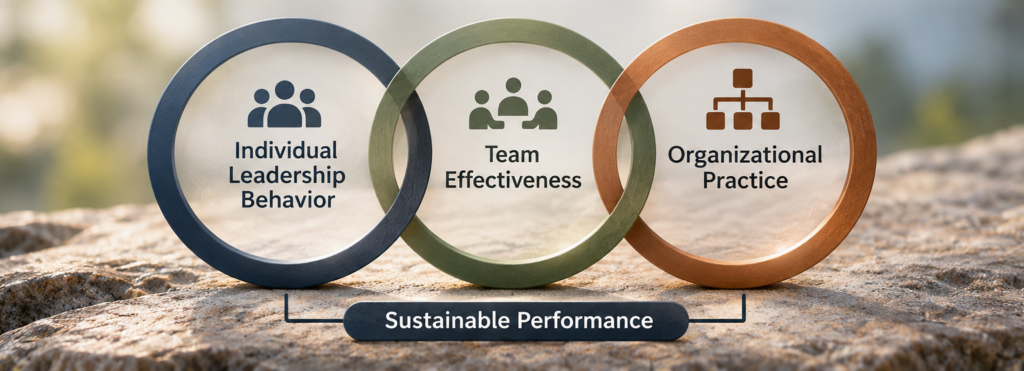
Over time, changes in individual leadership behavior can strengthen team functioning. Stronger team practices can influence how work is coordinated, and decisions are made throughout the organization. As those organizational practices become more consistent, they create conditions that support sustainable performance.
This connection between individual capability, team effectiveness, and organizational practice is fundamental to Thunderbird Leadership Consulting’s approach to organizational development.
What Does an Organizational Development Consultant Actually Do?
An organizational development consultant works alongside executive leaders to understand organizational conditions, identify opportunities for improvement, and support changes that strengthen organizational effectiveness.
The specific activities depend on the organization’s circumstances, but several elements are common to effective OD consulting.
Understanding the Patterns Behind Organizational Performance
One of the most valuable contributions an organizational development consultant can make is helping executives recognize patterns that are difficult to see from any single leadership position.
Consider an organization where employee feedback indicates that people feel comfortable speaking up, yet fewer employees believe they are included early enough in decisions affecting their work.
Each result provides useful information. Together, they raise a more consequential question: Are employees being encouraged to share their perspectives while the organization’s decision-making practices limit their opportunity to influence outcomes? The appropriate response depends on understanding that relationship.
Meaningful organizational diagnosis may incorporate executive interviews, leadership assessments, employee feedback, focus groups, organizational data, and facilitated conversations. The objective is not simply to collect information, but to identify relationships among experiences, behaviors, expectations, and organizational practices.
It also requires distinguishing between practices that are working well and those that could become more consistent. An organization may already have substantial leadership strengths that provide a foundation for improvement.
For executive leaders, the value of this approach is greater clarity about where attention may be most useful and why.
Strengthening Executive Team Effectiveness
Executive teams have a particularly important influence on organizational performance because their decisions and behaviors shape expectations throughout the organization.
An executive team may agree on its strategic direction while experiencing difficulty translating that agreement into coordinated action. Leaders may have different assumptions about decision authority, shared accountability, or how competing priorities should be resolved.
Organizational development consultants can facilitate the conversations and structured work needed to establish clearer expectations and strengthen collective leadership practices.
The objective is not simply to improve relationships among executives, although those relationships matter. It is to improve how the executive team functions in service of the entire organization.
Designing Targeted Organizational Interventions
Once organizational patterns are better understood, leaders can determine which changes deserve attention. Depending on the circumstances, interventions may include executive teaming, leadership development, context-based coaching, decision-making clarification, organizational culture work, or improvements to cross-functional coordination.
Importantly, these approaches should not be selected simply because they are familiar or widely used. Their value depends on how effectively they address the organization’s identified needs.
A leadership workshop may be beneficial. But if inconsistent accountability is primarily influenced by unclear expectations or competing organizational priorities, the intervention must also address those conditions.
Effective organizational development connects the intervention to the organizational outcome it is intended to support.
Building the Capacity to Sustain Improvement
Organizational development should ultimately strengthen the organization’s ability to function effectively without depending indefinitely on outside assistance.
That requires attention to what happens after an assessment, planning session, or leadership development experience.
Are expectations becoming clearer? Are leaders applying new practices? Are teams working together differently? Have organizational processes and decision-making practices changed in ways that support the desired outcomes?
These questions help distinguish temporary activity from meaningful organizational improvement.
When Does an Organization Need Organizational Development Consulting?
Organizations do not need to be experiencing a crisis to benefit from organizational development. Some seek assistance because recurring challenges are interfering with performance. Others recognize that growth, leadership transitions, changing workforce expectations, or external pressures require their current practices to evolve.
Several circumstances may indicate that an organizational development assessment or consulting engagement would be valuable.
1. Strategic Plans Aren’t Translating Into Consistent Execution
Your organization has a strategic plan, and leaders understand its importance. Yet implementation remains uneven.
Departments may interpret priorities differently, initiatives compete for limited resources, or important decisions repeatedly return to the executive team. Progress depends heavily on individual follow-through rather than established organizational practices.
An OD consultant can help examine whether the organization’s decision pathways, accountability expectations, communication practices, and leadership structures adequately support strategic execution.
2. Strong Individual Executives Aren’t Functioning as a Strong Executive Team
An organization can have exceptionally talented executives without having a consistently effective executive team. Each leader may manage their respective responsibilities successfully while collective decisions, cross-functional coordination, and shared accountability remain challenging.
The distinction matters because organizational performance increasingly depends on work that crosses functional boundaries.
Organizational development can help executives establish stronger collective leadership practices rather than relying exclusively on individual expertise.
3. Organizational Culture Is Experienced Inconsistently
Employees may experience supportive leadership, open communication, and meaningful collaboration in one department while encountering very different conditions elsewhere.
These variations may occur even when the organization has well-defined values and leaders who genuinely care about employees. OD consulting helps leaders understand how organizational culture is experienced through everyday decisions, working relationships, communication, and accountability.
The goal may not be to create an entirely different culture. Often, it is to strengthen the consistency of practices that already reflect the organization’s values.
4. Leadership Development Isn’t Producing Lasting Organizational Improvement
Organizations invest substantial time and resources in leadership training, executive coaching, and professional development. These activities can strengthen individual capability, but their broader organizational impact depends on whether new behaviors are supported and reinforced.
A leader may develop stronger feedback skills but return to an environment where regular performance conversations are not expected or supported. A department director may improve collaboration skills while organizational priorities continue to reward departmental performance over shared results.
Organizational development helps connect individual learning with the team practices and organizational expectations necessary for broader improvement.
5. Growth or Change Is Increasing Organizational Complexity
Growth often exposes limitations in practices that previously worked well.
As an organization expands services, increases workforce size, integrates operations, or experiences leadership transitions, informal coordination may become less reliable. Responsibilities overlap, communication becomes more complex, and existing decision-making practices may no longer meet organizational needs.
OD consulting can help leaders recognize when organizational practices need to evolve and determine how to strengthen them without losing the qualities that contributed to earlier success.
6. Too Much Depends on a Few Leaders
When routine decisions repeatedly escalate to the CEO or a small number of executives, the organization may be relying on those individuals in ways that limit its broader leadership capacity.
The issue is not necessarily that other leaders lack the ability or willingness to make decisions. Unclear decision authority, inconsistent expectations, limited delegation, or previous organizational experiences may contribute to this dependence.
Organizational development helps leaders examine how responsibility and decision-making authority are distributed, with the objective of building greater capacity throughout the organization.
How Is Organizational Development Different From Leadership Training or Executive Coaching?
Organizational development consulting, executive coaching, leadership development, and management consulting can complement one another, but their primary focus differs.
Leadership training generally concentrates on developing specific knowledge, skills, or behaviors, such as communication, delegation, conflict management, or feedback.
Executive coaching supports individual leaders as they strengthen self-awareness, judgment, leadership effectiveness, and their ability to navigate complex responsibilities.
Management consulting encompasses a broad range of disciplines, including strategy, finance, operations, technology, and organizational transformation.
Organizational development consulting focuses on how leadership, teams, culture, and organizational practices interact to influence organizational effectiveness.
For executives evaluating consulting services, this distinction is important.
If an individual leader needs to strengthen a particular capability, coaching may be appropriate. If managers across the organization need to develop common leadership skills, structured leadership development may provide value.
However, when challenges involve inconsistent expectations, competing priorities, unclear accountability, or coordination across multiple leadership levels, a broader organizational development approach may be warranted.
These services are not mutually exclusive. In fact, combining individual leadership development with improvements in team functioning and organizational practices can create stronger conditions for sustained results.
The important question is not which service is inherently better, but which approach addresses the organization’s circumstances and desired outcomes.
What Does the Organizational Development Consulting Process Look Like?
Effective organizational development generally progresses from understanding current conditions to designing, implementing, and evaluating improvements.
The CIPD’s organizational development guidance identifies organizational diagnosis and appropriately designed interventions as important elements of the discipline.
At Thunderbird Leadership Consulting, our LIFT™ methodology connects four elements of this work.
Leadership Intelligence begins with understanding the organization’s context and gathering relevant evidence. This may include assessments, interviews, focus groups, and organizational information that help leaders better understand their current conditions.
Insight involves interpreting that information to identify meaningful patterns, relationships, strengths, and opportunities for improvement.
Focus connects understanding with action through diagnosis and design. Organizational leaders use the findings to determine priorities, define desired outcomes, and develop an appropriate roadmap. These decisions remain grounded in the organization’s own strategic objectives and capacity.
Targeted Intervention puts the roadmap into practice through the specific leadership, team, or organizational development activities needed to support improvement.
Although the methodology provides structure, organizational development is not a rigid sequence. New information and changing conditions may require leaders to revisit assumptions, refine priorities, or adjust interventions.
The essential principle is to understand the organization’s needs before prescribing solutions.
What Should Improve as a Result of Organizational Development Consulting?
The success of organizational development should be evaluated by what changes in the organization and how those changes contribute to its objectives.
Early improvements may be observable in leadership practices. Executives begin making decisions with clearer expectations about authority and accountability. Leadership teams become more effective at resolving cross-functional challenges. Managers communicate more consistently, and employees have greater clarity about how their work contributes to organizational priorities.
These changes matter because they influence the organization’s ability to execute.
Over time, stronger leadership and team practices may become established organizational expectations. Decisions can move more effectively through the organization. Strategic priorities receive more coordinated attention. Leaders develop greater capacity to address challenges without unnecessary escalation.
The resulting improvements may contribute to operational reliability, strategic execution, workforce stability, and the organization’s ability to adapt to changing circumstances.
The precise outcomes will vary, and organizations should establish meaningful measures that reflect their own goals. Not every improvement in organizational performance can be attributed directly to consulting. Financial conditions, workforce availability, regulatory changes, and other external factors also influence results.
What organizational development can help establish are the leadership capabilities and operating practices that make sustained performance more achievable.
At Thunderbird, we examine progress across individual leadership behavior, team effectiveness, and organizational practices because meaningful improvement should extend beyond the individual participants in a development experience.
How Do You Know Whether to Hire an External Organizational Development Consultant?
Many organizations already have experienced executives, human resources professionals, and internal leaders responsible for organizational effectiveness.
External OD consulting is not intended to replace that expertise. It can complement internal capabilities by bringing additional capacity, specialized experience, structured methods, and an independent perspective.
An external consultant may be particularly valuable when challenges cross departmental boundaries, when the executive team needs support examining its own effectiveness, or when internal leaders have limited capacity to lead organizational improvement alongside their operational responsibilities. Before selecting a consulting partner, executives should consider several questions:
- Does the consultant seek to understand our organizational context before recommending services?
- Can the consultant connect leadership and cultural concerns to practical organizational outcomes?
- Does the approach incorporate relevant evidence rather than relying primarily on assumptions?
- Will our executive team participate in identifying and owning organizational priorities?
- How will changes be supported, reinforced, and evaluated over time?
- Will the engagement strengthen our organization’s internal capabilities?
These questions help distinguish a comprehensive organizational development partnership from a series of disconnected activities. The right consulting relationship should improve an organization’s understanding of itself while strengthening its ability to act.
Organizational Development Is About Strengthening What Makes Performance Possible
Perhaps the most important distinction in organizational development is that the organization itself becomes the focus of improvement.
Individual leaders matter enormously. So do capable teams, committed employees, and effective strategies. But sustainable organizational performance depends on how these elements function together.
A clear strategy requires effective execution. Effective execution depends on coordinated decisions, shared expectations, and accountability. Those practices are influenced by leadership behaviors, working relationships, and organizational conditions that either support or complicate the work people are trying to accomplish.
When these elements reinforce one another, organizations become better positioned to navigate complexity, adapt to change, and sustain results.
The greatest value of organizational development consulting is not simply helping leaders resolve today’s most visible challenge. It is helping them strengthen the organizational capabilities that make tomorrow’s performance possible.
Explore What Organizational Development Could Make Possible
Thunderbird Leadership Consulting partners with organizations to strengthen executive team effectiveness, leadership capability, organizational culture, and the practices that support sustainable performance.
Our work begins with understanding an organization’s circumstances rather than prescribing predetermined solutions. Through evidence-informed discovery, collaborative design, and targeted intervention, we help leaders connect individual development with team effectiveness and organizational improvement.
Whether your organization is navigating growth, working to improve strategic execution, strengthening executive alignment, or seeking greater consistency in leadership practices, an initial conversation can help clarify where focused attention may be most valuable.
Explore Thunderbird’s Organizational Development Consulting Services
CLIENT PERSPECTIVE
Hear from the leaders we support.
See how Thunderbird’s work translates into the experiences of leaders and organizations we serve.
CONTINUE EXPLORING
Explore related topics.
BROWSE TOPICS
NEXT STEP
Sometimes the next useful step is a conversation.
Begin with what you are seeing. Together, we can clarify what deserves attention next.
Organizational capability is how sustainable performance is built.
Thunderbird perspectives help leaders look beyond the immediate issue to the organizational conditions shaping what happens next.
Thunderbird perspectives help leaders look beyond the immediate issue to the organizational conditions shaping what happens next.