Preserving the Human in AI
AI is entering organizational life faster than most leadership teams can fully make sense of it. Employees are already using it—formally or informally—to move faster, reduce busywork, generate ideas, and find answers. But adoption is not the same as readiness. Leaders often focus first on the technology: Which tools should we purchase? What efficiencies might…

AI is entering organizational life faster than most leadership teams can fully make sense of it. Employees are already using it—formally or informally—to move faster, reduce busywork, generate ideas, and find answers.
But adoption is not the same as readiness.
Leaders often focus first on the technology: Which tools should we purchase? What efficiencies might we gain? How quickly should we move?
The harder leadership work lies in the human systems surrounding the technology: decision rights, accountability, role design, performance expectations, training, and communication. When these are unclear, employees do not experience innovation. They experience uncertainty.
The defining AI leadership capability will not be adopting technology fastest. It will be knowing where AI adds value, where human judgment must remain decisive, and how to help people navigate the transition with clarity, voice, and trust.
Employees Are Experiencing More Than One Emotion
It is tempting to divide employees into “AI enthusiasts” and “AI resisters.” In practice, reactions are rarely that simple.
Employees may feel excited about reducing administrative work while worrying that their expertise will become less valued. They may appreciate the speed of an AI-generated summary while questioning whether they can trust it. They may want to experiment while fearing they will be judged for not already knowing how to use the technology—or for relying on it too much.
Beneath these mixed emotions are practical questions: Will my role still matter? How will my performance be evaluated? Who is responsible when AI gets something wrong? Will efficiency gains create more meaningful work—or simply more work?
A key leadership takeaway is that uncertainty is not automatically resistance. Sometimes it is a reasonable request for direction.
When leaders do not address these questions, employees answer them for themselves through rumors, informal workarounds, and assumptions about what the organization truly values.
Efficiency Is Not the Same as Effectiveness
AI can summarize documents, draft communications, analyze large amounts of information, identify patterns, and automate repetitive tasks. These capabilities can create genuine value.
But faster is not automatically better.
A healthcare organization can accelerate documentation without improving the patient experience. A college can automate student communication while leaving students feeling less seen. An organization can produce more reports without making better decisions.
Leaders therefore need to distinguish among three different outcomes:
Efficiency: How economically and quickly work gets done.
Effectiveness: Whether the work achieves its intended purpose.
Mission value: Whether the work strengthens outcomes, relationships, and public trust.
AI can increase output without improving any of the things that matter most. The question is not simply whether a tool saves time. It is what the organization will do with the time saved—and whether the resulting work is actually better.
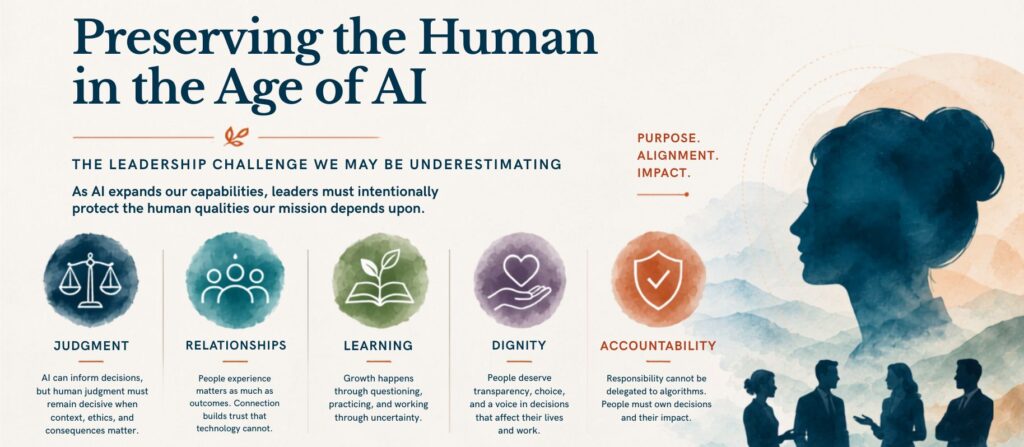
What Leaders Must Actively Protect
“Preserving the human” does not mean freezing current processes or refusing to redesign work. Some tasks should be simplified or automated. Nor does it mean assuming that human decisions are always fair or accurate. People are fallible too.
It means deliberately protecting the capabilities and responsibilities an organization cannot afford to weaken, as follows:
Judgment
AI can inform decisions, but it does not carry lived experience, ethical responsibility, or the full context that consequential decisions often require.
Leaders must be explicit about when AI may recommend, when it may assist, and when a person must make the decision.
Relationships
In work grounded in care, learning, service, and community trust, the experience of people matters alongside the result.
An interaction can be technically accurate and still leave a patient, student, employee, or community member feeling dismissed or unseen.
Learning
People develop expertise by questioning, drafting, analyzing, making mistakes, and working through uncertainty.
When AI routinely performs the early thinking through which employees learn, organizations may gain short-term speed while weakening their future capability.
Dignity
Employees and stakeholders should not feel that important decisions affecting their work, education, health, or access are happening to them through systems they cannot understand or challenge.
People need meaningful information, an opportunity to ask questions, and a way to request human review.
Accountability
Responsibility cannot be delegated to an algorithm. Employees need to know who owns a decision, who reviews the output, and who is accountable when something goes wrong.
Protecting these qualities also means involving the people whose work is changing. Employees closest to a workflow often recognize risks and opportunities before senior leaders or technology teams do.
A nurse may see where automation could interfere with patient care. A faculty member may recognize when a tool supports learning, and when it replaces it. A frontline nonprofit employee may understand why an efficient screening process could create barriers for the people the organization serves.
Participation does not require consensus on every decision. It means treating employees’ experience as essential information, especially during the early stages of design. Doing so improves workflows, reveals unintended consequences, and builds trust.
The Deeper Leadership Question
When organizations discuss AI, the most common question is:
What can AI do?
That question is useful, but incomplete.
A more consequential question is:
What kind of organization are we trying to become, and how should AI help us become it?
This shifts the conversation from tools to purpose. It requires leaders to consider what AI will reinforce and what it might quietly redefine: fairness, access, professional growth, service quality, accountability, and trust.
As leadership teams consider new AI applications, five questions can help guide the conversation:
- What important human capability could be weakened if we automate this work?
- Where must a person remain visibly and meaningfully accountable?
- Whose work will change—and have those people helped shape the change?
- How will we know whether AI is advancing our mission rather than merely increasing output?
- What do employees and stakeholders need to hear now, even if we do not yet have every answer?
AI will continue to evolve, and leaders will rarely have perfect certainty. They can still provide clarity about purpose, boundaries, participation, and accountability.
The organizations that navigate this transition well will not necessarily be those with the most AI features. They will be the ones that understand where technology should lead, where it should assist, and where human presence and judgment must remain unmistakably in charge.
Preserving the human in the age of AI is not about resisting technology. It is about ensuring that as organizational capabilities expand, the judgment, relationships, learning, dignity, and trust the mission depends upon grow stronger, not weaker.
Selected References
- Andy Kemp, “Rising AI Adoption Spurs Workforce Changes,” Gallup, April 12, 2026.
- Luona Lin and Kim Parker, “U.S. Workers Are More Worried Than Hopeful About Future AI Use in the Workplace,” Pew Research Center, February 25, 2025.
- Hannah Mayer, Lareina Yee, Michael Chui, and Roger Roberts, “Superagency in the Workplace: Empowering People to Unlock AI’s Full Potential,” McKinsey & Company, January 28, 2025
REAL CLIENTS. REAL RESULTS.
As a result of working with Thunderbird...
“You learn things as a CEO about your organization that you really did not know.”
Patrick Shannon, Chief Executive Officer, Huntsville Memorial Hospital
CONTINUE EXPLORING
Explore related topics.
BROWSE TOPICS
NEXT STEP
Sometimes the next useful step is a conversation.
Begin with what you are seeing. Together, we can clarify what deserves attention next.
Organizational capability is how sustainable performance is built.
Thunderbird perspectives help leaders look beyond the immediate issue to the organizational conditions shaping what happens next.
Thunderbird perspectives help leaders look beyond the immediate issue to the organizational conditions shaping what happens next.