Your Leadership Growth Should Change More Than You
Leadership development often begins with a personal realization. You recognize that you step in too quickly, avoid a conversation that needs to happen, hold onto decisions others may be ready to make, or communicate differently under pressure than you intend. Those moments matter. Increased self-awareness can change how a leader understands their choices and their…

Leadership development often begins with a personal realization. You recognize that you step in too quickly, avoid a conversation that needs to happen, hold onto decisions others may be ready to make, or communicate differently under pressure than you intend.
Those moments matter. Increased self-awareness can change how a leader understands their choices and their impact on others.
But awareness is only the beginning.
The more consequential question is: What changes because you changed?
If leadership growth remains primarily an internal insight, its reach is limited. The greater opportunity is for that individual shift to begin influencing how other people think, decide, communicate, and work.
That is when personal development starts becoming organizational impact.
Insight is the starting point
A meaningful leadership-development experience may begin with a coaching question, feedback from a colleague, an assessment result, or a difficult conversation that reveals something you had not previously seen.
Perhaps you recognize that your desire to be helpful has made you the person everyone turns to for answers. Maybe you realize that you move so quickly toward solutions that others have little opportunity to develop their own judgment. Or you discover that although you value candid feedback, people are less comfortable disagreeing with you than you thought.
These insights are valuable because they create choice. Once you can see a pattern, you can decide whether to continue it.
The challenge is turning that new awareness into something others can actually experience.
What happens when you return to the work?
Consider a leader who realizes, “I solve too many problems for my team.”
The insight itself does not build greater capability in the team. The shift begins when the leader changes what happens next.
Instead of immediately providing an answer, they ask, “What do you think we should do?”
Instead of taking over a difficult decision, they help the person think through the available options and consequences.
Instead of becoming the automatic escalation point, they clarify which decisions the team already has the authority to make.
Over time, the team may begin bringing recommendations rather than only problems. Managers may become more confident making routine decisions. Fewer issues may travel unnecessarily upward.
The original shift happened within the leader. The meaningful impact becomes visible in what other people are increasingly able to do.
Look for evidence around you
One way to evaluate your leadership growth is to look beyond yourself.
If you are working on delegation, do not only ask whether you are delegating more. Ask whether the people around you are exercising greater judgment and ownership.
If you are working on communication, do not only ask whether you are communicating more often. Ask whether people are clearer about what matters, why priorities have changed, and what decisions they are expected to make.
If you are working on feedback, do not only count the conversations you have had. Look for whether expectations are clearer and whether issues are being addressed before they become larger problems.
Leadership development becomes more meaningful when the evidence begins appearing in the environment around the leader.
A useful question is:
What are other people now able to do more effectively because I am leading differently?
Practice is what makes development visible
People rarely experience our leadership through what we have learned. They experience it through what we repeatedly do.
A leader may decide to invite more disagreement. Asking for another perspective once is a good start. The stronger signal comes when someone disagrees during a high-pressure conversation and the leader remains curious rather than defensive.
A leader may decide to delegate more authority. The real test comes when someone makes a reasonable decision differently than the leader would have made it and the leader allows the decision to stand.
Consistency turns intention into experience.
Over time, those repeated experiences begin shaping how people work together. Team members learn whether they can exercise judgment, raise concerns, take appropriate risks, make decisions, and recover from mistakes.
Personal development begins influencing the team.
Make one leadership shift visible
Trying to apply everything you have learned at once is rarely necessary. Choose one shift and make it observable.
For example, if you are working on developing others rather than immediately solving problems, decide what you will do differently the next time someone brings you an issue. You might ask for their recommendation before sharing yours. You might clarify what decision they have authority to make. You might allow them to carry the decision and return later to discuss what they learned.
Then pay attention to what happens.
Do they begin thinking through issues differently? Do they approach you with more confidence? Do they make more decisions independently? Does someone else on the team begin doing the same thing?
Those changes provide information about whether your development is traveling beyond you.
From individual growth to organizational capability
The path from personal growth to organizational impact is usually gradual.
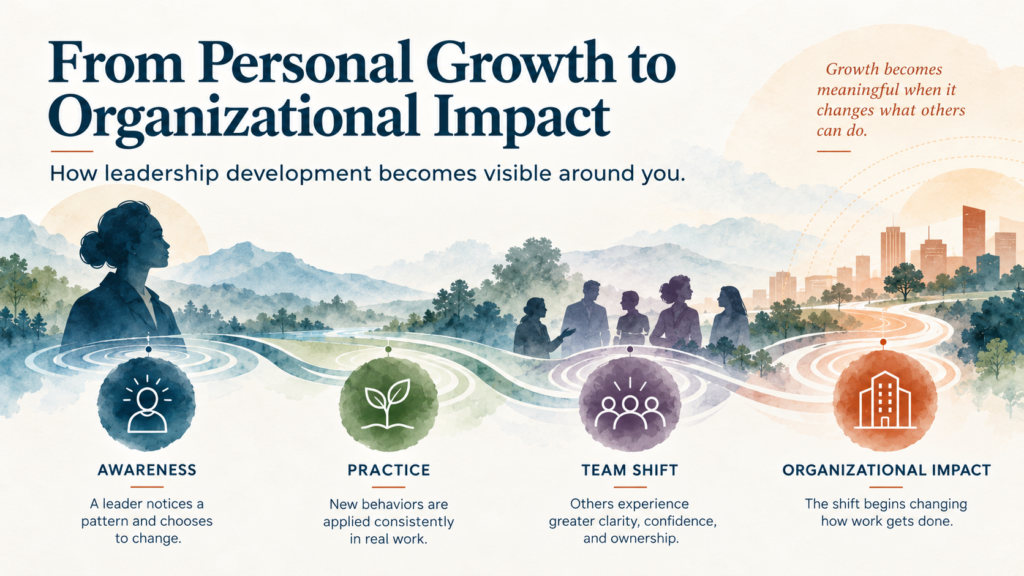
A leader notices a pattern and changes a behavior. That behavior is practiced consistently. Other people begin responding differently. Eventually, the team may develop a different way of working.
A leader learning to coach becomes more consequential when the people around them become stronger problem-solvers. A leader developing greater decision discipline becomes more consequential when fewer decisions are repeatedly reopened. A leader learning to delegate becomes more consequential when leadership capacity expands beyond one person.
This is how individual leadership growth can begin contributing to organizational capability.
Future-ready leadership therefore requires more than continuing to accumulate knowledge. It requires leaders whose development increases the capability around them.
Put it into practice
Choose one leadership shift you are currently working on and take three steps:
1. Name the change.
What are you intentionally trying to do differently as a leader?
2. Identify the impact.
If that change is working, what should someone on your team be able to do differently because of it?
3. Look for evidence.
Over the next several weeks, notice what is actually changing in decisions, conversations, ownership, confidence, or follow-through.
The question is not only whether you are becoming a stronger leader.
It is whether your growth is making someone else, your team, and eventually your organization more capable too.
Your leadership growth should change more than you.
REAL CLIENTS. REAL RESULTS.

After working with Thunderbird, one client said...
“By holding myself accountable and modeling it, the teams I lead are showing accountability that was not always present—we are becoming a unified front.”
Healthcare leader
CONTINUE EXPLORING
Explore related topics.
BROWSE TOPICS
NEXT STEP
Sometimes the next useful step is a conversation.
Begin with what you are seeing. Together, we can clarify what deserves attention next.
Organizational capability is how sustainable performance is built.
Thunderbird perspectives help leaders look beyond the immediate issue to the organizational conditions shaping what happens next.
Thunderbird perspectives help leaders look beyond the immediate issue to the organizational conditions shaping what happens next.