How to Become an AI-Enabled Leader
A Strategic Guide for Mid-Level and Senior Leaders The modern corporate landscape is undergoing a foundational shift. For years, organizational discussions centered around AI awareness; the conceptual understanding that machine learning would eventually transform industry operations. Today, that future has arrived. The defining competitive edge no longer belongs to corporations with the largest tech budgets, but to individuals who know how…
A Strategic Guide for Mid-Level and Senior Leaders
The modern corporate landscape is undergoing a foundational shift. For years, organizational discussions centered around AI awareness; the conceptual understanding that machine learning would eventually transform industry operations. Today, that future has arrived. The defining competitive edge no longer belongs to corporations with the largest tech budgets, but to individuals who know how to collaborate with these systems. AI is not replacing professionals. Instead, professionals who are AI-enabled are rapidly replacing those who are not.
For mid-level and senior leaders, transitioning into an AI-enabled leader is double-edged. You must master these technologies to optimize your own productivity, while simultaneously modeling the competencies required to guide your teams through an era of unprecedented technological disruption.
Defining the “AI-Enabled” Leader
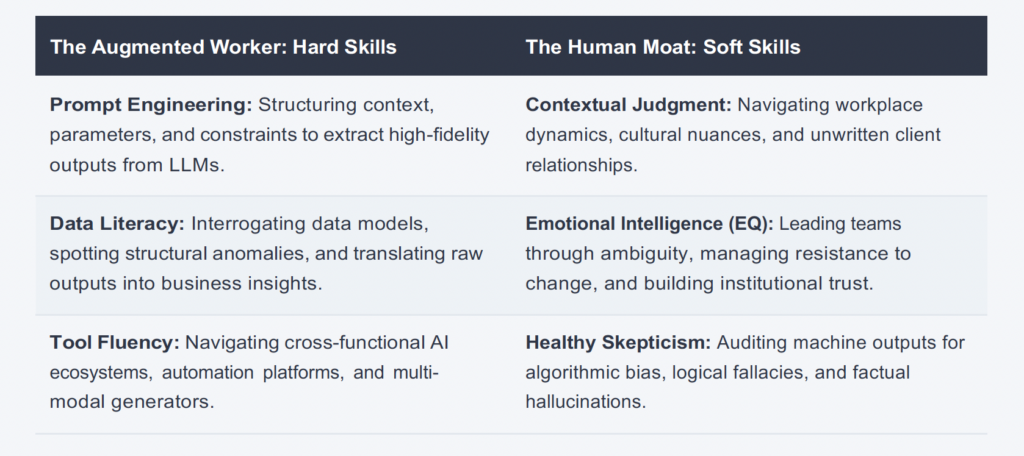
An AI-enabled leader treats artificial intelligence not as a passive software utility, but as an active, collaborative partner. This approach augments human capability across three core operational horizons: automating high-volume routine tasks, synthesizing vast data ecosystems, and accelerating strategic decision-making. True enablement requires balancing technical proficiency with sharp cognitive oversight.
Core AI Capabilities for Leadership
To lead effectively, senior professionals must develop hands-on mastery over key operational pillars:
- Generative Text and Strategic Ideation: Utilizing Large Language Models (LLMs) to draft executive communications, synthesize extensive industry reports, and stress-test strategic business plans against diverse counter-arguments.
- Data Synthesis and Predictive Analysis: Using advanced analytics tools to instantly identify macro-trends within complex spreadsheets, query unstructured data, and generate visual performance dashboards without waiting on technical analyst queues.
- Workflow Automation: Leveraging AI-driven integration platforms (such as Zapier or enterprise-grade agents) to connect disparate software systems, eliminating manual data transfers and streamline cross-departmental operations.
Navigating Enterprise Risk and Governance
As a leader, your engagement with AI cannot happen in a regulatory vacuum. True enablement requires a sophisticated understanding of corporate risk. Professionals must strictly adhere to data privacy boundaries, ensuring proprietary intellectual property or protected client information is never exposed to public training models.
Furthermore, leaders must champion transparency by establishing clear boundaries for AI usage within their teams. This means aligning every pilot project and automated workflow with your corporate IT security framework and compliance standards. Innovation without governance is a liability; true AI enablement balances rapid experimentation with absolute operational integrity.
Conclusion
AI enablement is an ongoing cognitive commitment rather than a static technical certification. For mid-level and senior leaders, the mandate is clear: your value is no longer measured by the volume of answers you retain, but by your capacity to ask the right questions and direct the right technology. By blending technical fluency with irreplaceable human judgment, you secure your position as an invaluable architect of the future workforce.
Glossary of Critical Terms
Large Language Models (LLMs): AI systems trained on vast amounts of text data so i t can understand, generate, and synthesize natural language for tasks like drafting communications and analyzing reports.
Prompt Engineering / Contextual Prompting: The skill of structuring queries by providing a specific persona, situational context, parameters, constraints, and output formats to extract accurate, high-quality responses from an AI tool.
Multi-Modal Generators: AI tools capable of processing and producing multiple types of media beyond text, such as images, voice, or code.
Workflow Automation: Leveraging AI-driven software or enterprise agents to connect different systems, eliminate manual data entry, and streamline cross-departmental operations.
The Augmented Worker Framework: A balanced model for professional development that pairs technical “hard skills” (like prompt engineering and data literacy) with irreplaceable human “soft skills”.
The Human Moat: Uniquely human capabilities that AI cannot replicate or replace, such as emotional intelligence (EQ), contextual judgment, and ethical oversight.
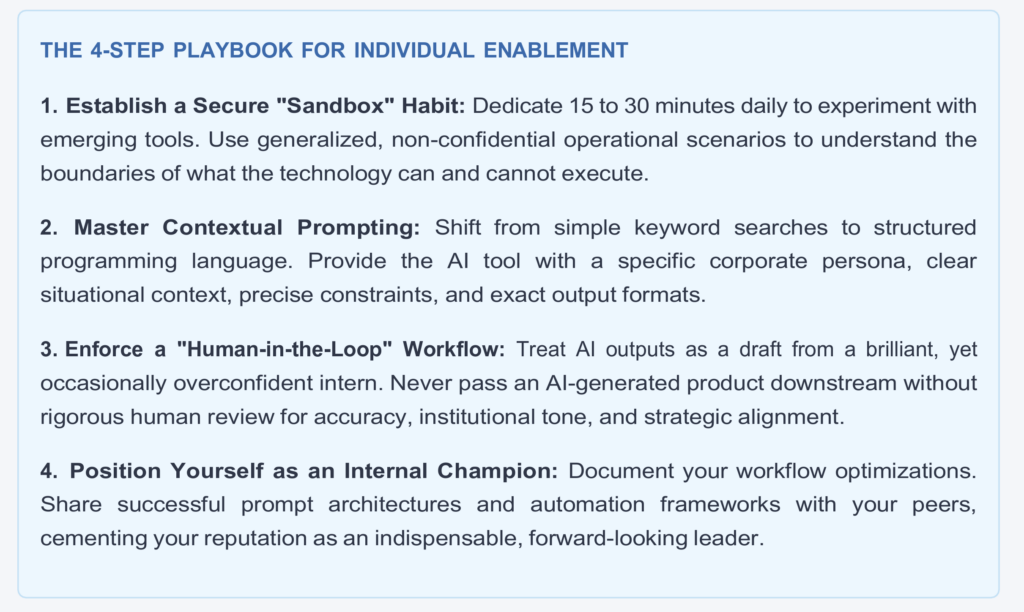
Human-in-the-Loop Workflow: An operational approach where human judgment is required to review, audit, and refine AI outputs before they are used, ensuring accuracy, tone, and strategic alignment.
Public Training Models: Open AI systems that may store user inputs to train future iterations, posing a security risk if proprietary corporate data or client information is entered.
REAL CLIENTS. REAL RESULTS.

Based on our engagement with Thunderbird...
“I made it a point to meet with every single member of my staff, as well as some from other departments, at least once a month to listen, receive feedback, and exchange ideas. It’s a lot of work, but they say it’s helped because no one else takes the time to listen to them.”
Healthcare Leader - Program Participant
CONTINUE EXPLORING
Explore related topics.
BROWSE TOPICS
NEXT STEP
Sometimes the next useful step is a conversation.
Begin with what you are seeing. Together, we can clarify what deserves attention next.
Organizational capability is how sustainable performance is built.
Thunderbird perspectives help leaders look beyond the immediate issue to the organizational conditions shaping what happens next.
Thunderbird perspectives help leaders look beyond the immediate issue to the organizational conditions shaping what happens next.