When Trust is Strained: A Leader’s Guide to Rebuilding Trust Within Your Team
Trust is a foundation of high-performing teams. When trust is strong, communication improves, collaboration increases, decisions move forward, and people are more willing to share ideas and hold one another accountable. When trust is strained, even routine work becomes challenging. Trust is built through everyday interactions, decisions, and behaviors. It takes time to build and…

Trust is a foundation of high-performing teams. When trust is strong, communication improves, collaboration increases, decisions move forward, and people are more willing to share ideas and hold one another accountable. When trust is strained, even routine work becomes challenging.
Trust is built through everyday interactions, decisions, and behaviors. It takes time to build and can be damaged quickly when actions do not align with words.
How Do You Recognize When Trust Is Low?
Look for warning signs such as:
- Strained communication: Conversations become defensive, information is withheld, or people hesitate to speak openly.
- Increased conflict: Disagreements become personal, assumptions replace curiosity, and motives are questioned.
- Slower decision-making: Decisions are challenged, excessive approval is sought, or progress stalls.
- Reduced collaboration: Individuals or departments operate in silos and become reluctant to offer or ask for help.
- Weakened accountability: Commitments are missed, responsibility is shifted, or expectations are applied inconsistently.
- Declining performance: Productivity, quality, engagement, attendance, or retention may suffer.
These behaviors do not automatically indicate a lack of trust. Workload, unclear expectations, inadequate resources, and organizational change may also contribute. Yet, they are all signals that deserve attention.
Five Steps to Rebuild Trust
1. Start With Yourself
Before asking what others need to change, assess how your own leadership may be contributing to the situation.
Reflect on the following areas:
Character: Am I demonstrating integrity, fairness, transparency, and genuine care? Competence: Am I providing the direction, resources, and support my team needs?
Vulnerability: Am I willing to acknowledge my mistakes, ask for help, accept feedback, and learn from others?
Communication: Am I listening, setting clear expectations, sharing information, and following through?
Engagement: Am I accessible, seeking input, recognizing contributions, and responding constructively to concerns?
Leadership requires the willingness to hear uncomfortable feedback, acknowledge our impact, and make changes when needed.
2. Create Opportunities for Honest Feedback
As leaders, we cannot ask our teams to be open, accept feedback, and take accountability if we are unwilling to model those behaviors ourselves. Our willingness to be vulnerable and acknowledge opportunities to grow supports rebuilding trust. Use one-on-one conversations and team discussions to understand people’s experiences and identify behaviors that strengthen or damage trust.
Ask questions such as:
- What am I doing that builds your trust?
- What actions or behaviors have weakened your trust?
- What could I do differently to better support the team?
- What do we need to change to work more effectively together?
Encourage team members to reflect on their own contributions to team trust and performance. When trust is strained or low, consider engaging a neutral facilitator to help create a safe environment for honest, productive conversations.
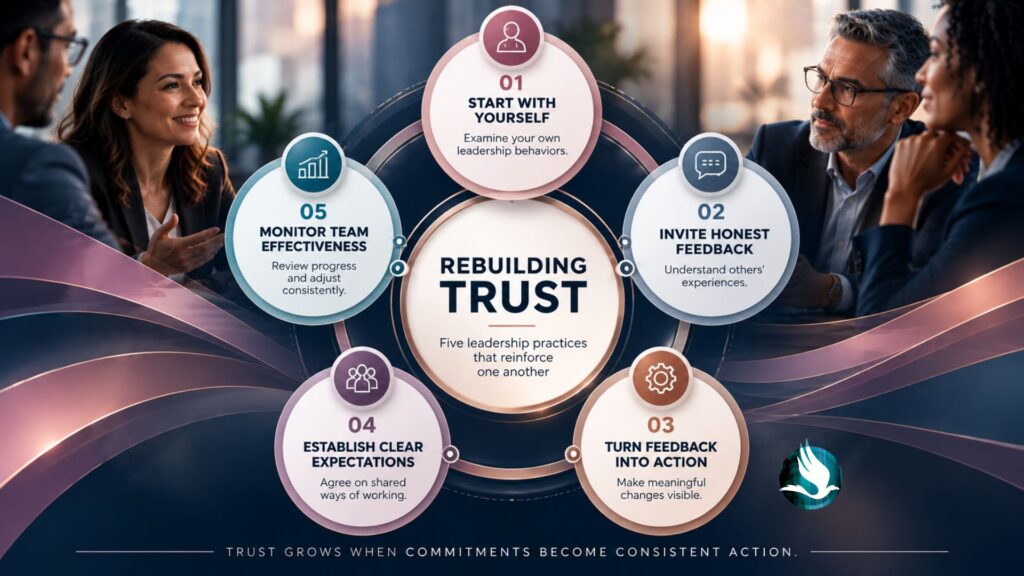
3. Turn Feedback into Action
Gathering feedback is only the beginning. Trust will not improve if people share concerns and see no meaningful change.
Identify key themes and develop a specific action plan. Share with the team:
- What you heard and learned.
- What you will do differently.
- What actions the team can expect from you.
- How progress will be measured and reviewed.
Invite the team to hold you accountable. Ask for feedback on whether your actions are making a difference.
Trust grows when people see that their feedback matters and commitments lead to consistent action.
4. Establish Clear Expectations
Rebuilding trust is a shared responsibility. Work with the team to establish ground rules for how members will communicate, collaborate, manage conflict, and hold one another accountable. Ensure expectations are clear, fair, and applied consistently to everyone, including the leader.
5. Monitor Team Effectiveness
Review team expectations, behaviors, and performance monthly while trust is being rebuilt. As the team makes progress, transition to quarterly reviews to sustain improvement.
Assess progress by asking:
- Are we communicating more openly?
- Are we addressing conflict more constructively?
- Are we following through on commitments?
- Are collaboration and accountability improving?
- Are we seeing positive changes in engagement, quality, and results?
Monitor indicators such as turnover, attendance, productivity, quality, and engagement. Consider these measures alongside direct feedback and observations of team dynamics; no single metric tells the entire story of trust.
Use what you learn to adjust your leadership approach, reinforce progress, and address concerns and strengthen teamwork.
Lead With Trust
Trust is demonstrated through behavior and reinforced through results. As leaders, we build trust when our actions align with our words, expectations are clear and fair, and our team members see that we are genuinely invested in their success.
Start with yourself. Invite honest feedback. Take meaningful action. Establish shared expectations. Monitor progress.
Trust is not rebuilt through a single conversation or initiative. It grows through consistent leadership, accountability, and a shared commitment to improving how we work together. The result is stronger relationships, a healthier team culture, and more sustainable performance.
Resources
Covey, S. M. R. (2006). The speed of trust: The one thing that changes everything. Free Press.
Lencioni, P. (2002). The five dysfunctions of a team: A leadership fable. Jossey-Bass.
REAL CLIENTS. REAL RESULTS.

Sharing anonymous feedback, one of our client leaders said...
“Trust and priorities. I think we all like each other, but I'm not sure we trust each other enough to even say the truth sometimes. We don't disagree a lot. It's not a bad thing, but it also makes me wonder.”
Higher Education Leader
CONTINUE EXPLORING
Explore related topics.
BROWSE TOPICS
NEXT STEP
Sometimes the next useful step is a conversation.
Begin with what you are seeing. Together, we can clarify what deserves attention next.
Organizational capability is how sustainable performance is built.
Thunderbird perspectives help leaders look beyond the immediate issue to the organizational conditions shaping what happens next.
Thunderbird perspectives help leaders look beyond the immediate issue to the organizational conditions shaping what happens next.