What Version of Yourself Is Leading Today?
Recently, I was coaching a leader when a familiar word surfaced. “Should.” In fact, it came up in two separate coaching conversations with two different leaders during the same week. The word itself is rarely the issue. What follows it is often more revealing. Beneath the “should” is usually a judgment, an expectation, or a …

Recently, I was coaching a leader when a familiar word surfaced.
“Should.”
In fact, it came up in two separate coaching conversations with two different leaders during the same week.
- “I feel like I should be further along.”
- “I should be more confident speaking up.”
- “I should have figured this out by now.”
The word itself is rarely the issue. What follows it is often more revealing. Beneath the “should” is usually a judgment, an expectation, or a comparison to a version of ourselves we believe we ought to be.
It made me wonder how many leaders spend their days measuring themselves against an outdated expectation rather than responding to the realities of the season they are currently in.
Leadership changes us.
Not all at once, but over time.
As responsibilities increase and challenges become more complex, we adapt. We develop habits, beliefs, and ways of operating that help us navigate the demands of leadership. Many of those adaptations serve us well. Some eventually outlive their usefulness.
The determination that helped us advance may become an inability to rest. The desire to contribute may evolve into difficulty delegating. The drive for excellence may quietly become perfectionism.
Without realizing it, leaders can begin leading from versions of themselves that were built for a different season.
Different seasons require different versions of us.
The version that built the department may not be the version needed to scale it. The version that guided the team through a crisis may not be the version needed to rebuild culture afterward. The version that earned the promotion may not be the version needed to lead at the next level.
Great leaders continue to evolve. They periodically pause and ask a simple question:
What version of me is needed for this season?
Sometimes the answer is not about gaining another skill or adding another responsibility.
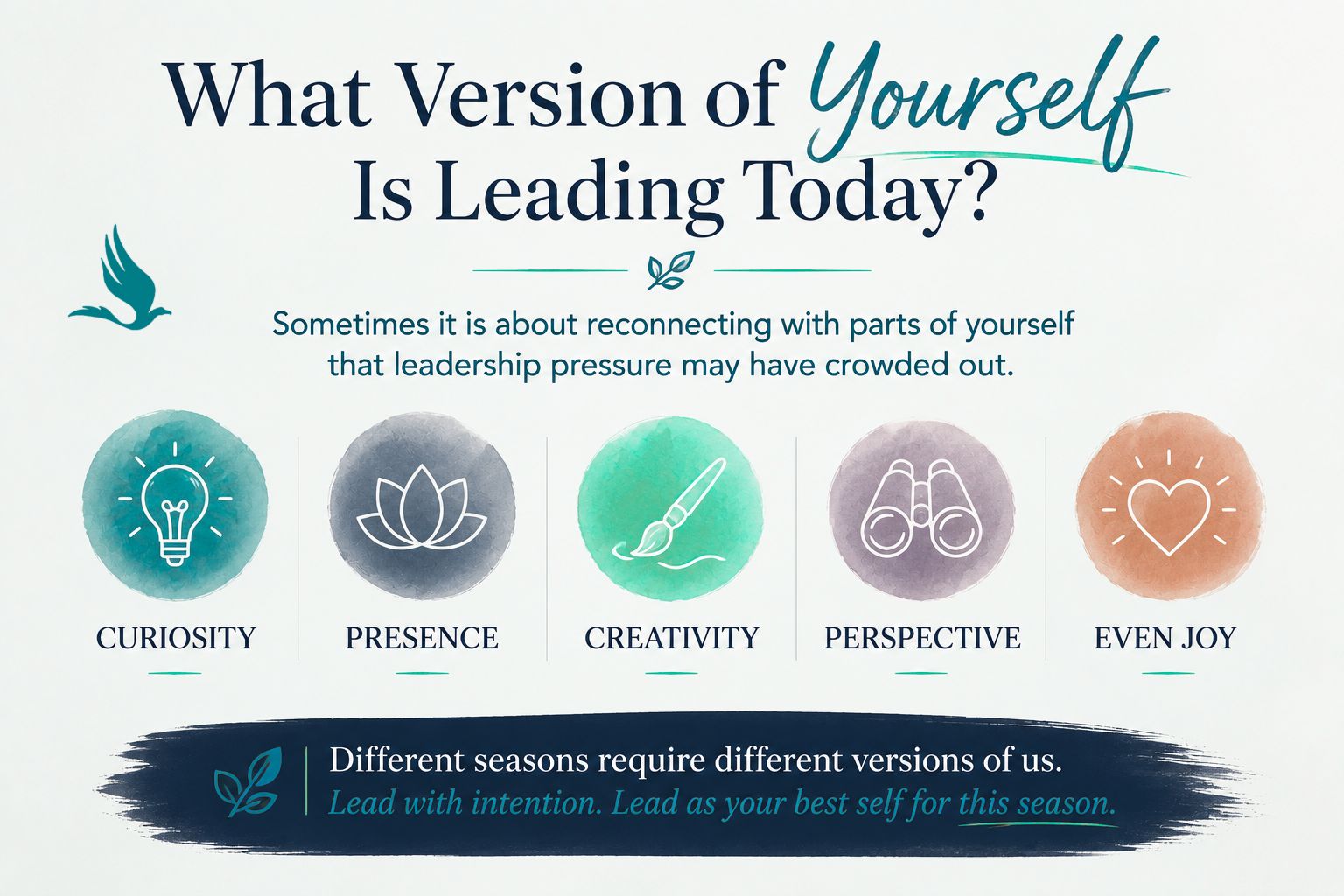
Sometimes it is about reconnecting with parts of yourself that leadership pressure may have crowded out.
- Curiosity.
- Presence.
- Creativity.
- Perspective.
- Even joy.
Not as luxuries, but as leadership resources that influence how we think, decide, connect, and lead.
Leadership growth is not always about becoming more.
Sometimes it is about becoming more intentional about what you carry forward and what you leave behind.
Reflection
Is your leadership evolution happening by default or by design?
REAL CLIENTS. REAL RESULTS.

Based on our engagement with Thunderbird...
“I have developed more patience, greater self-reflection about my style, and a stronger sense of balance.”
Higher Education Leader - Leadership Program Participant
ELEVATE
Stay connected with ELEVATE.
Subscribe to receive Thunderbird’s monthly ELEVATE edition with practical leadership insights for strengthening teams and organizations.

CONTINUE EXPLORING
Explore related topics.
BROWSE TOPICS
NEXT STEP
Sometimes the next useful step is a conversation.
Begin with what you are seeing. Together, we can clarify what deserves attention next.
Organizational capability is how sustainable performance is built.
Thunderbird perspectives help leaders look beyond the immediate issue to the organizational conditions shaping what happens next.
Thunderbird perspectives help leaders look beyond the immediate issue to the organizational conditions shaping what happens next.