When Everything Can Be Faster, Do We Have to Be?
One of the most compelling promises of AI is time. Tasks that once took an hour can take minutes. Information that required significant research can be synthesized almost instantly. Drafting, organizing, analyzing, and planning can all happen faster. That creates an interesting question. What will we do with the time we get back? Our instinct…

One of the most compelling promises of AI is time.
Tasks that once took an hour can take minutes. Information that required significant research can be synthesized almost instantly. Drafting, organizing, analyzing, and planning can all happen faster.
That creates an interesting question.
What will we do with the time we get back?
Our instinct may be to fill it. Another project. Another meeting. Another goal. Another task that previously did not fit.
There is certainly value in greater productivity. But if every efficiency simply creates room for more activity, we may miss one of AI’s greatest opportunities.
Capacity Does Not Have to Become More
What if some of the capacity AI creates becomes something other than additional output?
A leader might have more time to think before making an important decision. A manager might spend twenty minutes actually talking with an employee instead of rushing to the next task. A team might have space to explore an idea rather than immediately moving to execution.
And perhaps some of that capacity doesn’t need to stay at work at all.
It might mean leaving on time for dinner. Having enough energy for the people waiting at home. Returning to something you enjoy. Sitting quietly without feeling compelled to make the moment productive.
Efficiency has value. So does presence.
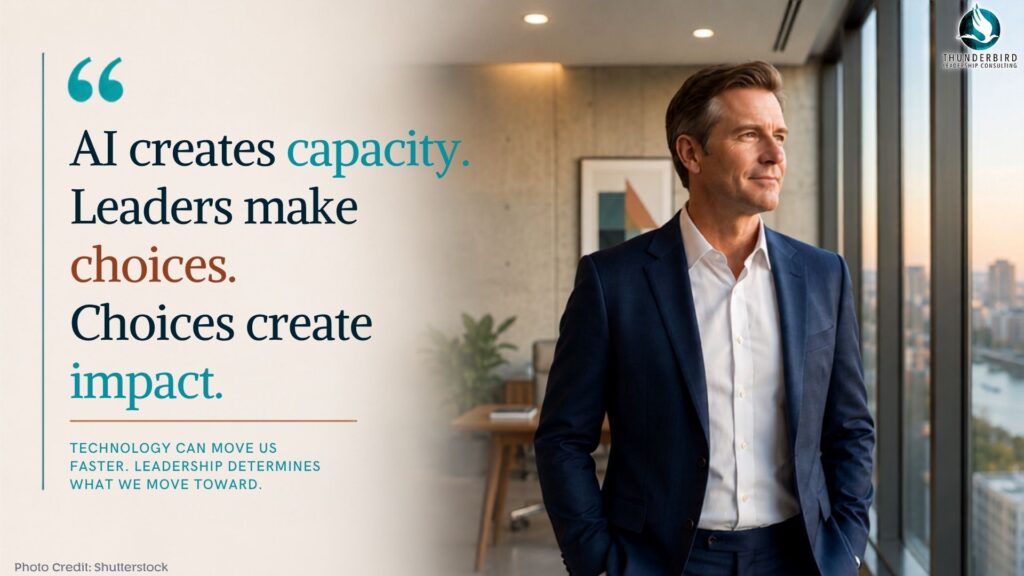
Choosing What the Time Is For
Technology has spent decades promising to make our lives easier and our work faster. Yet many of us feel busier than ever.
AI gives us another opportunity to make a different choice.
Before automatically filling the capacity it creates, we can decide what that capacity is for.
Some of it should absolutely become better performance, greater innovation, and meaningful organizational progress.
But perhaps some of it can also become thinking, connection, creativity, curiosity, rest, and joy.
AI may help us do more.
One of the more interesting possibilities is that it might also give us the freedom to decide when more isn’t the goal.
A Quiet Reflection
As AI begins giving you time back, where is that time going?
What deserves more of your attention, not because it produces more, but because it matters?
And if technology gives you the opportunity to move faster, where might you intentionally choose not to?
NEXT STEP
Sometimes the next useful step is a conversation.
Begin with what you are seeing. Together, we can clarify what deserves attention next.
Organizational capability is how sustainable performance is built.
Thunderbird perspectives help leaders look beyond the immediate issue to the organizational conditions shaping what happens next.
Thunderbird perspectives help leaders look beyond the immediate issue to the organizational conditions shaping what happens next.