Leading in the Age of Complexity
Editor’s Note:We are pleased to share this essay from Lee D. Lambert as part of this month’s exploration of leadership in the age of AI. Lambert widens the lens beyond technology alone, examining the convergence of forces reshaping the environment leaders are navigating and the shift from managing predictable systems to making sense of complexity….

Editor’s Note:
We are pleased to share this essay from Lee D. Lambert as part of this month’s exploration of leadership in the age of AI. Lambert widens the lens beyond technology alone, examining the convergence of forces reshaping the environment leaders are navigating and the shift from managing predictable systems to making sense of complexity. His perspective offers an important challenge for executive leaders: when the map is no longer reliable, leadership requires the ability to interpret what is changing, navigate competing priorities, and move with clarity even when certainty is unavailable.
Recently, I watched Amy Webb take the stage at SXSW and give a eulogy. Not for a person. For her annual trends report. Her message was precise: we are no longer in a period where discrete trends can be identified, tracked, and planned for. We are in a period of convergence.
The room shifted. And so did my thinking.
Because what she described didn’t feel entirely new. I’ve long operated through the lens of complexity — a recognition that the challenges we face are interconnected and must be approached in an integrated, holistic way.
But something is different now. It’s not just that the forces are present. It’s that the signal strength has increased. What once felt like emerging complexity now feels like active convergence. And that changes the nature of leadership.
01 | From Complexity to Convergence
Across higher education — and increasingly across society — we are responding to a growing list of challenges as if they are separate problems to solve. Inflation. Housing. Enrollment. Trust. Workforce alignment. Artificial Intelligence.
We name them. We assign them. We build strategies around them.
But what if that’s the mistake?
Here is a non-exhaustive snapshot of the pressures shaping our environment:
- Inflation, interest rates, and economic uncertainty
- Wages lagging the cost of living, fertility, and demographic shifts
- Housing affordability and childcare costs
- Declining fertility and demographic shifts
- College affordability and student debt concerns
- Disengagement from college and work among segments of the population
- Immigration and labor supply challenges
- Fiscal constraints on public institutions
- Infrastructure pressures across our campuses
Each of these matters. But the real issue is not any single one. The issue is how they are interacting — simultaneously — reshaping who our students are, what they can afford, what they expect, and how they make decisions.
This is not a series of problems. It is a shift in operating conditions.
02 | The Question Beneath the Questions
All of these pressures are now being experienced through a single, deeper question:
Is higher education still worth it?
“THE QUESTION RESHAPING EVERY ENROLLMENT DECISION, EVERY LEGISLATIVE HEARING, EVERY FAMILY CONVERSATION”
That question is not always spoken directly. But it shows up in enrollment behavior, in conversations with families, in employer expectations, in legislative scrutiny.
This is not simply a messaging issue. It is a credibility challenge. And credibility, once assumed, must now be continuously earned.
03 | While We Were Improving, the Ground Was Shifting
To be clear: our sector has made real progress. We have improved student success outcomes, used data to better support students, and built more intentional pathways. This work matters deeply.
But much of it has focused on improving performance within the system. At the same time, the environment around us has changed. Students are navigating greater financial and social strain. Expectations for speed, flexibility, and relevance have increased. The meaning of outcomes is evolving.
We risk becoming more efficient at a model that is losing alignment with the world it is meant to serve.
04 | The Compression of Leadership
As convergence increases, something else happens. Time compresses. Patience declines. Trust becomes conditional. Leaders face growing pressure to provide simple answers to complex realities.
We see this not in theory — but in daily decisions:
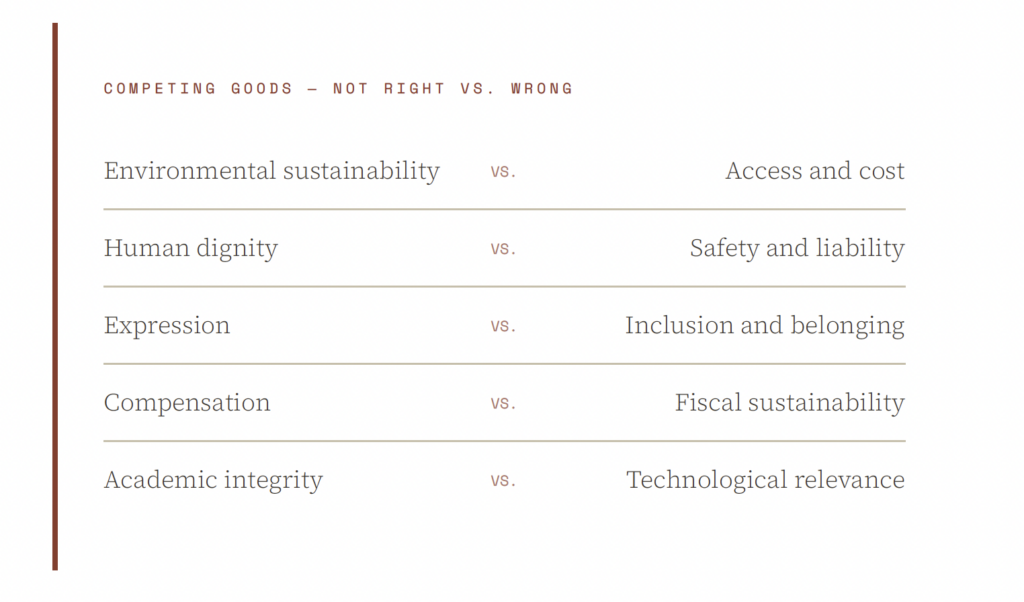
Each issue is real. Each reflects a legitimate value. But they often pull in different directions. Leadership in this environment is not about choosing between right and wrong. It is about navigating between competing goods under constraint.
05 | From Management to Sensemaking
Traditional leadership models were built for a different environment. They assumed relative stability, predictable patterns, and linear planning cycles. Those assumptions no longer hold.
Leadership in the age of complexity is not primarily about control. It is about sensemaking — the ability to interpret signals, understand patterns, anticipate interactions, and act with clarity in the absence of certainty.
This is not a technical shift. It is a cognitive and adaptive one.
06 | Why Wayfinding
Wayfinding is not about having a map. It is what you do when the map is no longer reliable.
Wayfinders orient to long-term direction. They read subtle signals.
They adjust continuously. They move with intention rather than reaction. In stable environments, leaders manage. In dynamic environments, leaders must navigate.
“Intelligence is becoming abundant. Judgment is not. The question is not whether we use AI — it is how we guide it.”
ON HUMAN-GUIDED INTELLIGENCE IN AN AGE OF CONVERGENCE
AI is not a future concept. It is already embedded in the systems we use and the decisions we make. It represents a fundamental shift. Which means the central challenge of leadership is ensuring that technology amplifies our values rather than replaces them.
07 | A Discipline for Leadership
In this environment, leaders need more than answers. They need a disciplined way of thinking. Three questions can anchor that discipline:
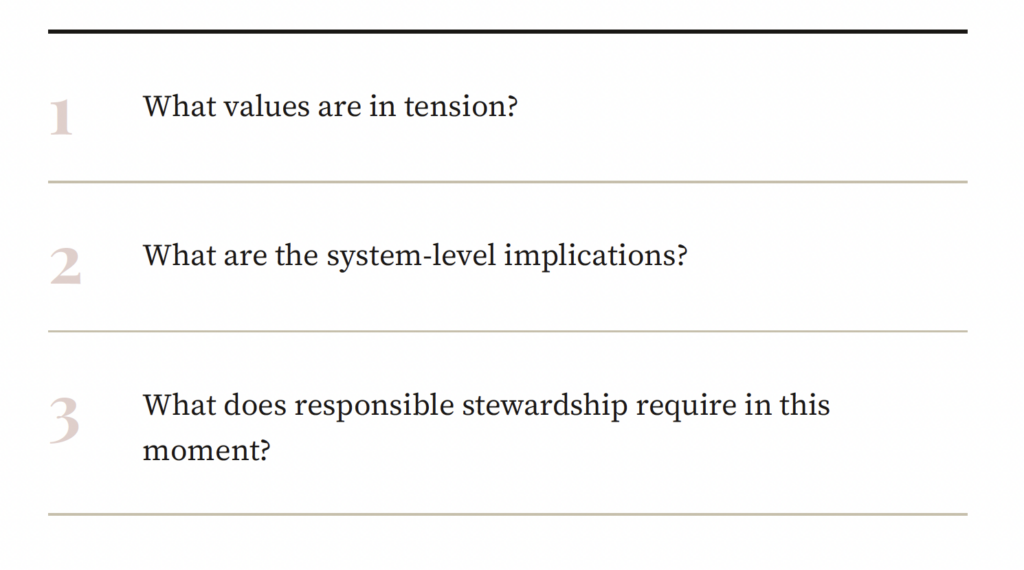
These questions do not eliminate complexity. But they allow leaders to act with clarity, integrity, and alignment — even when the answers aren’t clean.
The real question is not whether we are improving performance within our current model. It is whether we are positioning our institutions for the conditions that are emerging.
If trends once helped us see the future, convergence is asking us to navigate it. That requires something different. Not more control. Not more isolated solutions. Deeper awareness, stronger alignment, and the capacity to lead in motion.
The map is no longer enough.
We must become wayfinders.
WAYFINDING LEADERSHIP · SUBSCRIBE ON SUBSTACK FOR NEW ESSAYS
REAL CLIENTS. REAL RESULTS.
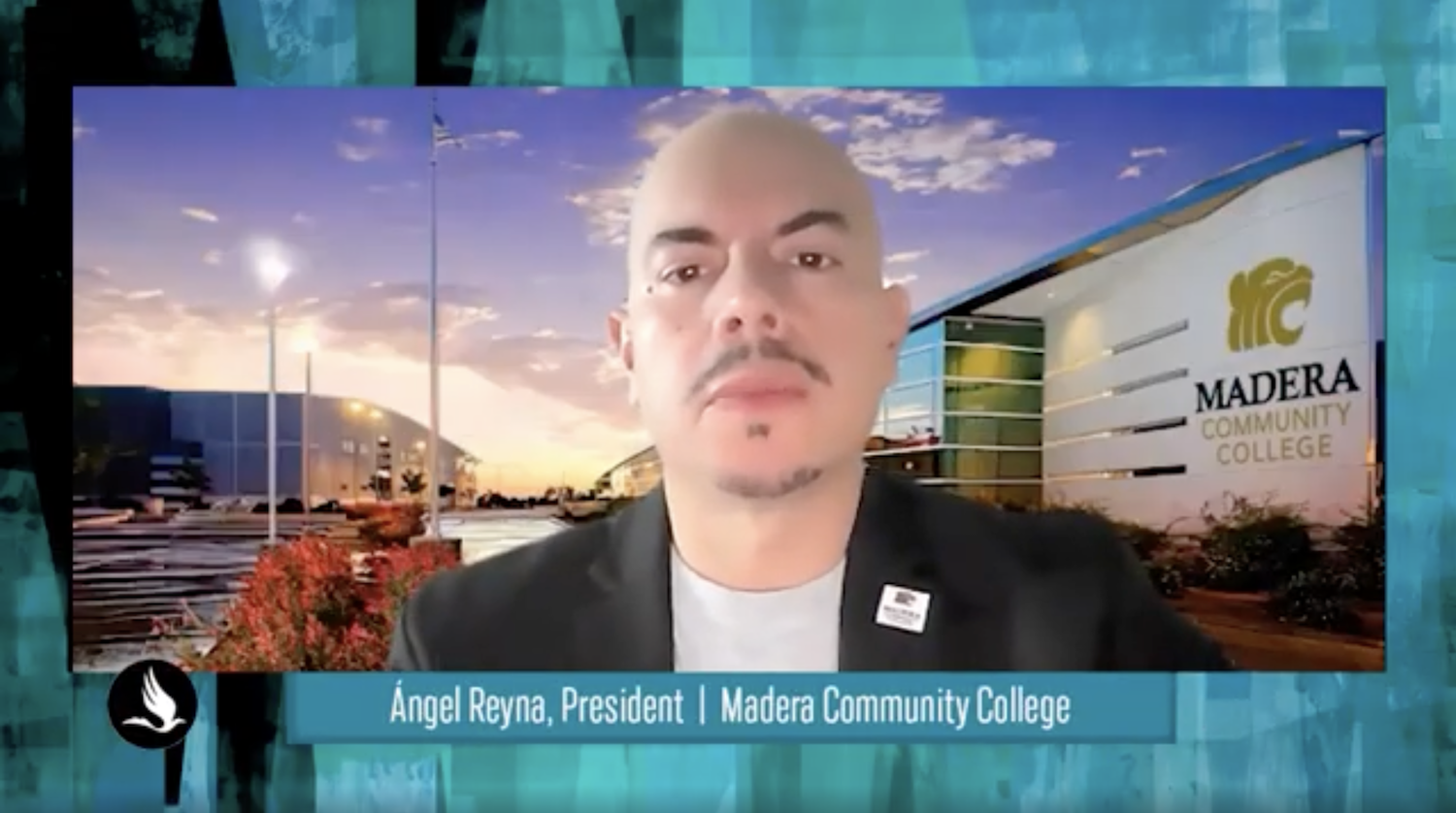
“I sought outside support because it was an opportunity for us to reset as an institution and leadership team, reset expectations, and strengthen mission alignment.”
Angel Reyna, President, Madera Community College
CONTINUE EXPLORING
Explore related topics.
BROWSE TOPICS
NEXT STEP
Sometimes the next useful step is a conversation.
Begin with what you are seeing. Together, we can clarify what deserves attention next.
Organizational capability is how sustainable performance is built.
Thunderbird perspectives help leaders look beyond the immediate issue to the organizational conditions shaping what happens next.
Thunderbird perspectives help leaders look beyond the immediate issue to the organizational conditions shaping what happens next.